

By Sarthak Takyar
India’s phenomenal renewable energy growth has been made possible by certain important regulatory decisions, landmark projects and, of course, increasing financial support for many segments, as witnessed in recent annual government budgets. Annual budgets are more than just accounting statements; they also highlight the government’s key priority areas. A case in point is the Union Budget 2025-26, which has allocated greater funds for the renewable energy ministry as compared to the power ministry, owing to the potential of renewables to address some of the legacy issues in the overall power sector.
Against this backdrop, this article summarises my observations on the budget’s implications for the renewable energy sector as well as its transformational impact on the power sector…
MNRE’s journey through the years
Years ago, it would have been understandable if the Ministry of Non-Conventional Sources, later renamed the Ministry of New and Renewable Energy (MNRE), was not the first choice of posting for many. This ministry was carved out of a larger energy ministry that covered power, coal and non-conventional energy sources. In its initial years, it focused on pilot-scale clean energy research and development projects. At the time, renewable energy technology in the country was still not mature, the sector did not receive major funds from domestic or international sources and the uptake of large-scale renewable energy projects at competitive costs seemed like a pipedream.
However, a global crisis changed the energy landscape. The oil shocks of the 1970s, which led to a spike in oil prices and supply chain uncertainties, underscored the need for alternative energy sources. As a result, the clean energy sector received significant government attention through separate departments/ministries and funds started flowing into the sector. The ministry’s importance slowly gained prominence as focus increased on climate change and energy security. The inflow of foreign capital, rising private sector enthusiasm, large-scale renewable project adoption (which could be inaugurated by ministers and prime ministers) and ambitious long-term climate targets increased the ministry’s attractiveness.
With its growing relevance, the MNRE is now considered at par with the Ministry of Power (MoP), which has been led by several former prime ministers and is currently headed by a former chief minister. In the recent Union Budget 2025-26, the MNRE’s allocation has increased significantly and, in fact, is more than that of the MoP – Rs 265.49 billion for the MNRE as against Rs 218.47 billion for the MoP.
This trend raises a question. If the MNRE continues to receive more funds than the MoP in the coming years, could the former become a more sought-after ministry than the MoP? With electricity being on the concurrent list, it is likely that the MoP allocations will gradually decline as the central government achieves its goals for the sector through centrally sponsored schemes, with states expected to allocate more funds for the renewable energy sector. The significant increase in funding for the MNRE suggests that the political winds are shifting in its favour.
If the MNRE continues to receive more funds than the MoP in the coming years, could the former become a more sought-after ministry than the MoP?
Free electricity populism
The significant increase in the MNRE’s fund allocation highlights the growing importance of distributed renewable energy sources. A lion’s share – Rs 200 billion – is reserved for the PM Surya Ghar scheme, marking a more than 80 per cent increase over the previous year’s revised allocation. The aim of the scheme is to install 4 million residential rooftop solar systems by March 2026 (ultimately 10 million by 2027). It provides subsidy support of Rs 30,000-Rs 60,000 for a 1-2 kW rooftop plant, suitable for households with an average monthly electricity consumption of 0-150 units. The support increases to Rs 60,000-Rs 78,000 (2-3 kW plant) and Rs 78,000 (above 3 kW plant) for households with an average monthly electricity consumption of 150-300 units and over 300 units respectively.
Increased funds for the MNRE can not only help meet India’s climate goals, but also solve legacy issues such as electricity freebies for farmers and residential consumers.
It can be concluded that the PM Surya Ghar scheme is the government’s attempt to counter some states’ agendas to provide free electricity (not linked to rooftop solar development) for a certain number of units of electricity. The central government has been trying to convince these state governments to use their funds to subsidise residential rooftop solar plants and reduce consumers’ electricity bills instead. An alternative model involving infrastructure development to subsidise citizens’ bills can be adopted to counter freebies.
Pralhad Joshi, Union Minister, MNRE, made the same point in his address at the 3rd India Energy Transition Summit organised by FICCI. The minister highlighted a case study of how a family had set up a rooftop solar plant under the PM Surya Ghar scheme and ultimately received “free” electricity with subsidised bills and also had the option of earning money by selling excess clean electricity to the grid. The minister emphasised that this model was more sustainable in the long run.
Overall, the residential rooftop solar segment has proven to be a dark horse. A segment that once struggled with sluggish growth and received limited policy focus, is now receiving over 75 per cent of the total funds allocated to the MNRE under the PM Surya Ghar scheme. Clearly, it is smart strategy that has given a long overdue fillip to this languishing segment and offered an alternative to the legacy practice of providing freebies.
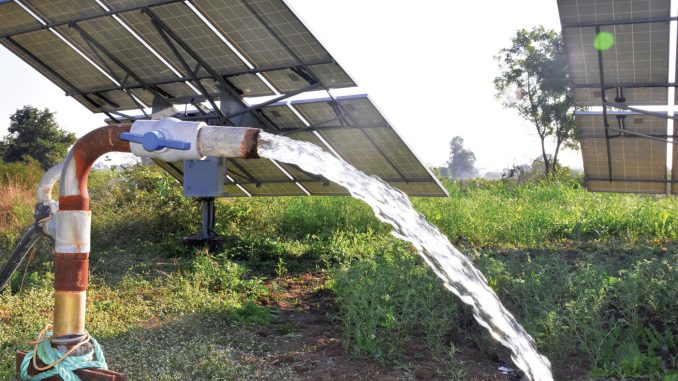
The PM-KUSUM scheme also offers a counter to the policy of providing free and subsidised electricity to farmers. While such policies may be defended to some extent on grounds of ensuring social equity, providing free electricity without a sunset clause not only drains the treasury but also leads to excessive water and electricity consumption, impacting soil health and the power distribution segment. Such freebies are also often misused for political reasons and vote bank gains.
The significant increase in funding for the MNRE suggests that the political winds are shifting in its favour.
Thus, a change in strategy by providing subsidies to farmers for solar irrigation pumps and ensuring feeder-level solarisation under PM-KUSUM offers an alternative political and policy model that promotes clean energy uptake and would lead to a gradual phase-out of direct subsidies. The government’s priority is reflected in the scheme’s substantial budget allocation of Rs 26 billion, the second highest for the MNRE after the PM Surya Ghar scheme. In 2025-26, the scheme aims to ensure Rs 8.88 billion in subsidy savings through feeder solarisation, reduce diesel consumption by 345 million litres, benefit 500,000 farmers and generate 1.6 BUs of solar energy.
Catalyst of change
To conclude, increased funds for the MNRE can not only help meet India’s climate goals, but also solve legacy issues such as electricity freebies for farmers and residential consumers.

