By Srijan Naayak
The Indian solar photovoltaic (PV) segment is witnessing remarkable growth, propelled by the surge in installations and supported by government policies. As of September 30, 2024, India’s cumulative installed solar capacity has reached approximately 90.76 GW and solar energy now constitutes 43 per cent of the country’s total installed renewable capacity. Amidst the surge in solar installations and declining tariffs, the importance of effective operations and maintenance (O&M) practices is becoming increasingly critical. These practices are essential for maintaining performance standards and maximising return on investment, which significantly impact the overall profitability of solar power plants and their internal rate of return (IRR). Renewable Watch provides an insight into the market trends, major players, challenges and outlook for this market segment…
Market landscape
The domestic solar O&M segment, once a market that focused primarily on plant security and module cleaning, has rapidly evolved into a distinct market with its own unique landscape and dynamics. These dynamics have changed due to decreasing module prices and project costs, increased competition and the need to fulfil forecasting and scheduling regulations. The key dynamics in the solar O&M market revolve around the type of player, the maintenance service offered and the technology used, which are discussed in detail in the following section.
Types of players
The solar O&M market in India is dominated largely by big solar independent power producers and engineering, procurement and construction (EPC) players such as Tata Power Renewable Energy Limited, Adani Green Energy Limited and Mahindra Susten, which have their in-house O&M teams since they operate mainly large utility-scale solar projects.
Right now O&M of most of the solar projects are self-managed while the remaining are under third party O&M service providers or fall under EPC contracts. Recently, the third-party O&M business model, which includes independent service providers, has gained traction, although it remains highly fragmented. This market segment is expected to grow rapidly in the coming years as the demand for specialised O&M services increases. The retendering of O&M contracts is becoming more common, presenting significant opportunities for independent service providers to expand their footprint.
Types of maintenance services
The maintenance services performed in the solar segment can be divided into two types, scheduled and unscheduled maintenance. Scheduled maintenance can be further categorised into preventive maintenance, involving routine inspection, servicing and cleaning of modules at a scheduled interval of time to minimise downtime and unnecessary production losses; and condition-based maintenance, involving monitoring of equipment condition and plant operations on a real-time basis and addressing potential problems at a very early stage to prevent downtime. In contrast, unscheduled maintenance consists of corrective maintenance, identifying issues or failures after they have occurred and is aimed at restoring the system to its proper
working condition.
Types of technologies used
The solar O&M segment is undergoing rapid transformation owing to emerging technologies and fast-paced innovations aimed at enhancing the efficiency of maintenance services for solar plants. A growing number of specialised third-party service providers have entered the market, leveraging economies of scale, technical expertise and advanced tools to deliver efficient and cost-effective solutions. The primary objective of these advancements is to increase plant uptime and reduce service costs.
This trend has been brought about by the integration of advanced technologies, particularly artificial intelligence (AI). A lot of players are using AI-driven predictive maintenance to monitor real-time performance and anticipate equipment failures before they occur, thereby minimising unplanned downtimes and reducing maintenance costs. Moreover, other technologies such as drones with thermal imaging quickly detect temperature anomalies in solar panels, enabling rapid fault identification and reducing inspection time. Meanwhile, remote monitoring systems utilise cloud computing to deliver real-time performance data, allowing for proactive maintenance interventions.
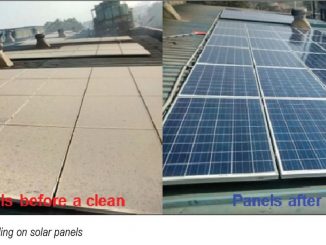
In terms of cleaning practices, several processes are being adopted, apart from traditional manual methods, the most popular of them being robotic cleaning solutions that ensure peak efficiency. The major players in the subsegment include Skilancer Solar, Nocca Robotics, Solabot, Aegus Technologies, Eccopia Scientific and Tayproa. Additionally, waterless or dry-cleaning technologies are now available at competitive prices as compared to a few years back. It reduces manpower requirements and instead uses only skilled labour for managing these advanced tools and ensure their effective operation. Moreover, innovative cleaning techniques such as nanocoatings and electrostatic methods are being explored by some players.
The adoption rate is higher for large utility-scale projects, where the project scale is much larger than smaller rooftop projects, making it more commercially viable to deploy advanced technologies.
Cost of solar O&M In India
According to Tata Power Solar, the standard cost of solar O&M in India has significantly decreased from Rs 800,000 to Rs 1 million per MW per annum in 2015 to approximately Rs 250,000 per MW per annum in April 2021. This reduction is largely attributed to technology advancements and the emergence of specialised third-party service providers. Due to technology advancement and the use of predictive analytics replacing manpower, O&M costs are expected to further reduce in the coming years.
Currently, most large asset owners manage their solar O&M activities in-house, as their extensive portfolios enable them to achieve economies of scale. This strategy allows them to effectively control performance and costs. In contrast, mid- and small-sized asset owners are experiencing ongoing pressures related to costs and profit margins, often leading them to outsource their O&M activities to specialised service providers.
As the market continues to evolve, the appeal of lower costs associated with guaranteed services is expected to encourage even large asset owners to consider outsourcing their O&M functions. This trend is driven by the realisation that specialised O&M providers can deliver improved efficiency, technical expertise and access to advanced technologies that may not be feasible for in-house teams.
Meanwhile, the residential rooftop solar segment faces profitability challenges in O&M contracts, particularly for smaller solar power plants. It is considered that O&M accounts for 1 per cent of the total EPC cost of a rooftop solar project. As noted in a document from the Karnataka Electricity Regulatory Commission, BESCOM has suggested that O&M expenses for rooftop solar plants be set at Rs 749,000 per annum, which is high. This underscores the importance of reducing O&M costs for rooftop installations. AI tools are assisting in saving costs as they reduce the downtime of the system, although the initial cost increases. According to Jakson, there is a Rs 6,000-Rs 15,000 per MW increase in the O&M cost depending on the advanced technology deployed.
Key challenges and the way forward
The utility-scale solar O&M segment in India faces several challenges that hinder efficiency and profitability. One, water scarcity complicates regular panel cleaning; two, slow adoption of advanced technologies such as drones and automated cleaning systems limits efficiency improvements; three, ageing infrastructure requires more intensive maintenance; and four, grid integration issues arise from the intermittent nature of solar energy. Besides, there are other module associated reasons such as dust accumulation, module shading, module mismatch and physical integrity.
Several other factors complicate maintenance efforts, including local soiling conditions, security issues and water quality. Furthermore, the variability in asset quality makes it challenging to establish standardised O&M practices.
Meanwhile, the floating solar PV segment encounters a unique array of challenges in O&M. Key issues include the need for regular mooring and anchoring to maintain the stability of floating plants. As the floating solar market grows, effectively addressing these O&M challenges will be essential for ensuring reliability and efficiency. Leveraging advanced technologies such as drones for aerial inspections and predictive analytics for maintenance scheduling can significantly help overcome these hurdles, allowing asset managers to enhance the sustainability and scalability of floating solar operations.
All in all, the future of solar O&M in India is set for significant growth. As the solar industry continues to expand, the increasing emphasis on sustainability among commercial and industrial segments and consumers is amplifying the demand for reliable O&M services. All stakeholders are keen to ensure that installed systems not only meet but also exceed operational expectations.
The ambitious growth of India’s solar O&M market requires a strong commitment to operational excellence across its expanding solar fleet. This entails embracing new-age technologies and implementing best practices to ensure that solar installations operate at their optimal capacity. Moreover, the importance of upskilling the workforce with the latest technological knowledge cannot be overlooked. Going forward, the solar O&M segment in India is well positioned to achieve significant advancements in the coming decade.