

India’s power sector is undergoing a transformation, shifting its focus from power purchase agreements (PPAs) to increased participation in power markets. This change is largely driven by the increased power demand from both households and industries, which has placed immense pressure on power generators and distribution companies to meet the growing need for electricity. While efforts have been made to establish more power plants, expand renewable energy, build transmission networks and enhance energy efficiency, there is still room for improving power access across the country.
In addition, the corporates are turning to power exchanges to meet their climate commitments when other renewable energy options are exhausted. In this context, power exchanges and green market-related products are gaining importance. One company that has been instrumental in promoting the use of power exchanges is the Indian Energy Exchange (IEX).
Operating since June 27, 2008, IEX has been publicly listed on the National Stock Exchange and the Bombay Stock Exchange since October 2017. The company has built an ecosystem of over 7,600 participants across 28 states and eight union territories, including over 60 distribution utilities, 700 conventional power generators, and 1,900 renewable energy generators and obligated entities. It has a base of over 4,800 commercial and industrial consumers, representing sectors such as metal, food processing, textiles, cement, ceramics, chemicals, automobiles, information technology, institutional organisations, housing and real estate, and other commercial entities.
Performance trends
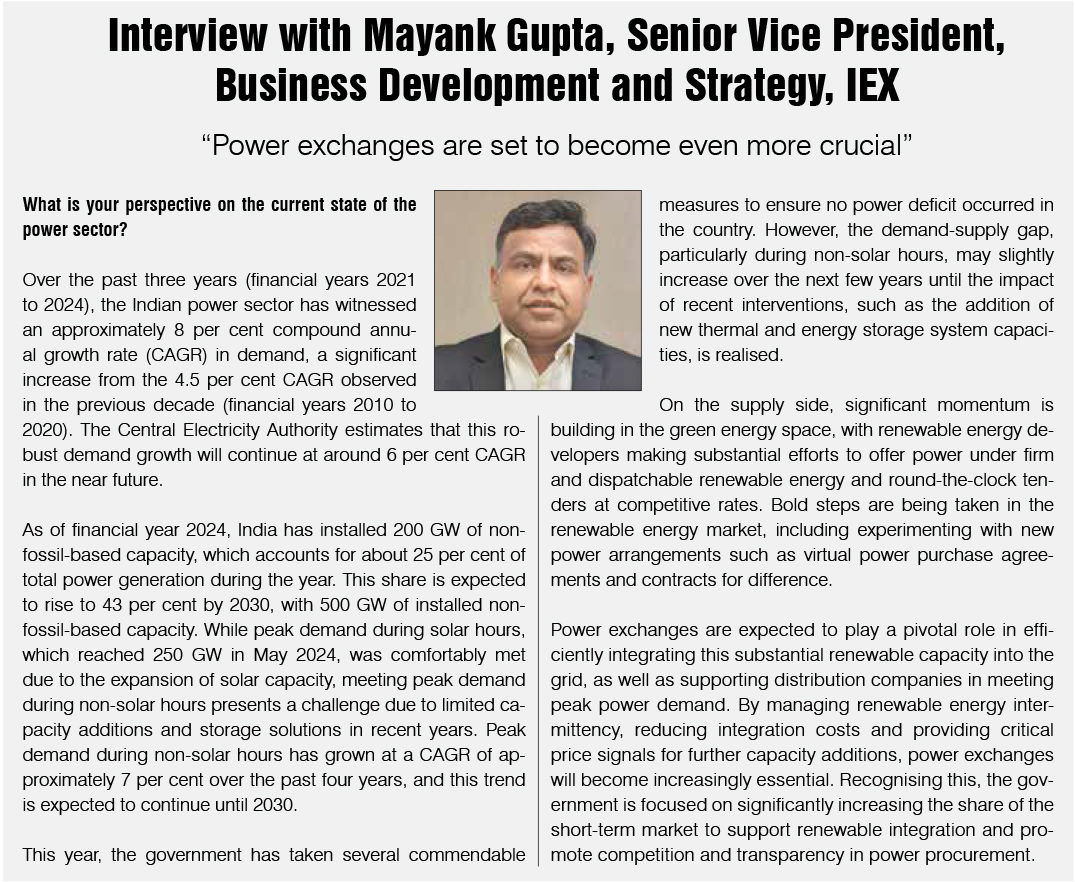
Mayank Gupta, senior vice president, business development and strategy, IEX, shares the key performance trends of IEX over the years and highlights government initiatives that have promoted the uptake of power exchanges in India.
“Over the past few years, IEX’s performance has been remarkable, reflecting the growing importance of transparent and efficient power trading mechanisms. During fiscal year 2024, several favourable policy and regulatory interventions further deepened power markets. Notable among these were the implementation of general network access regulations, the Indian electricity grid code regulations and transmission charges sharing regulations. Furthermore, there were amendments to the electricity late payment surcharge rules, which require the sale of un-requisitioned surplus power on exchanges,” says Gupta.
During financial year 2024, IEX achieved traded volumes of 110 billion units (BUs), a 14 per cent growth over financial year 2023. On the financial front, consolidated revenue for financial year 2024 increased by 16.1 per cent on a year-on-year basis, from Rs 4,741 million in financial year 2023 to Rs 5,508 million. The consolidated profit after tax stood at Rs 3,508 million during financial year 2024, marking a 14.7 per cent year-on-year growth.
The trends in the first four months of the current financial year indicate the growing role power exchanges will play, driven by surging electricity demand during extremely hot summer months. “According to government data, the country’s energy consumption reached 452 BUs in the first quarter of financial year 2025, representing an approximately 11 per cent increase compared to the same period in financial year 2024. Notably, during this period, the country’s peak demand reached 250 GW, surpassing the previous high of 243 GW recorded in September 2024,” says Gupta.
Overall, proactive measures taken by the government and regulators, including the sale of surplus un-requisitioned power on power exchanges, increased fuel supply and ensuring higher availability of generating units, have increased sell liquidity on the exchanges, resulting in competitive price discovery. IEX witnessed remarkable growth in the first four months of the current financial year. In the first quarter of financial year 2025, IEX recorded a total trading volume of 30.4 BUs, marking a significant 21.1 per cent year-over-year increase. The positive trend continued into July 2024, when IEX achieved its highest-ever total volume (including certificates) of 13,250 MUs, representing a 56 per cent year-over-year increase.
Meanwhile, IEX’s green market products, which include the green day-ahead and green term-ahead market segments, achieved a volume of 1,768 MUs in the first quarter of financial year 2025. In addition, a total of 2,112,000 renewable energy certificates (RECs), equivalent to 2,112 MU, were traded during this period.
“In July 2024, IEX’s green market performed exceptionally well, with a volume of 989.6 MUs, compared to 275.4 MUs in July 2023, registering a 259 per cent year-on-year increase. The REC market also witnessed unprecedented growth, with 3,150 MUs traded, a 405 per cent year-on-yearincrease, while the REC price reached an all-time low of Rs 120 per certificate in July 2024,” says Gupta.
Beyond energy trade within India, there are several opportunities in cross-border energy trading. IEX has received positive responses from Bhutan and Nepal. “Currently, we are receiving more than 15 MUs per day in ‘sell’ bids from Nepal. During our lean demand season, Bhutan and Nepal’s dependency on the Indian spot market increases to up to 1,000 MW in certain time blocks. With more transmission capacity in the future, we expect even greater cross-border trading, further strengthening regional energy integration,” says Gupta.
The way forward
Going forward, IEX aims to continuously introduce new products and segments to adapt to the changing dynamics of the power sector. In financial year 2024, IEX launched the ancillary market and the high-price term ahead market, and is now awaiting approval from the Central Electricity Regulatory Commission to extend the term-ahead market contract from three months to eleven months.
As India progresses towards its net-zero goals, merchant power plants will provide a fillip to the renewable energy market and enhance its role in achieving energy security by providing renewable energy developers with the flexibility to navigate market dynamics without being tied to long-term PPAs. “A joint study by IEX and the Solar Energy Corporation of India, conducted in collaboration with Deloitte, found that market-based renewable energy projects typically offer higher returns compared to those established through long-term power PPAs. Further, to leverage the wholesale market, certain capacities in existing tenders issued by renewable energy implementing agencies can be auctioned as open capacity, around 20 per cent of the tender quantum. Developers can generate revenue from this open capacity through the market. This will create additional revenue opportunities and will further build the liquidity in green markets. Furthermore, developers can some merchant capacity at their existing project locations to capture better market opportunities and increase the overall project internal rate of return,” says Gupta.
With India’s annual electricity demand expected to grow by more than 6 per cent until financial year 2030, the country is undergoing a significant energy transition, particularly with the integration of renewable energy. A resilient power sector, driven by a robust power market, will be crucial for meeting country’s economic and sustainability goals. Companies like IEX will play a key role in achieving these objectives.
