

 By Rabindra Satpathy, Senior Vice President, Clean Energy Technology Center, Solar Division, Holtec Asia
India has set an ambitious target to generate half of its energy demand from renewable sources and achieve 500 GW of non-fossil fuel capacity by 2030, in line with its COP26 commitment made in Glasgow in November 2021. This target will primarily be met through the use of solar energy, including solar PV and solar thermal. As of July 2024, the country’s combined installed renewable energy capacity, including solar, wind and large hydro projects, stands at 197 GW. The increasing penetration of renewable energy into the grid poses challenges for grid management and raises concerns about energy security and reliability. This highlights the need for cost-effective energy storage solutions for the successful deployment of renewable energy. Two specific types of tenders have emerged in the market – standalone battery storage tenders and flexible and despatchable renewable energy (FDRE) tenders. FDRE is crucial for India to achieve its 100 per cent renewable energy target.
While electrical energy can be stored in batteries, thermal energy stored during sunshine hours can be converted to electrical energy during non-sunshine hours. Thermal energy storage can also be used for other applications such as industrial process heat. However, battery-based energy storage has some disadvantages. The life of a lithium-ion battery is 8-10 years, thus requiring replacement every 10 years. In addition, the high cost of large battery-based storage leads to dependency on Chinese suppliers, and battery capacity degrades by about 2 per cent every year. Although solar PV is affordable, the combination of PV and batteries is not cost-effective for long-duration energy storage.
The Jawaharlal Nehru National Solar Mission was launched in 2010 to promote both solar PV and concentrated solar power (CSP) projects. However, CSP struggled to compete with solar PV due to the falling prices of solar PV modules. As of July 2024, solar PV installations have reached a capacity of 87 GW, whereas the total installed CSP capacity stood at 329.5 MW during its initial years, with only 101 MW of CSP plants currently operational. Even concentrated PV technology could not compete with flat plate PV modules. To achieve the target of 500 GW, it will be essential to develop large storage projects, including CSP plants with thermal energy storage.
In the US, demand for CSP with thermal storage grew mainly due to its ability to provide solar power on demand and improve grid integration for renewables. CSP technologies have also advanced. For instance, Dubai’s recent 950 MW CSP-PV hybrid project with molten salt-based thermal energy storage provides solar power at 7.3 US cents per kWh. This is competitive with fossil-fuel-based power generation and available on a round-the-clock basis.
The CSP system uses a solar concentrator (or solar mirror field), which reflects and concentrates the incident solar radiation on to a solar receiver. The heat transfer medium flowing through the solar receiver absorbs the concentrated solar radiation through the receiver wall, increasing its temperature. The high-temperature HTM then transfers heat to the working fluid in a heat exchanger, increasing its temperature and pressure. The working fluid drives the turbine to generate electric power using the Rankine cycle.
The different types of CSP technologies are discussed below.
Parabolic trough collector (PTC): PTC-based CSP systems are line-focus-type systems, which consist of parallel rows of long parabolic shaped mirrors that concentrate sunlight on to a tube running parallel to the mirrors. The tube stores a liquid, such as molten salt. The thermal energy from the liquid is converted into usable energy by producing superheated steam that rotates a steam turbine, which in turn drives a generator to produce electricity. These plants require a large area. Owing to low operating temperatures (around 350 °C), PTC systems have a low thermodynamic efficiency of around 33 per cent. PTC technology is mature compared to other CSP technologies and most CSP plants worldwide use PTC technology.
Linear Fresnel reflector (LFR): These are line-focus systems that resemble the parabolic shape of PTC systems. They concentrate sunlight on to a receiver tube by using long rows of flat and slightly curved multiple mirrors. The solar energy is converted into thermal energy in the tubes, which is used to heat a liquid that moves through the system to rotate a turbine using steam. LFR systems occupy a large area and have a very low thermodynamic efficiency of around 15 per cent at operating temperatures of under 327 °C.
 Solar power tower (SPT): These systems are point-focus systems with large, flat and rectangular mirrors called heliostats that surround a tower. Light is reflected by the heliostats on to a receiver placed at the top of the tower, through which a heat transfer fluid (HTF) flows. The HTF is heated by the sunlight and then flows through a system, which transports this thermal energy to produce steam from water. The steam turbine drives an electric generator. The steam then condenses into water and is pumped through the system to the boiler for reheating. SPT systems have a high storage potential. Molten salt, that is, HTF, can be stored for later use. These systems are also relatively more cost-effective. They are able to achieve high temperatures, with a concentration ratio exceeding 1,000 suns. They also have a relatively high thermodynamic efficiency of around 40 per cent at 575 °C. At higher temperatures, SPT systems have the potential to achieve more than 50 per cent efficiency using a supercritical CO2 Brayton cycle. This technology is highly flexible, allowing designers to choose from a wide variety of heliostats and receiver designs.
Parabolic dish (PD): A less common CSP technology is the parabolic dish. These systems consist of a concave dish to focus sunlight on to an elevated receiver at the dish’s focal pont. A piston-cylinder design uses a sterling engine, located in the focal point of the receiver, to produce power. The entire system tracks the sun with the dish and the receiver. This system has a high thermodynamic efficiency of 65-80 per cent at an operating temperature of 1,226 °C, and it occupies a small area. However, it has not achieved significant commercial success.
Among these technologies, solar power tower-based CSP systems are the most advantageous for hybrid solar systems, particularly when combined with solar PV and thermal energy storage.
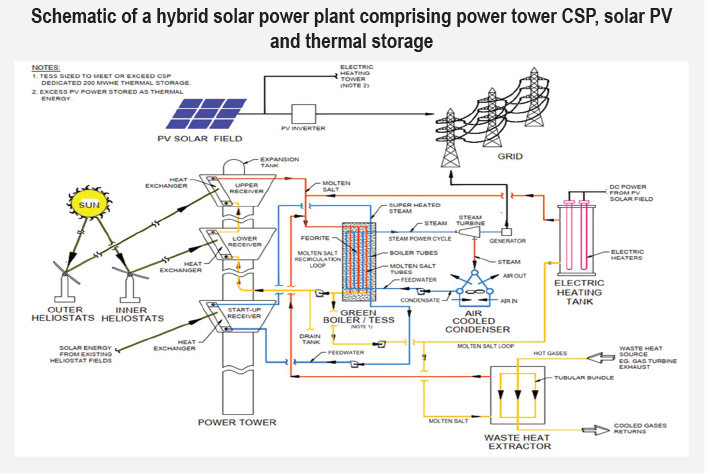
The hybrid solar plant shown in the figure combines a CSP system with a thermal energy storage system and PV panels around the periphery of the heliostat field. The CSP system captures thermal energy by reflecting solar energy from heliostats on to a tower, where the heat is captured by a receiver.
Heliostats are large optical mirrors that are arranged in a circular or semi circular pattern around the power tower. They reflect solar radiation onto receivers. The solar radiation is absorbed by the heat exchanger in the receiver and transferred as thermal energy to a heat transfer fluid loop. This heat transfer fluid is continuously pumped through the loop and transfers thermal energy to a storage medium in a tank. The heat transfer fluid is pumped from the thermal storage tank to the receiver, heating up through solar thermal energy and returning to the storage tank. The heat from the storage tank is fed into water tubes, which are connected to the steam generator system to generate super-heated steam. The super-heated steam drives the steam turbine using a standard Rankine cycle to produce electrical power. The tank stores thermal energy and provides 24-hour heat input to the steam cycle, even at night.
The following are the salient features of a typical hybrid solar power system:
- The solar PV plant generates electricity, supplying to the grid and meeting the auxiliary power requirements of the CSP plant during the day.
- The hybrid system produces more energy per land use than standalone CSP or PV systems, with a lower levellised cost of energy.
- The best performing hybrid solar project produces about 8 MWh of energy per acre when direct normal irradiance is more than 1,700 W/sq. m, making the best use of land.
- The green boiler thermal storage system has a life cycle five times longer than lithium-ion batteries, contains no hazardous materials and is not subject to cycling or calendar degradation.
- The receiver, a heat exchanger, absorbs sunlight with minimal reflection and captures reradiated energy. It contains tubes filled with heat transfer fluid, which is heated by captured radiation reflected by the heliostats.
- CSP plants may have multiple receivers mounted at different heights on the power tower to capture more thermal energy. The receivers can be cylindrical type or cavity type.
- Water was used as heat transfer fluid in conventional CSP plants. Molten salts, which are a combination of sodium and potassium nitrate, are used as both heat transfer fluids and heat storage mediums. Graphite or iron combined with molten salts are also used for heat storage.
- The power tower is a key component of CSP systems, which have single or double towers within the solar heliostat field, with tower heights varying depending on the design of the heliostat field and receivers.
- The design and energy yield of CSP plants depend significantly on the available direct normal irradiation at the plant’s location.

