

Energy efficiency is a crucial element of energy policy, facilitating a reduction in energy consumption, lowering greenhouse gas emissions and yielding economic benefits. The Bureau of Energy Efficiency (BEE) in India has been a leading force in promoting energy efficiency through various programmes and initiatives. This involves using less energy to deliver the same service by leveraging technological advancements, encouraging behavioural changes and implementing policy interventions. The advantages of energy efficiency are broad and impactful. Economically, it results in reduced energy bills for households and businesses. Environmentally, it decreases greenhouse gas emissions, contributing to climate change mitigation. Furthermore, it enhances energy security by reducing demand, thereby easing the pressure on energy resources and infrastructure.
Trends in energy savings
According to BEE, the cumulative electricity consumption by all sectors (industrial, domestic, agriculture and commercial) stood at 1,296,300 GWh during 2022-23. Of the total consumption, the industrial sector accounted for the largest share (41.16 per cent), followed by the domestic (25.77 per cent), agricultural (17.67 per cent) and commercial (8.29 per cent) sectors.
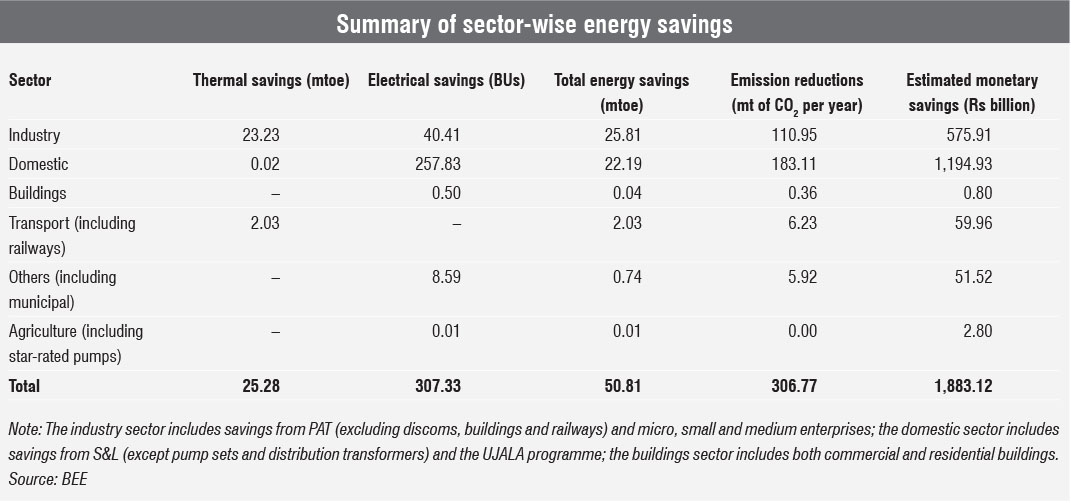
In 2022-23, the adoption of energy efficiency schemes/programmes reduced the overall electricity consumption by 249.89 BUs, leading to a 19.28 per cent reduction in electrical energy requirement across various sectors of the economy. The domestic sector had the highest contribution, accounting for 80.12 per cent of the total electrical energy savings from all energy efficiency interventions during 2022-23.
The adoption of energy efficiency schemes/programmes resulted in overall energy savings of 50.81 million tonnes of oil equivalent (mtoe) in 2022-23. Various energy efficiency measures led to overall thermal energy savings of 25.28 mtoe, while overall electricity savings stood at 307.33 BUs. These energy savings translated into monetary savings worth Rs 1,883.12 billion per annum.
The equivalent reduction in CO2 emissions was around 306.57 million tonnes (mt) annually.
Energy efficiency schemes at both national and state levels, carried out by BEE and other agencies, led to a reduction of 33.35 mtoe in demand-side energy consumption. The industrial sector accounted for 61 per cent of the total energy savings while the domestic sector accounted for 30 per cent. The remaining sectors contributed around 8.13 per cent of total energy savings during 2022-23.
 Key programmes and initiatives
India has committed to reducing its emissions intensity by 45 per cent by 2030 from 2005 levels. This ambitious target, part of the Nationally Determined Contributions under the Paris Agreement, requires limiting absolute emissions to around 4,584 mt of CO2 equivalent (MtCO2e). To achieve this, the overall emissions should be reduced by 3,753 MtCO2e over the baseline scenario. Energy efficiency, particularly in buildings and appliances, will be crucial in meeting this goal.
Energy efficiency in buildings and appliances
India’s building sector is poised for significant growth, with over 50 per cent of the 2030 building stock yet to be constructed. This offers a unique opportunity to incorporate energy efficiency from the ground up, unlike developed countries where most infrastructure is already in place. At present, about 33 per cent of the country’s total electricity consumption is attributed to commercial and residential buildings, and this is expected to grow to approximately 40 per cent by 2031-32.
To address this, India has implemented several initiatives:
- Energy Conservation Building Code: This code sets minimum energy performance standards for commercial buildings, promoting energy efficiency right from the design phase.
- Voluntary Star Rating Programme: Existing commercial buildings can opt for this programme, which rates them based on their energy performance.
- Shunya Labelling Programme: This programme recognises and promotes net zero energy buildings and net positive energy buildings, encouraging the development of buildings that produce as much or more energy than they consume.
- Standards and Labelling (S&L) Programme: The programme was introduced to inform consumers about the energy and cost-saving potential of various appliances and equipment. According to the 2022-23 Impact Assessment Report by BEE, this programme has saved 81 BUs of electricity. Key initiatives include:
- Star-rated ACs: High-efficiency air conditioners (ACs) are promoted through a star rating system, with incentives for consumers to replace older models with 5-star rated ones.
- Market Transformation Programme: This incentive-based programme encourages consumers to switch to energy-efficient appliances, significantly reducing energy consumption.
LiFE Initiative
Launched by the Indian Prime Minister at COP26 in November 2021, the Lifestyle for Environment (LiFE) initiative aims to foster sustainable lifestyles to combat environmental degradation and climate change. The initiative is integrated into India’s broader energy transition strategy and promotes the following:
- Energy-efficient practices: Encouraging households to adopt energy-efficient appliances and sustainable mobility.
- Behavioural changes: Promoting mindful consumption through campaigns like setting ACs at 24 °C to optimise energy use.
Industrial and government policies
Energy efficiency in the industrial sector is driven by the Perform, Achieve and Trade (PAT) scheme. This scheme targets energy-intensive industries, assessing specific energy consumption and setting reduction targets. Eight cycles of the PAT scheme have been launched, and the Ministry of Power has introduced the Carbon Credit Trading Scheme as a next-level action.
Transport sector and EVs
India has implemented fuel consumption standards for cars and heavy-duty vehicles. With the increasing number of electric vehicles (EVs), the government has also established guidelines and standards for charging infrastructure, promoting the development of a supportive ecosystem.
DSM
Demand-side management (DSM) interventions are critical for reducing energy demand and deferring investments in generation, transmission and distribution networks. In India, DSM measures have led to significant energy savings and efficiency gains. Key interventions include:
- Energy-efficient pump sets in agriculture: Improves the efficiency of irrigation systems.
- Efficient water pumping systems: Enhances the efficiency of drinking and sewage water pumping systems in local bodies.
- Distribution transformer network: Improves the efficiency of the electrical distribution network.
- Star rating of appliances: Promotes energy-efficient appliances and white goods.
These measures have resulted in total annual energy savings of around 51 mtoe, which is 6.6 per cent of the country’s total primary energy supply. This also equates to annual cost savings of approximately Rs 1,943.2 billion and a reduction of around 306 MtCO2e.
Challenges and the way ahead
Despite the significant achievements in energy efficiency, several challenges remain that need to be addressed to ensure continued progress. One of the
primary challenges is increasing awareness and adoption of energy-efficient practices and technologies across all sectors of society.
Another significant challenge is the development and enforcement of effective policy frameworks and regulations. Strengthening these frameworks and ensuring their stringent enforcement will be essential for maintaining momentum in energy efficiency efforts. Well-designed policies can drive substantial progress by setting clear standards and incentivising the adoption of energy-efficient solutions.
Conclusion
Energy efficiency is a cornerstone of sustainable development, offering economic, environmental and social benefits. BEE’s comprehensive programmes and initiatives demonstrate the potential for substantial energy savings and emission reductions. Continued efforts in policy implementation, technological innovation and stakeholder engagement will be key to achieving long-term energy efficiency goals and combating climate change.
