India’s solar power sector has grown and evolved significantly over the past few years and technology continues to advance at a rapid pace to meet the industry’s demands for cost-efficiency. In conjunction, related segments such as solar thermal, recycling of solar components, distributed solar, energy storage and green hydrogen are also witnessing significant innovations in both technology and policy framework. The National Institute of Solar Energy (NISE) has been at the forefront of these technology innovations, driving clean energy deployment. Its focus lies not just in research and development (R&D), but also in providing consultation to various agencies as well as capacity building and skill enhancement of renewable energy professionals. Against this backdrop, Mohammad Rihan, director general, NISE, discusses the key initiatives of the organisation as well as his take on recent developments in the solar sector. Edited excerpts…
How has the solar power sector in the country evolved over the past decade?
I think the growth of solar power in the country has been remarkable. If we go back to 2011-12, we had only 10 MW of installed solar power in the country. Right now, we have almost 85 GW installed already and a similar capacity is in the pipeline, with some in the tendering stage and some under implementation. This transition will gather momentum and I am sure that we will be able to meet our 2030 targets. The pace of growth is satisfactory.
Moreover, in the past few years, we have made good progress in the areas which were earlier not addressed, such as local manufacturing. The most important thing now is to achieve self-reliance across the entire supply chain. Therefore, the production-linked incentive (PLI) scheme in manufacturing is one of the key initiatives, and we are pushing for integrated manufacturing.
Going forward, we need to focus on integrating solar power into our energy system. As the penetration level increases, the challenges associated with grid integration will also grow. Although we have a very strong grid, challenges will arise that will need to be tackled at different levels. We need to work on shifting demand from evening to daytime, scaling up storage and identifying the best possible way to utilise the geographic diversity of the country.
How does India compare with what is happening globally in solar PV technology manufacturing and adoption?
India is witnessing technological developments and advancements alongside evolving market trends. In my opinion, so far, developers have aligned with global standards and we are moving in line with global advancements. So, I think we are on the right track.
What are some of the focus areas for you right now at NISE?
 NISE is a nodal institute for solar energy, and given the extensive developments in this field, I would like to divide NISE’s activities into three parts. The first is R&D, where our team is working on issues at the cell and module levels. We are also addressing system-level concerns, such as grid integration of solar energy, and exploring various storage options. A new dimension has been recently added focusing on the recycling and handling of PV waste. Apart from that, we are working on solar water pumping as well as solar thermal, especially for lower temperature applications, storage and heating and cooling applications. Another crucial area of study is resource assessment and planning.
The second part is consultancy or technical support, which we are providing to different agencies, including the Ministry of New and Renewable Energy (MNRE). Recently, a solar PV module star rating was released by the Bureau of Energy Efficiency, for which NISE handled the technical aspects. We are also the technical institute responsible for the PLI scheme in manufacturing.
We are providing consultancy for several significant projects, including a floating solar project in Madhya Pradesh and a UNICEF project focused on the solarisation of health facilities. Further, we also support state nodal agencies in various aspects, such as manufacturing, waste disposal and recycling.
Third, we have recently been made the implementing agency on green hydrogen projects. Our significant presence in this field is highlighted by our green hydrogen production plant, which was established in 2014-15, almost 10 years back. So, we are strengthening our efforts in this area, focusing on key R&D initiatives, and have introduced two types of training.
As the solar sector rapidly evolves, we need to match this growth with trained manpower and the right skillsets. NISE is playing a key role in this area by conducting international training programmes in collaboration with the Ministry of External Affairs and the International Solar Alliance. We also offer national-level programmes, where we conduct scheduled as well as customised programmes for various agencies. Additionally, we train technicians under the MNRE’s Suryamitra Skill Development Programme, and NISE supports many PhD students and interns working on their projects. On recycling, we will begin with awareness programmes and gradually develop a full-fledged training programme.
How important do you think distributed renewable energy is for the Indian energy sector?
While utility-scale projects are crucial for achieving scale and size, solar power, by nature, is a distributed source. Its best utility lies in its capacity as a distributed source of energy.
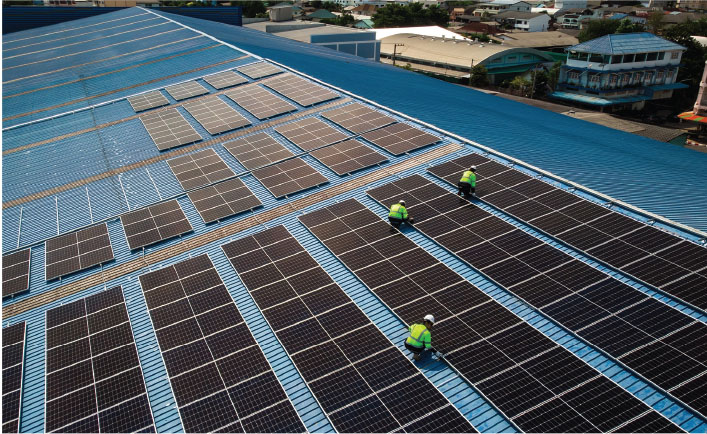
India’s rooftop solar segment has been lagging behind target, but the PM Surya Ghar scheme has provided a strong push, with an impressive number of registrations under the scheme. We need to promote rooftop solar installations on residences, schools and government buildings. In this regard, the recent policy on mandating solar installations on all government buildings is a step in the right direction. Schools have also been directed to do the same. While off-grid systems have their own challenges, they also offer significant benefits.
What is your take on solar PV recycling?
Solar PV recycling is becoming increasingly important, especially considering the scale of solar PV installation. While solar PV systems are durable and offer long-term benefits, they have their own limitations and a finite lifespan, which presents a challenge. Thus, if we make it the responsibility of the developer today, how can we ensure that the developer will dispose it of after 25 or 30 years? Further, developers may include the cost of recycling in the selling price, which will make solar installations costly.
However, initial discussions, debates and policy considerations are under way. Another drawback is the lack of good detailed examples or case studies from other countries. Further, the technology for recycling is still evolving, and it remains unclear which method – mechanical, chemical or another approach – is better.
In terms of capacity building, is there any plan to have focused training programmes for women?
I already have this idea in mind to plan a version of the Suryamitra programme exclusively for women. About three to four months ago, NISE completed a training programme for Mongolian citizens, which comprised only women. So, on the same lines, I have discussed with my team the possibility of organising one or two batches per year of these important programmes specifically for women. Gender inclusiveness is a crucial aspect of the energy transition.