By Mohammad Ziaulhaq Ansari, Technical Manager, Alfanar Power Private Limited
The Ministry of Defence (MoD), in a publication issued through the Ministry of New and Renewable Energy, recently provided a clear-cut demarcation of no-go zones for the construction of wind power projects in states with wind potential. This initiative will prevent wind farm operations from being endangered in the future. It will also enable greater transparency and accuracy, and speedy disposal of applications.
The move will help in the dissemination of information and in increasing transparency. Previously, the industry had no way of knowing whether a wind project construction would be at risk of being halted. Some projects have faced significant delays because no prior information was available, and acquiring accurate information on no-go areas from the MoD was a time-consuming process. A formal application needed to be made to the MoD, which led to long delays and significant investments being put at risk, distorting project return calculations and engendering disinterest from lenders. Due to this, several wind projects still face significant challenges and are in deadlocks. Developers, in order to avoid losing time, would go ahead with ground activities with a partial understanding of such demarcations. Later, they would receive notices from MoD objecting to the development, leading to a complete halt in operational activities.
The policy move will reduce the risk for developers due to the newly available information on where a project cannot be set up. However, a significant portion of potential wind energy zones, which otherwise had very good potential, must now be avoided due to this demarcation, which is concerning.
While the demarcation has been established for all six windy states of the country, this article only discusses the implications of this notification on wind power project development in Gujarat. It will critically examine the amount of high wind potential zones that have been lost because of this no-go demarcation.
Wind power constitutes a significant share of the country’s renewable energy capacity. The Indian government has set an ambitious target of 500 GW of installed electricity capacity from non-fossil fuel sources by 2030. As per the National Institute of Wind Energy (NIWE), the country has an installable wind power potential of about 1,164 GW at 150 metres above ground level, while the current installed capacity is just 45.88 GW as of May 31, 2024. This estimation of installable wind power potential is the outcome of extensive research carried out by NIWE over the years using the weather research forecasting technique combined with micro multi-scale modelling and long-term reanalysis data sets. The result is a thematic map for P50 annualised average capacity utilisation factor (CUF) with classifications of less than 25 per cent, 25-30 per cent, 30-32 per cent, 32-35 per cent, 35-38 per cent, 38-40 per cent and more than 40 per cent ranges. Normalised power curves and inclusions of standard correction factors have been applied in the computation. Land features that are not suitable for wind farm development were excluded with appropriate buffer ranges, such as roads, railways, protected areas and airports. After removing exclusion layers, the remaining potential zones are calculated in sq. km. Installable wind power capacity is estimated at 4.5 MW per sq. km with the assumption of five times the rotor diameter on one axis and seven times the rotor diameter on another axis of what a typical micro-siting configuration entails.
The installable wind power potential of Gujarat is estimated to be 180.7 GW, with 87 GW on wasteland, 92 GW on cultivable land and 5 GW in forest area. This represents the suitable areas with capacity, and the same potential can be segregated based on CUF with ranges, that is, 32 GW of installable wind capacity under 32-35 per cent, 34 GW under 35-38 per cent 16.5 GW under 38-40 per cent, and 21.1 GW for over 40 per cent. This is after the exclusion of unsuitable areas.
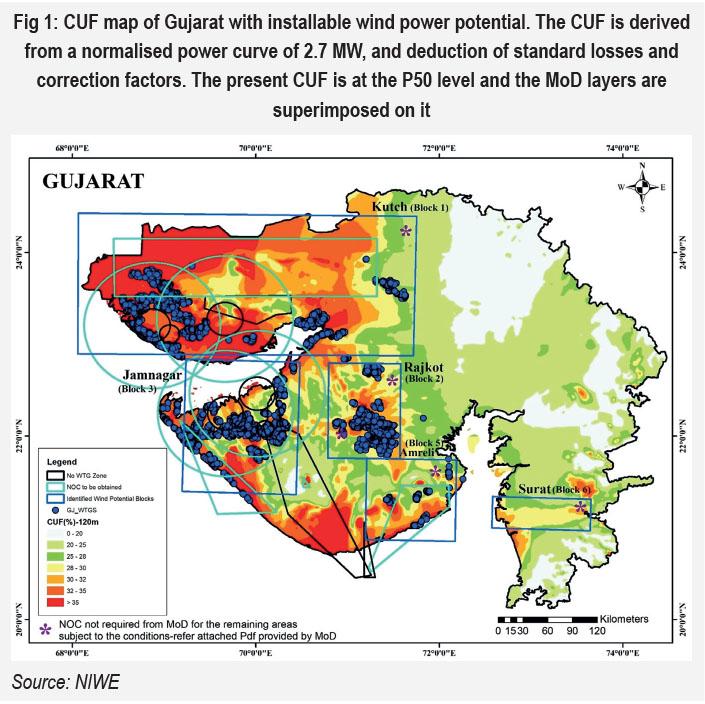
Figure 1 further demonstrates the CUF map of Gujarat with installable wind power potential. The CUF is derived from a normalised power curve of 2.7 MW of wind turbine technology, and the deduction of standard losses and correction factors. Grid availability of 95 per cent, machine availability of 95 per cent and transmission line loss of 3 per cent, considering the line from the respective wind turbine to the grid substation, with a fixed array loss of 10 per cent, is assumed to arrive at net CUF P50. The present CUF is at the P50 level. The present map is devoid of any exclusion areas.
The questions are: how many sq. km and how many GWs of high potential area have been wiped off because of the MoD’s notification, which prominent areas are affected and which areas need to be avoided? Preliminary research was carried out by superimposing the MoD layers on top of the CUF wind map at a height of 150 m above ground level after excluding unsuitable areas. The study indicates that a quantum of 2,100 sq. km of high potential area has been wiped out under the CUF range of 35-38 per cent, 2,200 sq. km under 38-40 per cent and 2,100 sq. km for 40-45 per cent. As much as 10 GW of installable potential capacity has been excluded under the CUF range of 35-38 per cent, 10 GW under 38-40 per cent and 9 GW over 40 per cent. The cumulative capacity is 29 GW, and this is a sizeable number. Exclusion zones with less than 35 per cent CUF have not been considered under this analysis because developers typically avoid investing in sites with such low CUF values.
On the ground level, with a cumulative exclusion of 29 GW of installable capacity, a significant portion of cultivable land must be avoided, particularly in the zones of Jafrabad on the state’s south coast (the Gulf of Khambhat) and Una. Jafrabad is amongst the highest potential zones in Gujarat and has an average annual wind speed of 7.5 m/s at 150 m. The pockets in Jafarabad have the potential to generate a CUF of more than 38 per cent with the utilisation of high-rated modern-day wind turbine technology featuring larger rotor diamteres and higher hub heights. Jafarabad is among the prime pockets; however, on account of the no-go zone, it must be avoided. When referring to a CUF of more than 38 per cent, we are stating the CUF as the probability of exceedance at 90 per cent confidence level.
In the districts of Amreli and Junagadh, which lie on the south coast of the state, high potential pockets such as Khambha, Dhari, Visavadar, Bilkha, Junagadh, Gondal, Jetpur, Kagavad, Dhank, Sadodar, Butavadar, Kalavad and Bhayavadar must be avoided, which otherwise has a good potential of achieving a CUF of over 35 per cent. The average annual wind speed in these pockets is approximately 7.5 m/s at 150 m height. There are meteorological masts set up by the NIWE in these pockets.
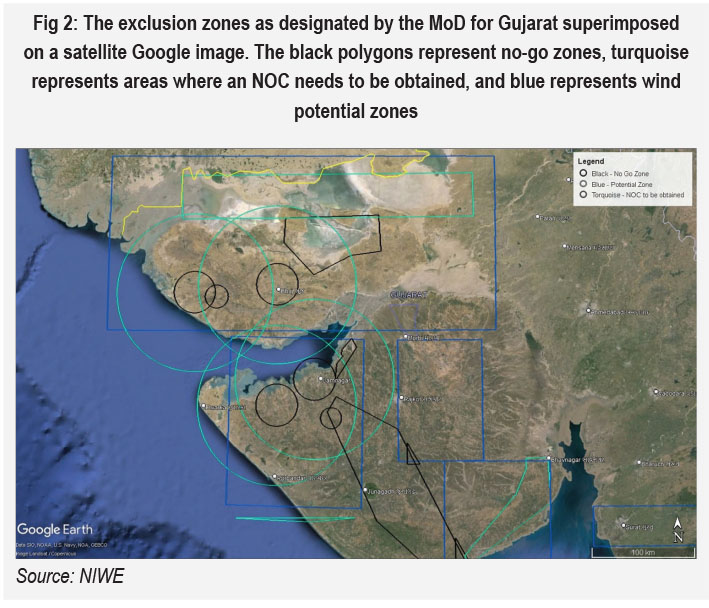
On the northern coast, wind pockets including Khambhalia, Khad Khambhaliya, Lalpur, Salaya, Jamnagar, Chella, Dhrol, Balachadi, Jodiya and particularly those in the districts of Jamnagar and Rajkot, are at higher risk and must be avoided. These areas have equal potential of achieving a CUF of over 38 per cent with high-rated modern-day wind turbine technology with large rotor diameters and higher hub heights. Potential zones in the Rann of Kachchh and Kachchh, including wind pockets in Bhuj such as Naliya, Jakhau, Ustiya, Kothara and Khanakpar, must be avoided. Areas in the neighbouring zones, particularly in Nakhatrana, Devpar, Netra, Ambara, Valka Mota, Dayapar, Rawapar, Valka Mota, Subhaspar, Ganduli, Pandhro, etc., which have seen significant development in the past three years, and form a large cluster with an installable capacity of roughly around 4 GW, cannot be further explored, having come under the no-go zone. This zone otherwise has the potential of achieving a CUF of over 35-38 per cent with high-rated modern-day wind turbine technology with large rotor diameters and higher hub heights.
In the extended areas of Bhuj towards the plain landscape, areas such as Nirona, Sarspar, Kukma and Mankuwa must be avoided. A significant portion of areas in the north of Kachchh, and some portions of Khavda, Khari, Daddhar Moti, Bhojardo, Trambau, Rav Moti, Vajepar, Rapar and Lodrani must be avoided, which otherwise have the potential of achieving a CUF of over 35 per cent.
This article primarily focuses on the zones that are to be avoided for any projects going forward. However, there are other zones with considerable high potential in terms of CUF that can be explored for future projects as they are not confined to any no-go zone, but require a no objection certificate from the MoD.
On the southern coast of the state, in the districts of Gir Somnath, Junagadh and Porbandar, areas such as Diu, Sutrapada, Keshod, Mangrol, Balej, Kutiyana, Kutiyana, Upleta, Porbandar, Lalpur, Manavadar, Bhanvad and Jamjodhpur can be explored. These zones have not witnessed wind projects during the past decade but have high potential, exhibiting average annual wind speeds of 7.0-7.2 m/s at 150 m. These areas have the potential of achieving a CUF of 35-38 per cent.
In the districts of Khambhaliya and Devbhumi Dwarka, the region along the coastline is open for operational projects and has not been confined to any no-go zone. Prominent zones such as Visavad, Raval, Lamba, Kalyanpur, Bhogat, Bhatiya, Madhi, Dwarka, Shivrajpur, Mithapur and Okha have been excluded from any no-go zone activities. These areas too have a very high wind potential.
In the districts of Amreli and Rajkot, areas such as Savarkundla, Mahuva, Sidsar, Bhavnagar, Babra, Jasdan, Ratanpar, Wankaner, Vaghasiya, Chardava, Morbi, Halvad and Malia can still be explored as these are medium to high potential zones.
On the northern coast (Rann of Kachchh and Kachchh) wind pockets of Bhuj such as Mundra, Mandvi, Kera, Gadhsisa on the coast, Nakhatrana, Nirona, Netra, Valka Mota, Hajipar, Dhordo, Hodka, Nirona, Dayapar, Gaduli, Umarsar, Lakhpat, Narayan Sarovar, Baranada, Vayor and Karamta on the plains can still be explored. These areas have already witnessed significant development, and still have enormous potential that can be explored further. These areas have the potential of achieving a CUF of over 35-38 per cent with high-rated modern-day wind turbine technology with large rotor diameters and higher hub heights.
While the MoD is manifesting no flight paths in the no-go zones, it may have its own security concerns, which, from a broader perspective, are in the interests of national security and defence. The demarcation of no-go zones for wind power projects by the MoD is a double-edged sword for the wind sector. While this initiative may enhance transparency, speed up the application process and mitigate risks for developers, it excludes some high potential areas, which will impact overall wind power development in the country.