

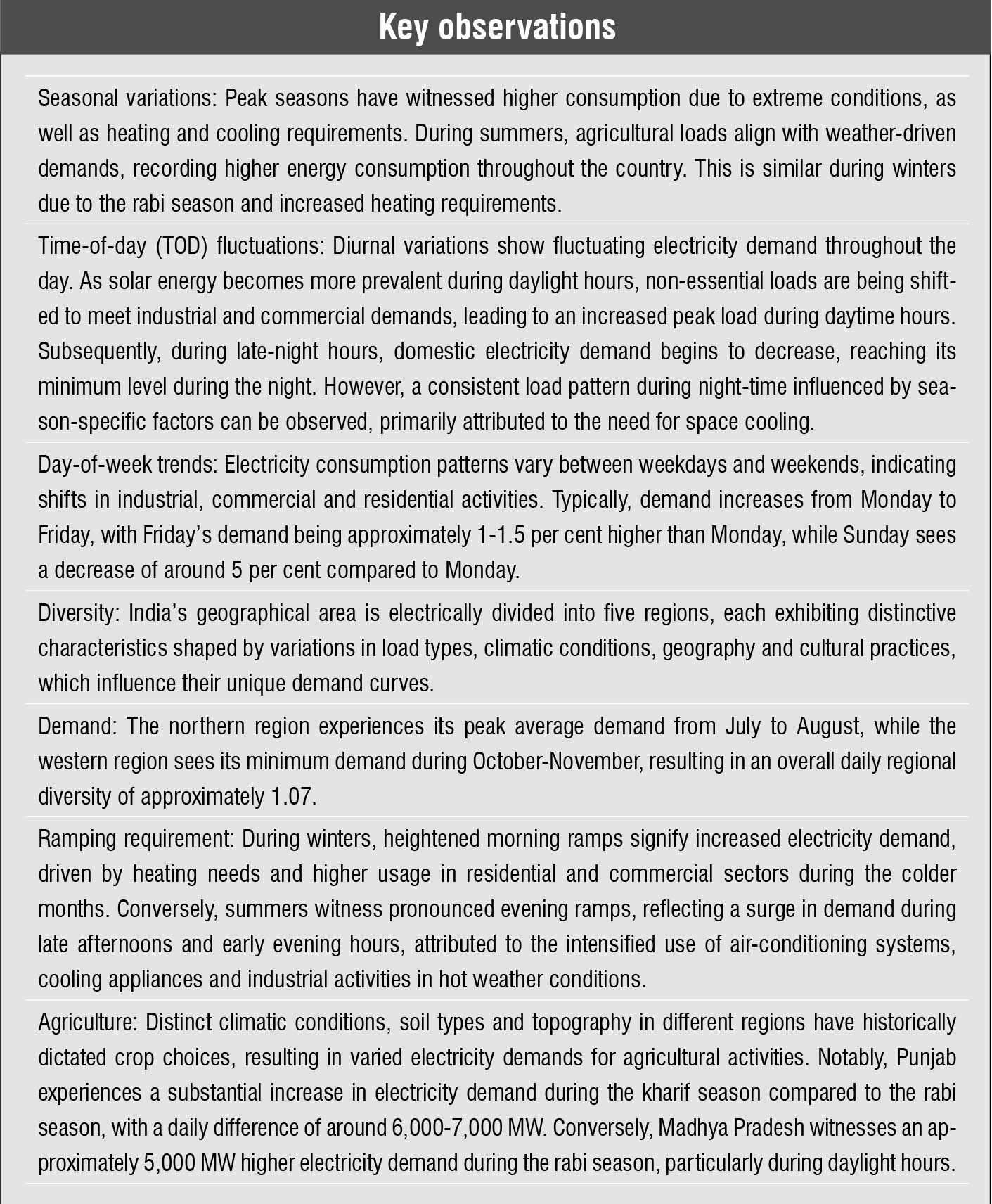
With the surging power demand in the country, a recent report from Grid Controller of India Limited (Grid-India) titled “Electricity Demand Patterns Analysis” provides insights into consumer demand and examines national -regional- and state-level electricity consumption and growth patterns, providing a comprehensive analysis on diurnal, seasonal and yearly patterns of electricity demand. The report notes that electricity consumption trends and peak demand hours across the country are significantly influenced by factors such as seasonal variations, time-of-day and day-of-week trends, and diversity in climatic geographical conditions and cultural practices. Key takeaways of Grid-India’s report.
Factors affecting demand met
Consumer behavior plays a key role in influencing the load profile of a state/region. Several factors, such as time, weather, diversity and economy, can have a significant impact on the load. The daily load is indicative of the nature of human activities carried out post sunrise, prior to sunset and during night-time. Differing consumer types and atmospheric temperatures can shape the curve depending on the usage requirements. For example, after sunrise, domestic loads increase as electrical appliances are switched on, followed by commercial and industrial loads during the daytime. Post sunset, domestic load rises again due to lighting and space cooling loads. The lifestyle of a population is another key factor that influences the demand from a particular region. During the weekend, electricity demand is at its lowest due to closed offices and peaks occurring during the mid-week, and has been observed to reach its maximum on Thursdays and Fridays. The load curve during a particular month responds to prevailing weather conditions. This has resulted in the formation of a unique daily load curve throughout the year for each month, which is repeated every year. Humidity and rainfall can also significantly contribute to the surge in domestic, commercial and agricultural consumer demands, influenced by fluctuations in temperature.
In India, states such as Maharashtra, with a major industrial load, have relatively lower domestic loads than Delhi, which has mostly domestic and commercial loads. Unlike commercial and domestic loads, industrial load does not vary much throughout the year. Economic factors such as purchasing capacity, rapid industrialisation and per capita income of the population have shown a positive correlation with per capita electricity consumption, attributed to the increase in demand growth. The impact of festivals and cultural habits, especially during solar eclipses, is significant in India. The country witnessed a drop of approximately 25-30 per cent in total demand met during the lockdown imposed due to the Covid-19 pandemic. Further, the introduction of electric vehicles (EVs) into the market has not only revolutionised transportation but has also increased the demand for energy.
Regional diversity in demand
India, with its diverse landscape, can experience contrasting loads. Different geographical conditions, climate and cultural practices play a significant role in shaping the demand curve. The northern region of the country witnesses maximum demand met from July to August, while it is minimum in the western region during the same period and the reverse during October-November. Peak demand and ramp-up rates also vary across different regions during the daytime. Synchronising the electricity demand of all the regions can substantially contribute to meeting the overall demand. The benefits of synchronising demand peaks across regions underscore the need for a coordinated and integrated approach to power system planning and operation.
The power industry can successfully meet demand changes while guaranteeing optimal resource usage by addressing regional variations and adjusting the generating and transmission infrastructure accordingly. Ramp diversities are a crucial factor in optimising power system planning for grid operators and policymakers. It helps in anticipating fluctuating electricity demand and increasing efficiency in power generation and transmission to ensure overall system stability. The varied landscape and climatic conditions in the country also yield a diverse range of crops, resulting in varied electricity requirements. For instance, Punjab, with its hot and dry climate, demands higher electricity during the kharif season (summer cropping period) and low electricity during the rabi season (winter cropping period).
Challenges and opportunities
Balancing electricity supply and demand is one of the key issues that the sector faces, especially during non-solar peak hours. Flexible resources are necessary to address additional generation and ramping requirements during this period. The demand pattern during solar eclipses has shown an average demand reduction of approximately 3,972 MW during the eclipse, followed by a sudden hike of 6,372 MW after the eclipse. Flooding and cyclones can extensively damage infrastructure and lead to power outages, which require immediate attention for restoration.
Precipitation levels can significantly affect hydropower plants, making climate an important factor to consider in managing electricity demand and supply. Advancements in technology, especially the adoption of EVs and smart appliances, contribute to evolving demand patterns. The integration of renewable energy sources also affects demand dynamics due to their intermittency. Moreover, the increasing uptake of rooftop solar poses challenges in demand forecasting.
 Key takeaways
Solar generation during summers and winters significantly differs due to changes in the durations of daylight hours. In winters, from 6 a.m. to 8 a.m., solar power generation is insufficient to meet the increasing load demand during this period, which is not the case in summers. Operational risks and costs can be reduced by planning asset maintenance and despatch strategies for improving demand systems. To enhance coal flexibility, the minimum generation levels of coal should be at least 40 per cent, and two shifts for coal-fired units should be encouraged. Undertaking measures such as demand-side management, demand response and staggering supply hours to bulk consumers can positively enhance demand elasticity. Policies should be formulated to harness transnational diversities and establish transnational interconnections. It is important to note that the load recorded at load despatch centres typically excludes rooftop solar capacity and captive generation, placing the responsibility on the transmission system. The cooperation between these components becomes vital for managing peak demand and supply. Continuous analysis and monitoring of consumption at the intra-state level are crucial for understanding sectoral consumption patterns. This is important for making informed decisions and accordingly planning for various infrastructure projects. Further, encouraging energy storage can effectively address ramping requirements to provide capacity during peak non-solar hours.
To conclude, the report provides valuable insights and perspectives for planning authorities regarding power generation, transmission and distribution. These insights into electricity demand patterns and future electricity requirements are vital for resource adequacy planning, formulating power procurement strategies, establishing new generation facilities and developing efficient transmission and distribution systems.
By Muskan Aggarwal
