As the world moves towards net zero, economies across the globe are devising and implementing different strategies. The adoption of clean mobility solutions is one of the major moves planned by countries to reduce their dependence on fossil fuels. Electric vehicles (EVs) are considered ideal substitutes to traditional vehicles that run on internal combustion engines, and batteries are the most important component of these EVs. A lot of research and development has been going on in battery technologies to improve power density and extend battery lifespan.
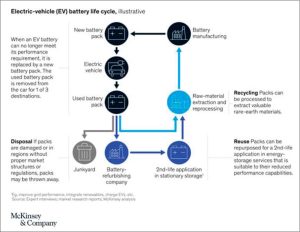
As per a report by NITI Aayog, the total cumulative demand for electric vehicle batteries (EVBs) is expected to reach around 381 GWh by the end of 2030. This development is expected to be driven by a 50 per cent compound annual growth rate in EV sales by 2030. With this increasing use of EVBs, it is very important to address effective mechanisms for managing the batteries after their end of life (EOL). As per a report by McKinsey & Company, manufacturers have three options when an EVB reaches the end of its useful first life: disposal, recycling of valuable metals or reuse. When battery packs are damaged or located in regions without an appropriate market infrastructure, disposal is often the most common method. However, unplanned and excessive accumulation of battery waste built up by disposal can have severe environmental consequences. Thus, it is crucial to recycle or reuse old EVBs while following a circular economy perspective.
Efforts to manage EVBs once they reach their EOL are currently lacking in India. Thus, challenges related to battery recycling and waste management after their EOL can become a major concern especially with the increase in the adoption of EVs expected in the future. However, mapping a sustainable battery value chain can be a game changer for the EV industry. Thus, well-regulated management of EVBs after they reach their EOL is required to facilitate rapid EV adoption. EVB recycling is a promising and effective EOL management solution. This solution, although yet to be implemented, has enormous untapped potential in India.
Need for EV battery recycling
According to a report by NITI Aayog on “Advanced Chemistry Cell Battery Reuse and Recycling Market in India”, the following factors highlight the urgent need to work towards EVB recycling.
Environmental hazards
Used EVBs generate a lot of waste over time. The E-Waste (Management and Handling) Rules, 2011, the E-Waste (Management and Handling) Rules, 2016 and the E-Waste (Management) Amendment Rules, 2018 are the legislations that are now in force in India. Although they specify a variety of recyclable materials, precise guidelines for proper disposal of EV batteries are still missing. Mostly, batteries end up in landfills as the rising volumes of battery waste are not addressed within a reliable recycling ecosystem. Hazardous heavy metals are used in making these EVBs and left untreated they can further contaminate the soil and groundwater. Additionally, harmful gases are released during treatment operations and informal recycling can increase environmental risks.
Self-reliance for resources
The rare metals required for the production of cell components are quite scarce in India. For the booming EV industry in the country, either the cell components or the raw materials have to be imported to keep up with the demand for EVBs. If batteries are recycled they can become a source for these rare metals. According to the report, 95 per cent of metals can be recycled using recycling technologies and further be used to produce new batteries. This would reduce imports and the reliance on other countries for raw materials used in battery manufacturing.
Geopolitical risks
With insufficient infrastructure and limited resources, there are chances of geopolitical risks associated with import of raw materials needed for EVBs. Some of these risks are supply chain disruptions, political instability, and the pandemic, which can have a direct impact on the price of EVBs as well as EVs.
Effective price mechanism
One of the greatest risks considered by financial institutions while mobilising funds for the EV industry is its resale risk due to the absence of a second-hand or EV resale market. The creation of a well-established reuse or recycle ecosystem can help in the discovery of the resale value of batteries as well as EVs. This will increase the availability of EV financing, thereby increasing EV adoption in the country.
In addition to the above parameters, a well-established battery recycling mechanism can help industry players optimise their costs by using recycled material from batteries. This would further help in bringing down the cost of procuring fresh metals either domestically or through imports. In the long run, this can make the supply chain more effective for businesses.
Attaining a sustainable battery value chain
According to a McKinsey & Company report, EV batteries are designed for yielding high performance, keeping in consideration factors such as charge and discharge rates, life cycle and thermal tolerance. These batteries are usually retired at an 80 per cent state of health and can still contain some healthy modules at their EOL which can be further reused directly for other EV applications. Alternatively, EOL battery packs can be further deployed for other stationary storage applications.
Recycling and reusing batteries is paramount for achieving a sustainable battery value chain. According to various studies, batteries can be recycled using a variety of processes involving key technologies such as mechanical recycling, pyrometallurgy and hydrometallurgy. Higher rates of metal recovery are possible in batteries when these technologies are used in addition to pretreatment. Several hundreds of cells in an EV battery must be tested to determine the overall health of the battery while ensuring no cell damage.
Recent developments
In 2020, the Ministry of Environment, Forest and Climate Change (MoEFCC) released the draft Battery Waste Management Rules to replace the Batteries (Management and Handling) Rules, 2001. The draft rules include all types of batteries, regardless of shape, volume, weight, material composition or use as well as all equipment that use batteries. The draft rules aim to ensure safe and formalised battery recycling, with a focus on tracking batteries that have reached the end of their useful life via online records and data management.
In July 2022, Ola Electric announced a $500 million investment for the establishment of its state-of-the-art Battery Innovation Centre (BIC) in Bengaluru. The BIC will house superior cell research and development facilities with over 165 unique and cutting-edge lab equipment to address all aspects of cell-related research and development. According to the company, the centre will be capable of developing entire packages of battery pack design, fabrication and testing. The centre will also have in-house production facilities for anode and cathode materials from mg to kg scale and an integrated unit for nanoscale analysis and molecular dynamics modelling. Further, it will have a facility for crystal structure analysis to create novel battery materials. The BIC will house prototype lines capable of producing all form factors such as cylinder, pouch, coin and prismatic cells.
In August 2022, Metastable Materials, a Bengaluru-based urban mining start-up, inaugurated its research and development and innovation centre in Bengaluru. The company has devised a chemical-free process that helps in extracting precious materials such as copper, aluminium, cobalt, nickel and lithium from lithium-ion batteries that are nearing the end of their useful lives. The company plans to eventually process up to 600 tonnes of EoL lithium-ion batteries per year.
Outlook
The expansion of the EVB recycling segment and the reuse of such batteries is essential for the EV industry to expand sustainably. However, the recycling segment has not yet been explored much owing to poor knowledge regarding recycling costs, inadequate technological support, less policy advances, poor regulatory framework and uncertainties regarding the viability of the second-use EVB market. Thus, stringent efforts to bridge the gaps through supportive policies are needed to augment the EVB recycling market. A robust battery recycling system would help in the creation of a circular and sustainable battery market in India.