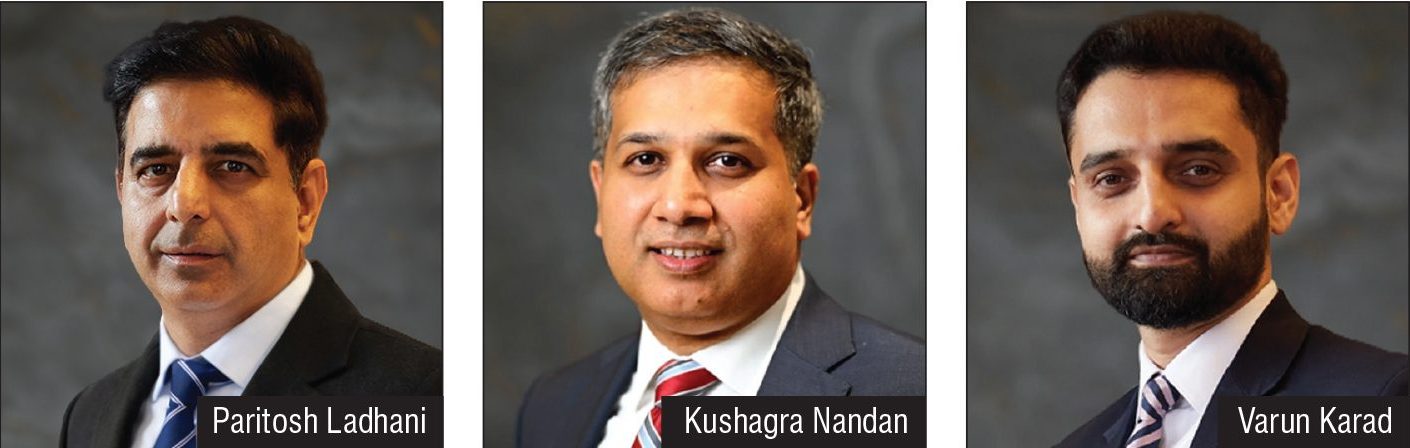
 Launched in 2026, LNK Energy aims to position itself as an integrated clean energy platform across the renewable value chain, spanning advanced solar manufacturing, renewable power generation and emerging green fuels. In an interview with Renewable Watch, Paritosh Ladhani, Kushagra Nandan and Varun Karad, Co-Founders, LNK Energy, discussed the motivation behind the platform, their green fuel and hydrogen strategy, how they plan to navigate the current global uncertainty, their concerns regarding manufacturing overcapacity and the company’s future growth plans. Edited excerpts…
What motivated you to build an integrated platform across the entire clean energy value chain rather than focusing on a single segment?
LNK Energy has been conceived at a time when energy security, industrial self-reliance and decarbonisation have become national priorities for India. The objective has been to build a long-term institution in clean energy rather than pursue short-cycle opportunities in a rapidly evolving sector. Clean energy manufacturing and infrastructure must be approached with the same discipline, scale mindset and execution rigour that characterises large industrial businesses. Technology decisions made at the manufacturing stage directly influence the performance of renewable power projects. Fragmented participation across the value chain may deliver short-term gains, but it does little to build durable industrial capability.
An integrated platform that combines manufacturing, renewable power generation and green fuels can improve supply chain visibility, enable better technology adoption and potentially enhance operational efficiency over the long term. At the same time, the energy transition is expanding into areas such as energy storage and green hydrogen. Companies that develop capabilities across multiple segments of the energy ecosystem may be better positioned to participate in these emerging opportunities. Our goal is to contribute to building India’s clean energy industrial base with patient capital, strong governance and global quality execution. Hence, LNK Energy plans to invest Rs 100 billion over the next five years toward building an integrated ecosystem of manufacturing, renewable energy generation and emerging clean energy technologies.
Can you outline the key milestones and timelines for the planned 6 GW facility at Chhatrapati Sambhaji Nagar, Maharashtra? Which technologies do you plan to produce?
Our manufacturing facility in Chhatrapati Sambhaji Nagar, Maharashtra, represents the first major step in building LNK Energy’s integrated clean-energy platform. The facility is planned as a 6 GW solar manufacturing complex covering solar cells and modules, with plans for phased backward integration into ingot and wafer manufacturing over time. It will focus on automation, process efficiency and internationally benchmarked production practices. Development will take place in stages. Our current timeline targets the commencement of module manufacturing by FY 2026, followed by solar cell production. Ingot and wafer manufacturing may be added as part of a phased backward integration strategy over the subsequent two to three years. Land for the project has already been secured, and the process of identifying equipment suppliers and engineering partners is under way.
From a technology perspective, the facility is being designed around high-efficiency TOPCon-based cell architectures, which currently represent a widely adopted technology in crystalline silicon solar manufacturing. At the same time, it will have sufficient flexibility to adapt to technological developments as the industry evolves. The Project is being developed as a private industrial investment. The intention is to develop manufacturing capabilities that can operate competitively within the broader global solar supply chain.
Do you plan to produce solar components primarily for the domestic market or are export targets also part of your strategy?
In the near term, our primary focus will be on the domestic market. India’s solar deployment trajectory over the next decade suggests sustained demand for high quality, domestically manufactured solar components. The country has set ambitious renewable energy targets and electricity demand continues to grow steadily. Policy initiatives aimed at strengthening domestic manufacturing are also improving demand visibility.
Moreover, our approach is not simply to compete on volume, but to build globally competitive, integrated manufacturing capacity that prioritises quality, reliability and long-term performance. As solar becomes a core part of national energy infrastructure, product quality and technology will become increasingly important differentiators in the market. Over time, as our manufacturing platform scales and operational efficiencies are achieved, we will evaluate export opportunities in select international markets. India will remain one of the most important solar markets globally and our immediate priority is to participate meaningfully in the domestic market.
How do you plan to manage supply chain risks amid the current global uncertainty (such as US tariffs and ongoing geopolitical conflicts)?
Supply chain resilience has become one of the defining themes for renewable energy manufacturing globally. Hence, our approach to managing these risks rests on three pillars: gradual integration, strategic partnerships and diversification.
First, building a platform with deeper integration across the manufacturing value chain. Capabilities in ingot, wafer and cell as well as advanced manufacturing processes will increasingly determine supply chain resilience and technological competitiveness. Second, long-term partnerships with technology and equipment providers are important for ensuring stability in manufacturing operations. These partnerships enable better coordination on technology upgrades, quality standards and production timelines. Third, the diversification of suppliers across geographies is essential. Relying on a single source for critical materials or equipment can create vulnerabilities. Building relationships with multiple suppliers helps improve supply visibility and reduces operational risks.
India’s policy initiatives aimed at strengthening domestic renewable manufacturing are also helping create a more stable ecosystem for investing in large-scale manufacturing. In the long run, countries and companies that build deeper industrial capabilities across the clean energy value chain will be far more resilient than those that depend on fragmented global sourcing.
LNK Energy announced plans across green fuels and green hydrogen. What opportunities do you see in this space, and how do these plans fit into your broader clean energy strategy?
Green fuels and green hydrogen are expected to play an important role in the global decarbonisation journey, particularly in sectors that are difficult to electrify such as heavy industries, refining, shipping and certain transport segments. India has articulated its ambitions through the National Green Hydrogen Mission. The country benefits from abundant renewable resources and a large industrial base that could serve as an early adopter of green hydrogen.
Our interest in this space is therefore aligned with our broader strategy of building a diversified clean energy platform. Advanced manufacturing and renewable power generation provide the foundational capabilities required for future green hydrogen production. Once our manufacturing platform is operational, we intend to progressively expand into green fuels with a strong emphasis on green hydrogen. While the sector is still evolving and economics will continue to improve over time, there will be significant long-term opportunities in building scalable, technology-driven solutions. We are currently evaluating multiple technology pathways and partnerships and expect to enter this segment over the next couple of years.
What are your views on overcapacity concerns and decreasing demand for manufacturing in the market? How do you assess the demand-supply balance and what will be LNK’s strategy?
The discussion around overcapacity in solar manufacturing often focuses on nameplate numbers, but the reality is more nuanced. If one looks purely at installed manufacturing capacity, it may appear that the market is oversupplied. But when the technology mix, efficiency levels and the degree of integration across wafers, cells and modules are examined, the picture changes significantly. A large portion of existing capacity is based on earlier technologies, while the industry itself is transitioning towards higher efficiency cell architectures and more integrated manufacturing systems. Not all installed capacity is equally competitive. Manufacturers that adopt newer technologies, improve efficiency and build integrated production systems will be better positioned to remain competitive.
At the same time, the demand fundamentals remain strong. Global electricity demand continues to rise and solar power remains one of the most cost-effective sources of new generation. As economies grow and sectors such as transport, hospitality, and manufacturing increasingly shift towards electricity, overall power consumption is expected to expand significantly. These structural trends, combined with geopolitical volatility in fossil fuels, will continue to underpin long-term demand. Solar manufacturing cycles are inevitable in a fast growing industry and navigating them requires patient capital and long-term industrial thinking. Our focus is therefore on building a technology-driven manufacturing platform with strong operational efficiency and integration across the value chain.
What are your future targets?
Over the next three to five years, our priority is to establish LNK Energy as a credible and competitive platform within the renewable energy ecosystem. Moreover, we have three key targets. One, successfully commissioning and scaling our manufacturing facility in Maharashtra. Two, expanding our presence across renewable generation through independent power producer project and hybrid open access solutions for commercial and industrial consumers. Three, continuing to explore opportunities in adjacent areas within the clean energy ecosystem, including green hydrogen and green fuels where they align with our long-term strategy.