India’s renewable manufacturing landscape has undergone a significant transformation over the past few years, supported by strong policy incentives and growing localisation across solar and wind components. However, the industry still faces key gaps in upstream materials, advanced steel availability, skilled manpower and stable raw material supply, keeping it partly dependent on imports. Global supply chain diversification is creating new opportunities but also demands greater resilience and technology upgrades. With deeper integration, clearer taxation, improved financing and continued innovation, India is poised to strengthen its position in the global renewable manufacturing landscape. In this context, leading solar and wind manufacturers discuss the state of the sector. Edited excerpts…
What are the most pressing issues facing India’s renewable energy manufacturing industry?
Dr Govind Bhagwatikar
India’s renewable energy manufacturing sector stands at a moment of significant opportunity, yet the path to global competitiveness is constrained by several structural challenges. The most pressing among these is the limited depth of the upstream value chain. While module, tower and nacelle assembly capacities have expanded, India continues to rely heavily on imports for polysilicon, ingots, wafers, high-efficiency cells, specialty gases, advanced glass and power-electronics components. This dependence exposes manufacturers to volatile global pricing, supply disruptions and geopolitical risks. In parallel, the industry must keep pace with rapid global technology transitions. Solar technologies are moving rapidly toward TOPCon, HJT and perovskite tandem cells, while the wind sector is advancing to 5-8 MW+ turbine platforms. These shifts require significant capital investment, advanced manufacturing capabilities and specialised engineering talent – areas where the domestic ecosystem continues to develop.
Economics also play a central role. High industrial electricity tariffs, logistics bottlenecks and limited availability of ultra-high-purity materials raise the cost of production. Moreover, access to long-tenor, affordable financing remains constrained despite the sector’s capital-intensive nature. Bridging this financing gap is essential for manufacturers to scale efficiently and remain competitive in global markets.
 Gyanesh Chaudhary
India’s renewable manufacturing sector is expanding rapidly, yet a few structural barriers continue to limit its full potential. A major constraint is the country’s heavy reliance on upstream imports of wafers, ingots and encapsulants, which leaves manufacturers vulnerable to global price swings and supply disruptions. Strengthening domestic capacity across these segments is essential for long-term stability.
At the same time, India’s manufacturing ecosystem needs stronger backward integration. Even as module production has scaled, domestic capabilities in cells, wafers and polysilicon remain insufficient to build a fully self-reliant value chain.
Adding to these challenges is a widening talent gap. The pace of clean energy manufacturing growth is outstripping the availability of skilled engineers and technicians. Overcoming import dependence, integration gaps and workforce shortages is critical for India’s clean energy leadership.
Dr Saravanan Manickam
In the wind energy segment, the most significant challenge is competing with China, where raw materials are much cheaper and manufacturers benefit from stronger infrastructure support, better working capital facilities, lower electricity costs and various incentive schemes. Indian wind manufacturers also struggle with shortages and high costs of critical components such as bearing materials, several key metals, magnets for yaw systems and large castings, all of which are either expensive or not readily available domestically.
In addition, the sector remains heavily dependent on Europe for essential electronics such as sensors, IGBTs and control systems. Although the Make in India initiative has enabled high localisation, manufacturers still need targeted government incentives, specifically for supply of bearing materials, rare metals, magnets and large castings to improve global competitiveness and strengthen the export market.
 Vinay Rustagi
The lack of homegrown technology expertise and the continued dependence on other countries for everything from core technology to materials and minerals, capital goods and components remain the biggest vulnerabilities for the sector. Another major challenge is uncertainty in global trade. On the one hand, securing reliable upstream supplies is becoming increasingly difficult; on the other, export prospects are being undermined by volatile tariffs and anti-dumping duty regimes. There is also an acute shortage of adequately trained manpower across the board, from highly skilled, senior technical resources to semi-skilled shop floor staff.
Hardip Singh
We have been manufacturing modules for over two years, with a current capacity of 6.5 GW. The biggest challenge is the lack of trained manpower. As this sector has only recently started expanding, the demand for skilled workers has surged sharply. We have addressed this by hiring freshers from local skill development centres and training them in-house. So far, this approach has worked well.
The second challenge relates to raw material supply chains, which can be unstable due to geopolitical factors. To mitigate this, we are de-risking by diversifying our supplier base, sourcing from both within India and from markets beyond China. This strategy has helped us stabilise operations to a great extent.
 Hemanshu Sugandhi
The key challenge we face is the limited availability of the specific steel grades required for tracker systems. These systems need advanced materials such as zinc-aluminium-magnesium alloy steel with self-healing properties to ensure long-term durability, but the domestic manufacturing capacity for such materials is very limited. While the government’s mandate to use locally made steel is a positive step, we need to ensure adequate supply and quality to support large-scale manufacturing.
Another issue is taxation clarity. Trackers, though used in solar projects, often get classified as steel products rather than solar components, leading to confusion about the applicable tax rates. Finally, land acquisition remains a major market challenge. Tracker systems are site-specific, and delays in securing land often disrupt project execution timelines.
How are global supply chains transforming, and how does this impact manufacturers?
Dr Govind Bhagwatikar
Global supply chains are undergoing fundamental restructuring, driven by geopolitical realignment and the need for greater resilience. Across the US, the European Union and the Indo-Pacific, procurement strategies are increasingly influenced by “China+1”, “friend-shoring”, and “near-shoring” considerations. These shifts offer India a window to position itself as a reliable alternative manufacturing hub. Global interest in India is rising, creating new opportunities for joint ventures, co-development models and long-term offtake arrangements. Export prospects are expanding as companies seek diversified sourcing partners. However, global overcapacity and rapidly shortening technology cycles pose challenges. Indian manufacturers must, therefore, strengthen backward integration, adopt digitalised supply chain management and prepare for emerging global requirements related to low-carbon and improved manufacturing practices.
Gyanesh Chaudhary
The global renewable energy supply chain is undergoing disruptive restructuring due to geopolitical changes, trade adjustments and post-pandemic diversification goals. Countries are adopting “China+1” strategies to decrease concentration risk, driving significant momentum for Indian manufacturers.
As global buyers diversify sourcing, India is rapidly emerging as a competitive alternative, driven by government incentives, improving quality and accelerated capacity expansion. Over the past two years, manufacturers have added substantial capabilities across the value chain: module capacity has crossed 100 GW, cell capacity has surged with production-linked incentive (PLI) investments, multiple players are scaling to gigawatt-level wafer and ingot lines, and new commitments to polysilicon signal an upstream shift.
Dr Saravanan Manickam
The Asia-Pacific region has emerged as the primary hub for wind turbine manufacturing. This places Indian manufacturers in direct competition with China, where raw material costs are lower and companies benefit from superior infrastructure and various incentive schemes. On the labour front, however, India remains highly competitive due to its low labour costs and a large pool of skilled labour available for component manufacturing. At the same time, several critical electronic components, including sensors, IGBTs and control systems, are mainly available in Europe, creating continued dependence on external suppliers.
Vinay Rustagi
China has been dominating the global solar supply chain, and many countries including India are looking to diversify their exposure. However, finding alternative suppliers takes time, and often means additional costs as well as compromises in quality, lead times and after-sales service support.
Hardip Singh
The key focus is on de-risking supply chains by reducing dependence on any single market or source. We are increasingly sourcing from Indian suppliers as well as other international markets beyond China.
Given that global supply disruptions are often driven by unpredictable geopolitical factors, diversification has become essential for maintaining stable and secure manufacturing operations.
Hemanshu Sugandhi
Before Covid-19, manufacturers operated through centralised hubs supplying globally. The pandemic disrupted logistics and highlighted the need for regional supply chains. Post-Covid, project sizes increased, and customers demanded faster deliveries and local sourcing to reduce risks. Nextpower, formerly known as Nextracker, has since localised 95 per cent of manufacturing in India.
We have moved from a single global hub to multiple regional manufacturing hubs, bringing production closer to markets and enhancing resilience. This strategy has helped us mitigate risks from disruptions such as the Red Sea shipping crisis and strengthen supply chain reliability.
What has been the impact of key policy measures to promote local manufacturing? What more needs to be done?
Dr Govind Bhagwatikar
India’s policy landscape has played a key enabling role in driving the sector’s current momentum. The PLI scheme, basic customs duty, the Approved List of Models and Manufacturers (ALMM), GST restructuring, ISTS waiver-linked domestic sourcing and targeted state incentives have together stimulated multi-gigawatt investments across solar and wind manufacturing. These policies have improved capacity utilisation, boosted investor confidence and encouraged the development of integrated facilities.
The next stage of policy evolution must shift towards technology sophistication, deep upstream integration and export competitiveness. Priority areas include incentivising polysilicon and wafer manufacturing, supporting advanced materials and power semiconductor production, strengthening national research and development (R&D) and testing infrastructure, expanding renewable-powered industrial clusters, and improving logistics efficiencies. Equally important is expanding access to concessional and long-tenor capital, enabling domestic manufacturers to scale in line with global benchmarks.
Gyanesh Chaudhary
India’s renewable energy manufacturing sector has witnessed remarkable growth, driven by visionary policy interventions that have accelerated the shift from import dependence to self-reliance. Initiatives such as the PLI scheme, ALMM and the introduction of basic customs duties have catalysed domestic investment, raised quality standards and created a robust foundation for sustainable growth across the solar value chain.
As a direct result of the PLI scheme, India has added 18.5 GW of module, 9.7 GW of cell and 2.2 GW of ingot-wafer manufacturing capacity as of June 2025. Overall, the country’s module capacity has surpassed 125 GW, with rapid scaling under way in upstream segments. Complementing this, renewable purchase obligations, rising from 24.61 per cent in FY 2023 to 43.33 per cent in FY 2030, are providing a clear, long-term demand signal that reduces investment risk and encourages capacity expansion.
The imposition of basic customs duties (20 per cent on solar cells and modules) and the Agriculture Infrastructure and Development Cess has also reinforced India’s commitment to building domestic competitiveness and resilience. Together, these measures have anchored a stronger, more integrated renewable manufacturing ecosystem.
Looking ahead, the focus must turn upstream to domestic production of polysilicon, wafers and ingots to ensure technological self-sufficiency and global competitiveness. Long-term policy stability, better alignment between manufacturing incentives and deployment targets, and continued investment in R&D, skill development and infrastructure will be pivotal. These steps will strengthen India’s position as a global leader in clean energy manufacturing and innovation.
Dr Saravanan Manickam
Policy measures such as the Make in India initiative have had a significant impact on promoting local manufacturing. As a result, Nordex has been able to localise around 90 per cent of its components and meet roughly 70 per cent of its cost structure within India. However, moving forward, the government needs to provide incentives or schemes for items such as bearing materials, bigger casting, forging like main shaft and rare metals, tower logistics including steel as this would make our products extremely competitive in the export market.
Additionally, to reach the national goal of 100 GW of installed wind capacity by 2030, the government must work more closely with both the central and state authorities to resolve issues pertaining to right of way, grid availability, land allocation and grid allotment.
Vinay Rustagi
With strong optimism supported by the government’s Make in India commitment, the domestic manufacturing sector is undergoing a complete transformation. Many new players have entered the sector, existing players are scaling up capacities, and backward integration is under way. New financing routes including bank financing and public markets have opened up. But the aspiration to become fully self-sufficient is a long haul. We need to invest more in domestic R&D, skill development, and finding alternative sources of raw materials and capital goods.
Hardip Singh
Government measures have had a very positive impact. When the ALMM policy was enforced last year, the domestic module manufacturing capacity jumped from 20-30 GW to nearly 120 GW, and it is expected to reach 150 GW by the end of this financial year.
Similarly, the announcement of the ALMM policy has triggered a wave of new investments in cell manufacturing, and we expect similar growth soon in wafer production. This is a policy-driven industry, competing with markets that often operate below cost. Hence, government support and protection are essential. Measures such as import duties, ALMM and the PLI scheme have provided strong incentives for local manufacturing. We are one of the beneficiaries of the PLI Scheme and overall, these policies have been instrumental in driving growth.
Hemanshu Sugandhi
Any push for local module manufacturing benefits trackers as well. Greater localisation of cells and modules drives ecosystem growth. In the short term, limited supply can affect module pricing. Higher module prices make trackers more viable, as they help optimise land and reduce the number of modules required per project. In the long term, the policy shift towards round-the-clock and hybrid projects rather than stand-alone solar is positive for trackers. Trackers enable more consistent generation profiles and work well with battery storage systems that need steady power output.
The concern is that if module supply remains constrained, developers may delay projects, shrinking near-term market opportunities. The focus now should be on bridging the gap between announced and actual manufacturing capacities.
What trends do you anticipate in the renewable energy manufacturing sector in the coming years?
Dr Govind Bhagwatikar
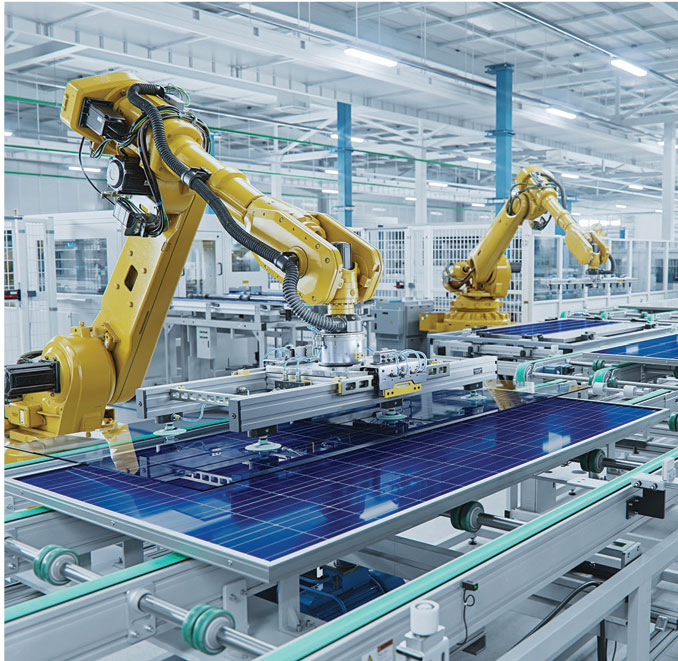
The next decade will be defined by technology-led growth. Solar manufacturing will transition to n-type architectures, larger wafer formats and high-throughput deposition technologies. Wind will move toward larger, lighter and more digitally integrated turbines. Industry 4.0 technologies – AI-enabled inspection, robotics and predictive analytics – will become essential for quality and yield optimisation. New sub-sectors such as battery cells, electrolysers, fuel cells, long-duration storage and offshore wind components will add depth to India’s manufacturing ecosystem. As global supply chains diversify, India is well-positioned to emerge as an export-driven renewable manufacturing powerhouse, provided policy continuity, technological advancement and cost competitiveness move in tandem.
Gyanesh Chaudhary
The renewable energy manufacturing sector is entering what may be its most transformative decade. India has become the world’s third largest solar energy producer with a total installed capacity of 125 GW, and we expect further expansion to pursue the goal of 500 GW by 2030.
Integration across the value chain will be a critical trend. Manufacturers are increasingly moving beyond modules into cells, wafers and battery energy storage systems to provide complete clean energy solutions. In line with this trend of competitiveness, technology evolution will continue to play a key role. Next-generation solar cell technologies such as N-Type, HJT, back contact technology and silicon-perovskite tandems, combined with AI-driven quality systems and a higher level of automation, will optimise efficiency and lower production costs.
As global supply chains diversify, export opportunities will position India as a critical player in the world’s clean energy network. The next phase of growth will be centred on integration, innovation and sustainability.
Dr Saravanan Manickam
The wind segment is expected to see increasing focus on artificial intelligence and cybersecurity. This is something every player is working on. Manufacturers are also moving towards larger rotor diameters and higher tower heights to efficiently harness wind in areas with lower wind potential. This shift reflects a broader technological trend of designing turbines that can operate effectively across varied wind conditions.
Repowering is a major opportunity for the wind sector. But it faces several challenges that need to be addressed in order to promote uptake. Most older wind farms operate with kW machines, while today’s turbines are typically 3 MW. Replacing the older machines with these new ones will require much larger fall-off distances and additional space, making replacement difficult. Clear guidelines are also needed for blade disposal at the end of the turbines’ operational life.
Furthermore, repowering must be driven by the government, especially since changes would be needed to power purchase agreements, and older turbines of 30–35 years must be removed or replaced. Hence, for repowering, policy support, safety requirements and government efforts need to work in tandem.
Meanwhile, progress in the offshore wind segment will take time and will depend on resolving several foundational challenges. The government has already taken an important step by allocating around Rs 72 billion for developing offshore wind infrastructure, and states such as Tamil Nadu and Gujarat offer strong potential in this segment. However, good wind resource locations are located nearly 100 km from the shore, making it essential to develop robust infrastructure to harness this energy. There is still a lack of clarity on who would be responsible for building the infrastructure like the interstate transmission system (ISTS).
Offshore wind projects also face high costs, with 60-65 per cent of the expenditure associated with equipment and the remaining 35-40 per cent linked to erection and commissioning, making project viability a key concern. Although India has abundant onshore wind potential, offshore wind presents a promising long-term opportunity given its consistent year-round availability.
The outlook for the wind power segment is positive, and achieving 100 GW of installed wind capacity by 2030 is feasible and promoting global wind export from 10 per cent to 20 per cent as per government direction, provided key issues are addressed. These include challenges related to the grid, right of way and land allocation. If these problems are resolved, meeting the national wind target should not be difficult. Under an ambitious scenario, the sector could reach around 107 GW by 2030. In the base case, installations are expected to reach 94-95 GW, and even in the worst case, the sector is projected to reach about 86 GW.
Vinay Rustagi
We see three main trends in module manufacturing. The technology cycle is getting shorter, new international hubs are emerging as more countries develop their local manufacturing capabilities in response to growing geopolitical and trade uncertainties, and there is a shift towards smart manufacturing with the increasing use of automation, ML and AI. More efficient technologies emerging at a faster speed are great news for end-consumers, but they pose big challenges for manufacturers, who must upgrade their plants more frequently, resulting in huge capex requirements.
Hardip Singh
The solar industry is evolving rapidly, with new technologies emerging every few months. Staying ahead of the technology curve is crucial. The level of automation is also rising quickly. For instance, our first production line, installed 18 months ago, had a capacity of 600 MW per year, while our latest line, commissioned just last week, has doubled that to 1,200 MW per year. Higher automation reduces manual handling, enhances reliability and improves product quality. This trend will only accelerate further in the coming years.
Hemanshu Sugandhi
We see a growing emphasis on robotic cleaning systems and thermal imaging technologies for real-time plant monitoring. Localising the production of such advanced technologies will strengthen the domestic renewable manufacturing ecosystem.