

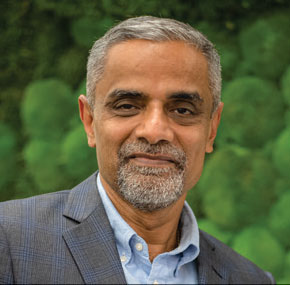
 “Professionally, I want to do as much as I can to promote disaster resilience and keep contributing whatever I can to protect lives and livelihoods. Personally, I want to stay healthy, and spiritually, I wish to keep growing and self-reflecting,” says Ramesh Subramaniam.
With a PhD in Economics, for 28 years, Subramaniam had been with the Asian Development Bank (ADB), working across the entire Asia-Pacific region. Until February 2025, he held the position of director general and group chief of the Sectors Group. Prior to ADB, he was in academic and industry research. Since mid-June 2025, he has been at the Coalition for Disaster Resilient Infrastructure (CDRI) as its new global director for programmes and strategy.
He shares that the impact of extreme heat on the power sector is initially through a considerable spike in demand, and it affects the entire value chain. Starting with generation, there are two problems. One, capacity cannot be changed quickly, and there are losses in system efficiency due to heat impact. Two, the transmission and distribution (T&D) systems get stretched carrying a heavier load, and T&D assets can age quickly, even over the short run, due to the stress placed on them. Thus, without an increase in capacity, such assets will face serious operational challenges over the medium term. Thus, he suggests that heat stress as a “slow-onset disaster” needs to be taken quite seriously by power system planners. More comprehensive and dynamic planning approaches need to be adopted, with risk-informed inputs on heat wave patterns guiding generation and T&D requirements. In parallel, given the fiscal stress in many countries, financial planning should be strengthened with innovative solutions. A key part of it is also to ensure tariffs are fully in line with market principles.
Further, to make renewable energy projects resilient to cyclones, utilities should shift to risk-informed decision-making. They should focus on protecting infrastructure, also known as “hardening”, through measures such as securing turbines and panels, and through underground cabling. “Agencies and utilities should also invest in strengthening early warning systems and emergency preparedness. All of these need to be backed by and anchored on staff training and capacity development, as well as dynamic business continuity planning,” he says.
On his management style, Subramaniam says that he is a “servant leader” and believes in working closely with all colleagues without being hierarchical.
In his spare time, he spends time with family and teaches human values classes for teens and young adults.
