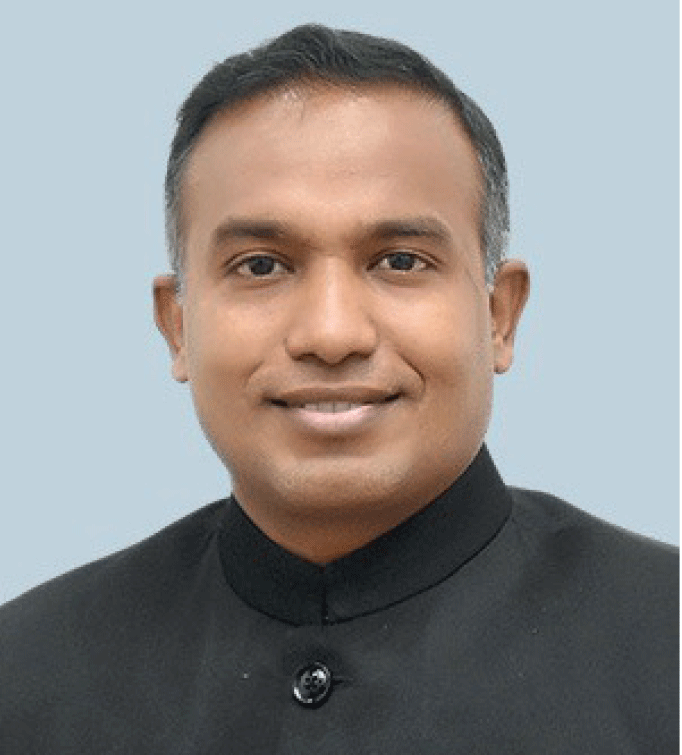
 In a recent interview with Renewable Watch, Radhakrishnan B. (Indian Administrative Service), Chairman and Managing Director, Maharashtra State Power Generation Company Limited (MAHAGENCO), shared insights on the company’s operations, project progress and future roadmap. He also talked about MAHAGENCO’s ongoing efforts to drive renewable energy (RE) integration, improve operational efficiency and embrace new technologies. Edited excerpts…
What have been the key milestones and achievements for MAHAGENCO over the past year?
Maharashtra is at the front, leading India’s clean energy shift with an ambitious plan targeting 38 GW of renewables, attracting investments totalling Rs 3.3 trillion, and generating approximately 700,000 jobs. Maharashtra, being India’s largest industrial hub and the top power consumer, is projected to see its electricity demand grow by 6.5 per cent each year. By 2030, the total requirement will be over 280 BUs, while peak power demand is anticipated to rise sharply – from 29 GW today to 45 GW.
MAHAGENCO was established in 2005 after the restructuring of the Maharashtra State Electricity Board (MSEB), and today has a total balanced power generation capacity of 13,880.22 MW.
MAHAGENCO has the highest power generation capacity among all state power generation companies in the country, and is the second largest power generation company in India after NTPC Limited. On April 27, 2024, MAHAGENCO recorded its highest daily thermal generation at 190.612 MUs and a peak load of 10,829 MW. Additionally, the highest thermal generation load of 8,620 MW was achieved on April 30, 2024, at 11:40 p.m.
MAHAGENCO achieved new generation records at key stations in 2024-25, including Khaperkheda (8,812 MUs), Koradi (13,611 MUs) and Nashik (2,974 MUs), with 10 units operating continuously for over 100 days. A major milestone was the successful commissioning of the 660 MW Bhusawal thermal unit in February 2025. In clean energy, MAHAGENCO completed a green hydrogen pilot project at Bhusawal and signed key agreements – an MoU with SJVN Limited for 5,000 MW of renewable projects and a joint venture with NTPC Green Energy Limited for 2,500 MW of RE projects in Maharashtra.
How has MAHAGENCO performed operationally and financially in recent years?
MAHAGENCO has demonstrated robust operational and financial performance in recent years, reflecting its strategic position as the largest state power generation company and the second largest overall in India. Despite the evolving energy landscape and the increasing push for renewables, MAHAGENCO has effectively managed its conventional fleet while aggressively expanding its green energy portfolio.
Operational performance
MAHAGENCO currently operates a balanced power generation portfolio of 13,880.22 MW, comprising 10,200 MW from thermal, 672 MW from gas, 2,580 MW from hydro and 428.02 MW from solar. The company has steadily increased its overall generation, achieving a record 61,453 MUs in 2024-25, slightly surpassing the 61,439 MUs it recorded in 2023-24. Segment-wise, hydro generation rose to 4,053 MUs from 3,668 MUs, gas generation increased significantly to 2,473 MUs from 1,769 MUs, and solar output grew to 385 MUs from 329 MUs, indicating improved asset utilisation and progress in its RE initiatives.
Financial performance
MAHAGENCO has shown positive financial growth in recent years, indicated by its billing performance. MAHAGENCO achieved its highest-ever energy billing in March 2025, amounting to Rs 29.30 billion, surpassing the previous record of Rs 28.98 billion in April 2024. In 2024-25, it recorded a peak annual billing of Rs 309.05 billion, up from Rs 287.91 billion in 2023-24.
MAHAGENCO has not only maintained its strong operational base in conventional power generation, as evinced by its record overall and segment-specific generation figures; it has also strategically invested in and commenced significant RE projects. This dual approach, supported by robust financial performance, positions MAHAGENCO as a key player in India’s energy transition, balancing immediate power demands with long-term sustainability goals.
What are some recent initiatives undertaken by MAHAGENCO? What are some initiatives planned for the near future?
MAHAGENCO is at the forefront of Maharashtra’s energy transition, actively pursuing a wide range of initiatives to align with both national- and state-level clean energy goals. These efforts span significant RE deployment, strategic collaborations and pioneering work in emerging green technologies.
MAHAGENCO has established a dedicated subsidiary, MAHAGENCO Renewable Energy Limited, to spearhead its green energy initiatives. The objective is to build a “Green Maharashtra” by focusing on non-conventional, green energy sources to provide affordable and maximum electricity to the state’s populace.
MAHAGENCO has prepared an ambitious plan to add over 8 GW of RE capacity by 2030 and over 12 GW by 2035. This includes projects under various modes such as bundling/renewable generation obligation (RGO) with thermal power, tariff-based competitive bidding, captive power and pumped storage plants (PSPs). Beyond conventional solar and wind, MAHAGENCO is strategically planning to develop green hydrogen/ammonia, floating solar, battery energy storage and wind-solar hybrid projects to achieve the ambitious targets set by both the Government of India and the Maharashtra government.
MAHAGENCO is actively advancing its RE portfolio through several major initiatives. The key solar initiatives include 148 MW of capacity under the CM Agriculture Feeder Scheme; 1,071 MW under the Mukhyamantri Saur Krishi Vahini Yojana 2.0; and a 1,956 MW RE bundling and RGO initiative, featuring Maharashtra’s largest 250 MW solar plant in Dondaicha. Floating solar projects totalling 605 MW are proposed at the Irai Dam and Lower Wardha, while a 102 MW project is planned on agricultural university land. For green hydrogen, a pilot project at Bhusawal has been successfully tested, and larger projects are being planned in Uran. Additionally, MAHAGENCO is developing PSPs totalling over 5,300 MW in partnership with the Water Resources Department, and exploring thorium-based small modular reactors with ROSATOM.
MAHAGENCO is not just generating power; we are building a resilient, sustainable and technologically advanced energy future for Maharashtra, aligning with India’s decarbonisation goals and positioning ourselves as a leader in the clean energy transition.
What roles do digitalisation and automation play in enhancing the efficiency of MAHAGENCO’s plants?
MAHAGENCO is leveraging digitalisation and automation to enhance the efficiency, reliability and safety of its power plants. With advanced sensors and real-time data analytics, the company has transitioned from reactive to predictive maintenance, enabling timely interventions and minimising unplanned downtime. The deployment of modern distributed control systems/supervisory control and data acquisition ensures centralised, remote monitoring and control of plant operations. Automation further empowers systems to autonomously optimise fuel input, regulate temperature and pressure, and respond to operational events, thereby reducing human error and enhancing responsiveness.
These digital advancements have significantly improved plant performance, reduced operational costs and strengthened regulatory compliance. As MAHAGENCO continues to embrace smart technologies, it is better positioned to meet growing energy demands and contribute to a more resilient and sustainable power infrastructure in Maharashtra.
How is MAHAGENCO balancing its conventional generation portfolio with the increasing push for renewables?
MAHAGENCO is navigating India’s energy transition with a strategic, balanced approach, ensuring grid stability and meeting escalating electricity demand while aggressively integrating RE. The company’s strategy hinges on RE bundling – a sophisticated method of combining intermittent renewable sources with reliable thermal power – alongside the strategic enhancement of its conventional generation portfolio.
MAHAGENCO is strategically enhancing its coal-based thermal capacity to ensure grid stability and meet Maharashtra’s rising power demand. With a current operational thermal capacity of 10,200 MW, the utility plans to add 4,380 MW of new thermal projects by 2035, including expansions at Bhusawal, Koradi, Chandrapur, Paras and Sinnar. This phased augmentation supports reliable base load generation amid increasing RE integration.
To address renewable energy variability, MAHAGENCO is focusing on RE bundling – combining renewable sources with thermal power to ensure consistent supply and meet RPO targets. Key initiatives include the 250 MW solar project at Dondaicha, and a planned 1,692 MW of RE bundling with thermal and 264 MW for RGO, aligned with the Ministry of Power’s clean energy goals. These projects are currently at the tendering stage.
In addition, MAHAGENCO is investing in battery storage to enhance grid flexibility and manage short-term fluctuations. A 100 MW battery energy storage system (BESS) integrated with solar power is being planned at Uran under a public-private partnership (PPP) model, with site assessments already completed. Through this integrated approach – thermal expansion, RE bundling and storage – MAHAGENCO aims to ensure a stable, reliable and cleaner power supply for Maharashtra.
What are the major challenges currently facing MAHAGENCO, and how is the company addressing them?
MAHAGENCO, while committed to its ambitious clean energy vision, faces several critical challenges that are common in the power generation sector amidst India’s rapid energy transition. The company is tackling these head-on, with proactive strategies.
Ageing infrastructure and plant modernisation
A portion of MAHAGENCO’s thermal fleet consists of agening units, many over 30-40 years old, leading to lower efficiency, higher maintenance costs and frequent breakdowns. To address this, MAHAGENCO is modernising its plants by upgrading boilers, turbines and electrical systems. It is also deploying advanced emission control technologies and investing in supercritical and ultra-supercritical technologies for enhanced efficiency and reduced emissions.
Coal supply issues
Coal remains the primary fuel for MAHAGENCO’s thermal plants, making consistent supply critical. Challenges such as shortages, logistical delays and quality inconsistencies impact operations. The company is securing long-term coal supply agreements and improving coal handling systems. It is also exploring alternative sources, such as imported coal and blending strategies. The recent allotment of the Gare Palma Sector II coal mine marks a strategic move towards coal self-reliance, helping reduce dependency and improve fuel quality control.
Environmental regulations and emissions compliance
Stricter emission norms from the Central Pollution Control Board and the Ministry of Environment, Forest and Climate Change of India pose a significant compliance challenge. MAHAGENCO is aggressively investing in FGD systems for SO2 reduction, ESP upgrades for particulate control, and selective catalytic reduction systems for NOx control in new projects. The integration of RE sources further supports emission reduction goals by decreasing reliance on coal.
RE integration and grid flexibility
The growth of solar and wind energy is introducing variability to the grid, requiring flexible thermal plant operations.
MAHAGENCO is modernising plants for improved ramping capabilities and investing in BESS projects and PSPs to ensure grid stability. RE bundling is also being explored to optimise integration.
Evolving regulatory landscape
The power sector is increasingly being shaped by environmental regulations, renewable mandates and performance-linked incentives. MAHAGENCO is aligning its operations with these parameters, focusing on emissions compliance and operational efficiency.
Cost competitiveness
As the power market becomes more competitive, MAHAGENCO is prioritising cost optimisation across procurement, logistics and inventory management to ensure financial sustainability.
Water scarcity and cooling needs
Water scarcity, especially in the dry regions of Maharashtra, threatens plant efficiency. MAHAGENCO is adopting water conservation practices and aims for maximum reuse through a “zero water discharge” model. A key initiative includes the commissioning of STPs with the Nagpur Municipal Corporation, where treated sewage water is reused for ash handling and cooling, showcasing circular water management.
By strategically tackling these multifaceted challenges, MAHAGENCO is enhancing its resilience and reinforcing its role in securing Maharashtra’s power needs while advancing India’s clean energy ambitions.
What is your strategic vision for MAHAGENCO over the next five to ten years, especially in the context of India’s clean energy goals?
MAHAGENCO, as the largest state power generation company and the second largest overall in India (after NTPC Limited), holds a pivotal position in India’s ambitious clean energy transition. Established in 2005, MAHAGENCO currently manages a balanced power generation capacity of approximately 13.88 GW. Over the next five to ten years, MAHAGENCO’s strategic vision is deeply aligned with India’s national clean energy objectives, which include achieving 500 GW of non-fossil fuel-based energy capacity by 2030 and net-zero emissions by 2070, as well as leadership in green hydrogen production.
MAHAGENCO is poised to significantly augment its power generation capacity to over 32 GW by 2035, with a strong emphasis on clean energy sources. This expansion will see approximately 12 GW of new solar PV and around 3 GW of PSP capacity additions between 2024 and 2035.
This will dramatically shift MAHAGENCO’s energy mix, with RE generation projected to increase from about 7 per cent in 2024-25 to 20 per cent in 2034-35, and the share of RE in the total capacity mix rising from 23 per cent to 56 per cent during 2023-35.
Recognising the future need for diverse green energy solutions, MAHAGENCO is actively exploring and investing in various RE projects, such as large-scale solar, PSP, wind and green hydrogen, positioning MAHAGENCO to contribute to India’s leadership in green hydrogen production.
While accelerating its green energy transition, MAHAGENCO remains committed to mitigating the environmental impact of its existing thermal power plants. This includes:
FGD installation and ESP retrofitting: Implementing advanced technologies such as FGD and ESP retrofitting to reduce emissions and improve air quality.
Sustainable coal transportation: Adopting cleaner methods for coal transportation, such as pipe conveyors, to minimise environmental pollution and enhance operational efficiency.
Through these strategic initiatives, MAHAGENCO aims to not only meet Maharashtra’s growing energy demands sustainably, but also play a crucial role in India’s journey towards achieving its ambitious clean energy goals, demonstrating global leadership in climate action.