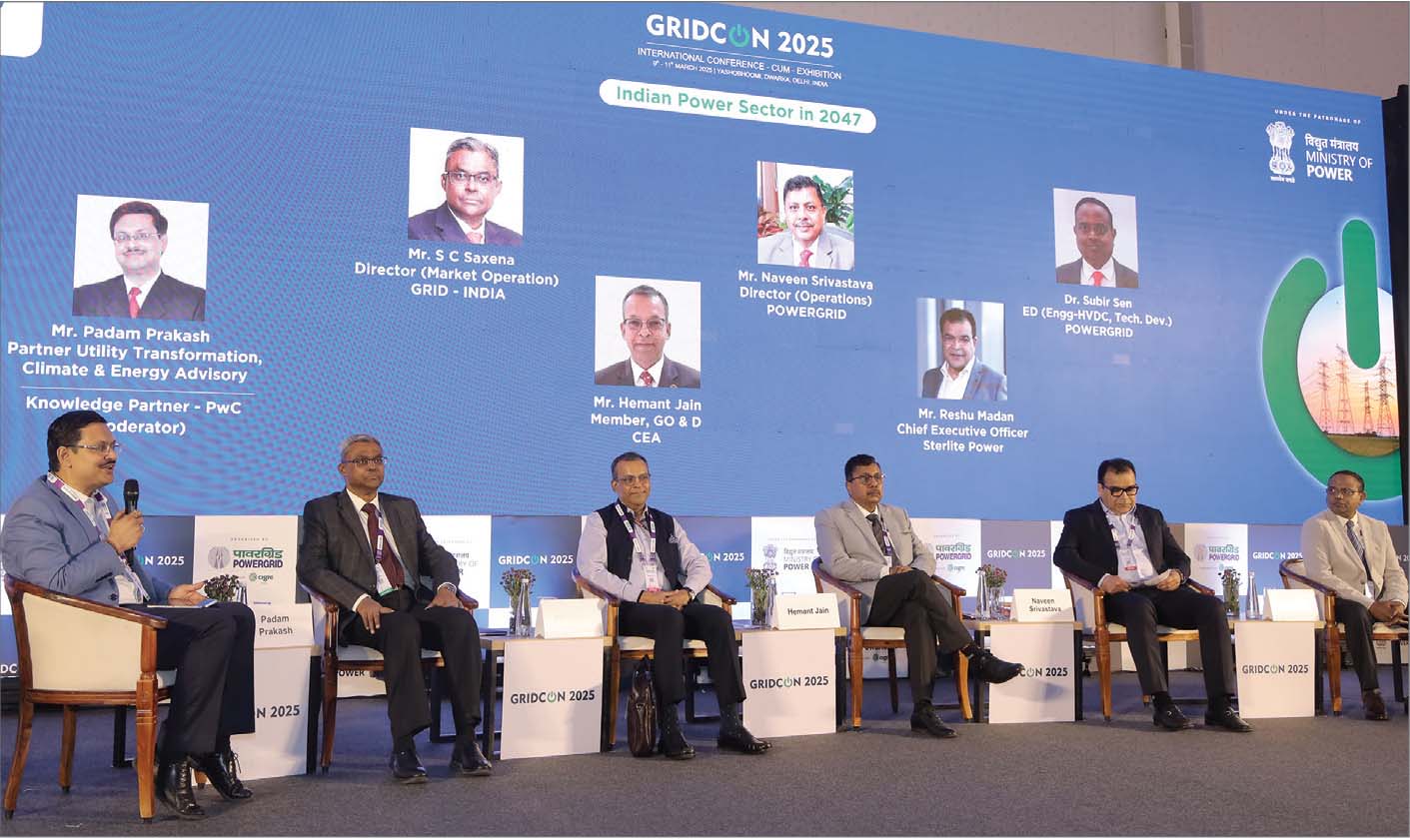
At GRIDCON 2025, a panel discussion on “Indian Power Sector in 2047” explored the key factors shaping the future of the power sector in India, including the role of transmission companies, grid stability, reliability and resilience, technological advancements in transmission, and policy and regulatory changes. Senior executives from the Central Electricity Authority (CEA), POWERGRID, GRID-INDIA, PwC, and Sterlite Power discussed the transformation of India’s power sector by 2047, highlighting the technological, regulatory and infrastructure advancements required to build a secure, sustainable and efficient grid. Edited excerpts…
Hemant Jain
Hemant Jain provided the perspective of a technical and planning body, emphasising the importance of building a robust power sector for realising India’s Vision 2047. He stated that as India approaches 100 years of independence, a strong power infrastructure will be a critical pillar of the country’s progress. He acknowledged POWERGRID’s leadership in developing the interstate transmission system (ISTS) and recognised the contribution of private transmission players in strengthening the sector. This collaborative effort, he noted, enabled India to meet a peak demand of 250 GW last year, with an expectation to reach 270 GW this year.
Jain highlighted that by 2047, India’s installed power capacity is projected to grow fivefold, with nearly 90 per cent coming from non-fossil fuel sources, including renewable energy and nuclear power. However, he pointed out an important distinction – while installed capacity is expected to grow five times, energy demand and peak load will increase only threefold. This indicates a shift in the energy mix, with a reduced reliance on conventional thermal power and a greater share of variable renewable energy. This transition poses a significant challenge in maintaining grid reliability. The evolving energy system will require careful planning and coordination among central, state and private sector players to ensure stability. Jain appreciated the collective efforts of stakeholders in reaching the current stage, where India can confidently meet its energy and peak demand requirements. Looking ahead, he emphasised the need for continued collaboration to address the challenges posed by an increasingly renewables-driven grid.
Regulations are essential to maintain the health and operability of the power system to serve consumers effectively. He acknowledged that while India’s ISTS has evolved and continues to do so, the real challenge lies in integrating intra-state transmission networks. Their seamless coordination is crucial for a well-functioning power sector.
He stressed that the harmonisation of regulatory processes is essential to ensuring that investors have clarity on compliance requirements and approval procedures before entering the sector. A cohesive regulatory framework will help streamline investments and execution timelines. He also highlighted the role of regulatory bodies and statutory entities such as the CEA in ensuring that the process remains efficient and investor-friendly, fostering a stable and predictable environment for power sector growth.
Looking ahead, he underscored the critical importance of peak load management, particularly in the context of increasing renewable energy integration and the expected 250 GW of thermal capacity by 2047. He emphasised that peak load management strategies, including flattening the load curve, must become a key focus in future policies and operational frameworks. He suggested that these strategies should be gradually incorporated into regulatory harmonisation efforts to ensure a balanced and resilient grid. He also highlighted the need for a more professional and expert-driven approach to load despatch functions at the state level. Jain called for state load despatch centres to be equipped with capabilities similar to regional load despatch centres, ensuring that holistic load forecasting, generation planning and resource mobilisation are carried out efficiently.
Reshu Madan
Reshu Madan highlighted Sterlite Power’s leading role in India’s private transmission sector and its international footprint, particularly in Brazil. He emphasised that investment in transmission infrastructure is critical. However, transmission development is lagging behind generation capacity, posing a major challenge for the sector. One of the challenges is the efficiency gap. In India, constructing a 400 kV line takes 1,100-1,200 man-days, while a 765 kV line takes about 1,600 man-days. In comparison, the same work takes 600 man-days in Thailand, 400 man-days in Brazil and only 200-250 man-days in the US or Europe.
Going forward, speed, innovation and mechanisation are essential for transforming the transmission sector. Sterlite has pioneered the use of heli-cranes in Jammu & Kashmir as well as drones for projects in the Northeast to accelerate their execution. These advancements have significantly reduced project timelines from 48-60 months to 24-36 months. Looking ahead, reducing dependence on manual labour is important due to skilled workforce shortages.
Regarding the company’s plans, he shared that Sterlite Power is making significant investments of Rs 4 billion to expand its conductor production capacity from 110,000 tonnes to 150,000 tonnes. A part of this investment will be used to set up a greenfield plant in Baroda, which will manufacture 400 kV cables. These investments and technological advancements align with the country’s growing power demand and the goal of building a resilient transmission network for the future.
Padam Prakash
By 2047, India’s economy is projected to reach $30 trillion-$35 trillion, with a per capita income of around $14,000 (up from the current $2,500), making a robust and dynamic power sector crucial to support such a growth. Further, the distribution segment is expected to become competitive, with discoms turning profitable and offering consumers the choice of supply. Electricity demand is expected to nearly double from 250 GW today to 410-430 GW. The installed capacity mix is expected to undergo a major change, reaching 2,100 GW by 2047, with significant capacity coming from solar and wind. The transmission segment is expected to witness key technological advancements, such as the deployment of 1,200 kV ultra-high voltage transmission and the addition of 200,000 ckt km of transmission lines and 1,200 GVA of transformation capacity.
S.C. Saxena
S.C. Saxena highlighted the changing dynamics of power demand and supply due to the increasing share of renewable energy. He pointed out that the growing solar generation and managing that in the daytime has not been a challenge. However, the real issue arises during non-solar hours, when solar generation becomes nil. This shift has led to a redefinition of peak demand periods, making non-solar peaks more significant and challenging than ever before. As more solar capacity is added, meeting daytime demand will become easier, but ensuring resource adequacy for non-solar hours will be critical.
To address this, new rules and regulations have been introduced, mandating resource adequacy studies up to a 10-year horizon. This includes reserve planning, ensuring not just demand fulfilment but also contingency preparedness. He cited a recent example where a significant capacity of solar power was lost in an instant due to cloud cover, emphasising the need for robust backup mechanisms.
On the transmission side, he noted that traditional power flows have historically been east to west, east to north and east to south, based on the placement of conventional power resources. However, with the rise of renewable energy in western, northern and southern India, electricity transmission flows are changing. This shift requires significant upgrades and modifications in the transmission infrastructure to efficiently integrate and manage variable renewable energy sources.
He highlighted that traditionally, the northern region was an importing zone, serving as a major demand centre. However, recent data revealed that during solar hours (10 a.m.-6 p.m.), the entire northern region is now exporting power, a fundamental shift from historical trends. This shift introduces new challenges in transmission operations, particularly the emergence of bidirectional power flows that change on a diurnal basis. Managing these dynamic flows will be critical, as they could lead to congestion issues across the transmission network. He acknowledged that congestion events are already occurring intermittently, underscoring the need for proactive grid management strategies.
Saxena also talked about the importance of flexibility in power generation, given the increasing share of renewable energy in the mix. With renewables set to dominate by 2047, all other energy resources – including thermal – must become more adaptable. While the share of thermal power is expected to decline, he projected that some level of thermal generation would still be necessary in 2047.
Dr. Subir Sen
Dr. Subir Sen outlined the road map for India’s power sector transformation by 2047, emphasising the need to reimagine and elevate the sector to meet dual energy goals – ensuring energy security and progressing towards net zero emissions by 2070. He noted that by 2047, 90 per cent of the electricity generation is expected to come from non-fossil fuel sources, making energy independence a key objective.
Dr. Sen highlighted three critical challenges – termed as “three A’s” – that must be addressed to build a sustainable and resilient power sector. These are adequacy, accessibility and affordability. To meet these objectives, he stressed the need for significant expansion of transmission infrastructure, covering bulk transmission highways at the interstate and intra-state levels, as well as deeper penetration into the distribution network.
The integration of advanced technologies is essential to ensure that the grid operates synchronously and efficiently. He advocated for a “smart” power system – one that can sense meaningfully and respond in real time – enabled by internet of energy (IoE) integrated with internet of things (IoT).
Dr. Sen emphasised that the future grid must minimise human intervention by leveraging digitalisation, artificial intelligence (AI) and machine learning (ML) for both construction and asset management. Predictive analytics will play a crucial role, allowing automated corrective actions to prevent faults even before they occur. He pointed to digital substations as a key component in managing the increasing renewable energy share, which is inherently variable and intermittent.
A major shift, he explained, will be the transition from grid-following inverters to grid-forming inverters, which will enhance grid stability and security. Additionally, energy storage will be crucial, particularly pumped storage hydropower, which is expected to grow from 4.7 GW at present to 116 GW by 2047. Other energy storage technologies, including battery energy storage systems, are projected to reach 47 GW by 2032.
Dr. Sen concluded by stating that achieving these goals will require an equal focus on digitalisation, decentralisation and automation, ensuring a resilient, efficient and future-ready power system for India. He also highlighted the importance of nuclear energy in India’s future energy mix, with 100 GW of nuclear capacity expected to come online.
He proposed innovative solutions for lower voltage levels (132 kV-220 kV), such as photonic coatings on conductors and high-capacity conductors, to improve transmission efficiency. Additionally, he emphasised the significance of medium voltage DC (MVDC) systems, which should be developed alongside high voltage DC (HVDC) systems (500 kV, 320 kV, 800 kV). He pointed out that even 33 kV and 66 kV DC systems could be valuable, requiring advancements in both software and infrastructure.
Regarding urbanisation and industrialisation, he noted that India’s population is expected to reach 1.7 billion by 2047, making it difficult to build new transmission infrastructure. MVDC networks and underground cable systems will be necessary for power distribution in densely populated areas.
Dr. Sen highlighted the importance of offshore wind energy, citing projects in Tamil Nadu and Gujarat, where 10 GW has been identified for development by 2032. Offshore wind power will require dedicated AC-DC transmission infrastructure, undersea power cables and transnational grid interconnections for optimal resource utilisation. He noted that the development of undersea grids and deep-sea power transmission would require extensive research and investment. He also discussed the key role of public-private collaboration in R&D to drive innovation, demonstration and deployment of new technologies.
Finally, he outlined four key priority areas for the power sector in India – energy security and net zero transition by 2047, smart and efficient transmission networks, AI-driven cybersecurity with a zero-trust approach and capacity building for emerging technologies.
Naveen Srivastava
Naveen Srivastava reinforced the scale of transformation required in India’s power sector by 2047. He noted that out of the projected 2,100 GW of generation capacity by 2047, 1,600-1,700 GW would come from renewable sources, significantly altering grid dynamics.
He emphasised that with an expected addition of 200,000 ckt km of transmission lines and a surge in transformation capacity to over 4,000 GVA, traditional manual operations would no longer be feasible. Instead, the grid would need to be AI-driven, IoT-enabled and largely unmanned. The volume of data generated by such extensive infrastructure would necessitate smart transmission lines and substations capable of self-operation and real-time decision-making.
Srivastava highlighted that POWERGRID is already advancing in this direction, with 281 substations currently being operated remotely. POWERGRID aims to transition towards fully digital substations by 2047. The focus is now on predictive maintenance through advanced monitoring technologies, including transformer and breaker condition monitoring.
In addition, POWERGRID is focusing on promoting local manufacturing, ensuring that foreign contractors setting up projects in India must invest in factories within the country. Also, to address the growing challenge of right of way, POWERGRID is implementing dynamic line rating systems, making existing corridors and transmission lines smarter to handle the additional load.
He stressed that cybersecurity is a critical focus area, given the vast transmission infrastructure network. Investments are being made to strengthen cybersecurity measures, including ensuring that operational technology and information technology systems remain separate, in order to mitigate cyber threats.