By Prasad Thakur, CIMO scholar and Labanya Prakash Jena, Sustainable Finance Expert
In 2022-23, agriculture contributed about 15 per cent of the country’s gross domestic product. About 60 per cent of India’s population is directly or indirectly dependant on it for its livelihood. The sector therefore remains a key focus for the government from the lens of food security, alleviation of poverty, and inclusive and sustainable growth. This drive has been outlined in various national plans, across decades and initiatives. Transformation of the agricultural and allied sectors through modernisation, diversification, and increased productivity is crucial for becoming a “Viksit Bharat’ by 2047.
Clean, reliable and affordable distributed renewable energy (DRE) has emerged as a critical success factor in establishing a robust and transformative agricultural sector. While India has made considerable progress in rural electrification, consistent and quality power for irrigation, processing, and cold storage remains a concern in some areas. As dependable grid power remains elusive, smallholder farmers often switch to diesel pumps, which can be expensive and environmentally unfriendly.
Existing support for DRE in India
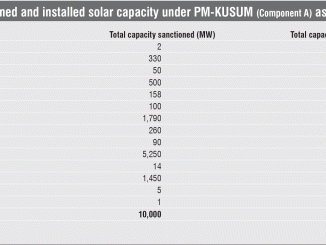
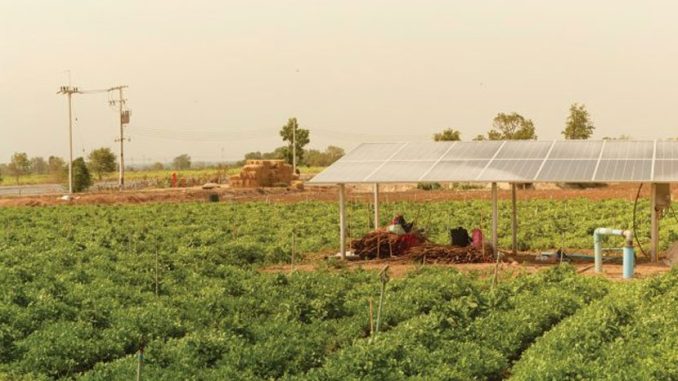
Within the framework of initiatives like the Pradhan Mantri Kisan Urja Suraksha evam Utthaan Mahabhiyan (PM-KUSUM), which aims to promote commercially viable DRE technologies, such as solar-powered irrigation pumps, post-harvest solutions (dryers, cold storage), processing equipment, small-scale grid-connected solar power plants and other solutions promoting quality of rural livelihoods. Such interventions specifically target smallholder farmers, agricultural self-help groups and micro, small and medium enterprises while selecting key agricultural value chains, aligned with India’s strategic priorities for agricultural development and food security. Such interventions include promoting rice, wheat, pulses, or horticultural products, livestock (dairy, poultry), or other agricultural products depending on the region and context, reflecting the diversity of Indian agriculture.
Addressable market potential of DRE solutions
India’s DRE agri-tech market can ride the wave of large-scale agriculture modernisation and favourable policy and financial support. More than 140 million smallholder farms can sustain the demand for solar water pumps, replacing millions of diesel units. The PM-KUSUM scheme’s target of 3.5 million solar pumps by 2026, showcases the market scale. Solar refrigeration and greenhouse dryers are crucial for increasing shelf-life of 330 million tonnes of produce. It can reduce post-harvest losses, currently about 10 per cent averaged over various fruits, vegetables and flowers, to less than 3 per cent. Their market potential is also boosted by their placement at the farm-gate, allowing the farmer to value-add without incurring logistics costs. Solar milling, supporting more than 300 million tonnes of grains, enables local processing and rural jobs. Millions of small mills offer vast replacement potential. Additionally, pooled agrivoltaics in nearby small farms can be promoted to driving DRE adoption.
Driving DRE adoption: novel market strategies for India’s agriculture
Establishing agri-energy cooperatives or self-help groups at the village/block level enabled with micro-finance facilities and DRE technology can be a game-changing move. They can have a direct access to recognised and regulated micro-finance institutions and technology partners. Embedding micro-finance directly within the cooperatives addresses the critical issue of access to value-chain credit for smallholders. These cooperatives can own and manage DRE solutions (like solar powered tractors, farm implements, drones, solar pumps, cold storage, among others) while also acting as aggregators for agriculture produce. Such aggregation can give them a better leverage in establishing favourable market linkages. The DRE technology partners can provide knowledge transfer and capacity building to farmers on DRE asset operations, maintenance, and data-driven farming practices. Such frameworks can mitigate financial and technology risk by going beyond individual ownership towards collective ownership. Successful pilot projects demonstrating such frameworks can ensure community buy-in.
DRE-powered agri-processing zones with guaranteed offtake agreements can be established through a hub and spoke configuration. It can transform the agro-economics in regions blessed with ample solar irradiation and high wind-speeds. These zones can be equipped with DRE-powered processing and value-add facilities for grading, sorting, milling, drying, cold storage, packaging, among others. By leveraging the learnings of existing food-parks and potentially adding 500 such solar-powered agri-processing zones, India can not only cater to the domestic market but also emerge as a major exporter of foods.
Carbon credit aggregation frameworks that allows smallholder farmers to participate in carbon markets by adopting DRE solutions can be the biggest enabler of carbon markets in India. Farmer cooperatives can act as aggregators and can bundle carbon credits from multiple farmers, making it viable for them to access carbon financing. This creates a new revenue stream for farmers, incentivising DRE adoption.
Developing solar-powered aquaculture and hydroponics parks can integrate DRE systems with controlled environment required for high-yield agriculture. These parks deploy vertical farming techniques and closed-loop aquaculture systems, maximising resource efficiency. They can be established in peri-urban areas, providing fresh produce and fish to nearby demand centres. They have shorter supply-chains, resulting in reduced emission and losses.
Such actions on the technology, business and policy front can potentially benefit 50 million smallholder farmers in the next 5 years, reduce around 45 million tonnes of carbon emissions per year by replacing fossil fuel as the energy source for powering farm-equipment and processing units and reducing post-harvest losses. This can directly result in 30 per cent increase in farmers’ incomes
Such out-of-the-box solutions can be designed to create a holistic and sustainable ecosystem for DRE adoption in India’s agricultural sector. By focusing on community ownership, value addition, data-driven subsidies, skill development, and carbon financing, India can unlock the transformative potential of DRE and drive inclusive and sustainable growth.