By Preeti Wadhwa
THDC India Limited (THDCIL), a leading public sector undertaking (PSU) in the power sector, was incorporated as a public limited company in July 1988 under the Companies Act, 1956. Initially, the equity of THDCIL was shared between the Government of India and the Uttar Pradesh government in a 75:25 ratio. However, following a strategic sale, a share purchase agreement was signed on March 25, 2020 between NTPC Limited and the President of India, enabling NTPC to acquire the President’s equity stake in THDCIL. Following this agreement, THDCIL became a subsidiary of NTPC. Currently, the ownership of THDCIL is split between NTPC, which holds 74.496 per cent, and the Uttar Pradesh government, holding 25.504 per cent. Having focused on hydropower projects initially, the PSU has now diversified into pumped storage, wind, solar park, floating solar and green hydrogen projects.
Current portfolio and expansion plans
According to the company’s annual report for financial year 2023-24, THDCIL’s current operational portfolio stands at 1,587 MW, comprising hydro, wind and solar power projects. In the hydropower segment, it operates the 1,000 MW Tehri hydropower plant and the 400 MW Koteshwar hydroelectric project (HEP) in Uttarakhand, along with the 24 MW Dhukwan small HEP in Uttar Pradesh. The company has also expanded to wind energy with a 50 MW project in Patan and a 63 MW project in Dwarka, both in Gujarat. Additionally, it operates a 50 MW solar power project in Kasaragod, Kerala. According to its financial report, the company’s total cumulative generation, achieved from all plants, stood at 4,830.63 MUs during 2023-24.
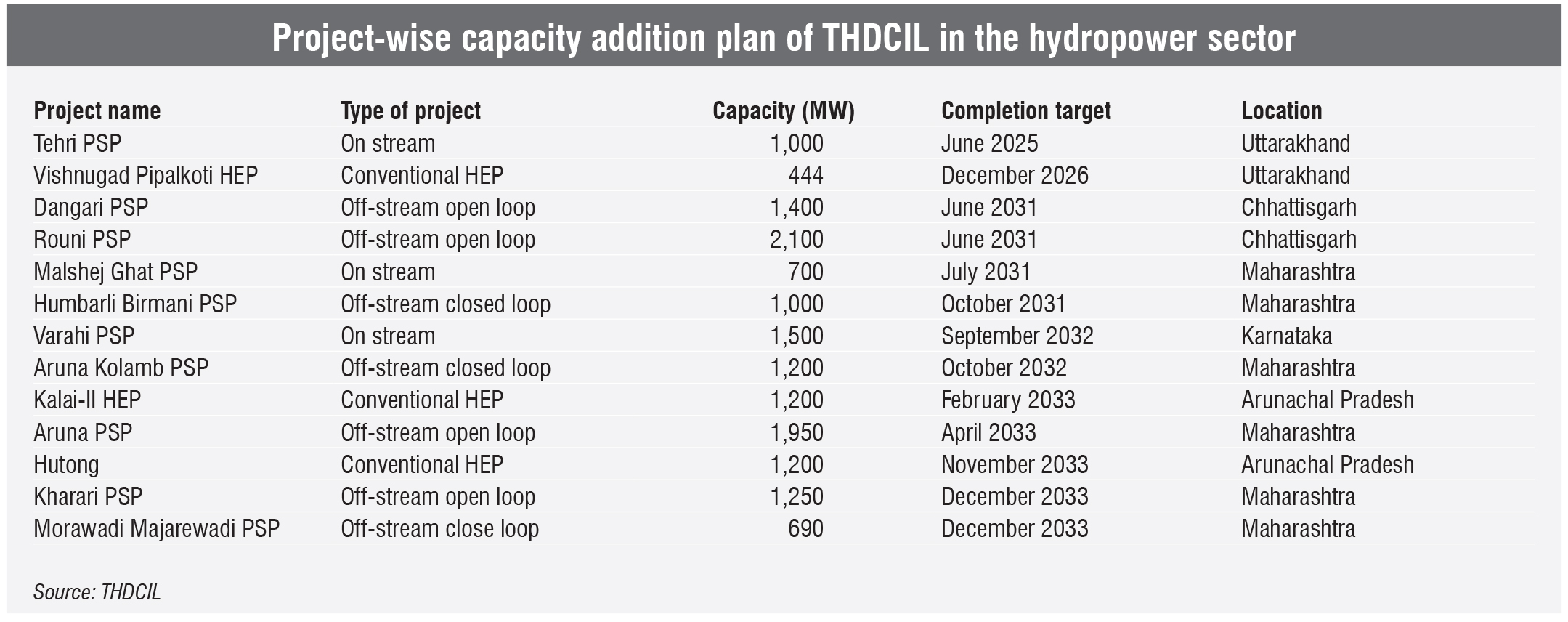
THDCIL is also actively developing 2,764 MW of projects. This includes the 1,000 MW Tehri pumped storage project (PSP), to be scheduled for commissioning by June 2025 and the 444 MW Vishnugad Pipalkoti HEP, expected to be completed by December 2026, both located in Uttarakhand. In the thermal power sector, the company is constructing the 1,320 MW Khurja super thermal power plant in Uttar Pradesh.
THDCIL is developing solar power parks through joint venture companies in order to expand its renewable energy footprint. Under TUSCO Limited, the company is working on a 600 MW solar power park in Jhansi, a 600 MW solar power park in Lalitpur and an 800 MW solar power park in Uttar Pradesh. Additionally, through TREDCO Rajasthan Limited, THDCIL is developing the 1,292 MW Bodana solar power park in Rajasthan.
THDCIL has also prepared detailed project reports (DPRs) for three floating solar power projects, with a total capacity of 464 MW, in Uttar Pradesh and has followed up with the state government for allocation of these projects for implementation.
Earlier, pursuing its plans to diversify into the green hydrogen space, in January 2024, the company inaugurated a green hydrogen pilot project with electrolyser and fuel cell technology in Uttarakhand.
THDCIL has an ambitious capacity addition plan. By 2033-34, it aims to achieve a total hydro capacity addition of 16,938 MW, including PSPs, bringing its total capacity to 18,362 MW.
THDCIL has signed a memorandum of agreement with the Arunachal Pradesh government for the implementation of the 1,200 MW Kalai-II HEP in Anjaw district in December 2023. Additionally, THDCIL is developing two other HEPs in the Lohit basin, with a combined capacity of approximately 2,500 MW in Arunachal Pradesh.
THDCIL signed an MoU with the Maharashtra government in September 2024 for the development of six PSPs, with a total capacity of 6,790 MW. The DPR preparation for these projects is currently in progress. In Chhattisgarh, the PSU has identified two PSPs – the 2,100 MW Rouni PSP and the 1,400 MW Dangari PSP, and is actively pursuing project allotment with the state government.
Furthermore, THDCIL entered into an MoU with Karnataka Power Corporation Limited in November 2023 for the development of the 1,500 MW Varahi PSP, with DPR work already under way. The company has also expanded its presence in Rajasthan, signing an MoU with the state government in September 2024 for the development of the 800 MW Bisanpura PSP in Bundi district and another 800 MW Rampura PSP in Tonk district. The preliminary feasibility report for these projects is currently being prepared.
Key challenges and future outlook
Although the company has ambitious expansion plans, it faces several challenges in developing the projects. The approval and clearance process remains long drawn, with multiple cases pending in various courts, the National Green Tribunal and the National Board for Wildlife. Land acquisition issues, law and order concerns, rehabilitation and resettlement challenges and difficult terrain conditions further complicate project execution. Geological uncertainties, including the presence of shear zones and underground streams, as well as the risks posed by landslides and flash floods, require advanced mitigation strategies. Additionally, the high cost of hydro projects, affected by plant location, dam construction, material costs and tariffs, poses a major challenge. In particular, the company’s Tehri PSP has witnessed significant time and cost overruns.
Despite these challenges, THDCIL has consistently been a profitable entity, having commenced its commercial operations in 2006-07 with the launch of the Tehri hydropower plant. However, the company’s total income has shown a downward trend over the years. According to the company’s annual report for 2023-24, the total comprehensive income for the years 2019-20, 2020-21, 2021-22, 2022-23 and 2023-24 was Rs 9.03 billion, Rs 10.92 billion, Rs 8.96 billion, Rs 6.7 billion and Rs 5.89 billion respectively. This reflects a gradual reduction in income over the period, although the company witnessed a growth in the total income in 2020-21. Specifically, from 2021-22 to 2022-23, there was a significant drop of around 26.5 per cent, from Rs 8.96 billion to Rs 6.7 billion. The decline continued in 2023-24, with a further decrease of approximately 12.1 per cent compared to the previous year. Over the span of 2020-21 to 2023-24, the total comprehensive income decreased by 46 per cent, highlighting a sharp downward trend in the company’s financial performance during these years.
Going forward, THDCIL advocates a comprehensive approach, involving both government and developer interventions to address these challenges and accelerate hydropower development. On the policy front, the company emphasises the need for streamlined approval processes, extended ISTS charge exemptions and the development of hydro-specific tariff structures. The company also supports financial incentives such as subsidies, tax holidays and GST waivers. Moreover, it is promoting technological advancements, including hybrid hydro-solar-wind projects and small/micro hydropower solutions, particularly in remote regions.
In addition, the PSU is focusing on financial sustainability through green financing options such as green bonds, public-private partnerships and viability gap funding to attract domestic and international investments. Going forward, government-backed guarantees can help mitigate risks associated with geological surprises, cost overruns and regulatory changes. Further, strengthening domestic manufacturing capabilities for key hydro components such as turbines, generators and valves will help reduce costs and over-reliance on imports. The company is adopting advanced geological surveying technologies and tunnel boring machines for faster and safer project execution. Investing in workforce training and local employment development will further ensure long-term operational efficiency and reliability.
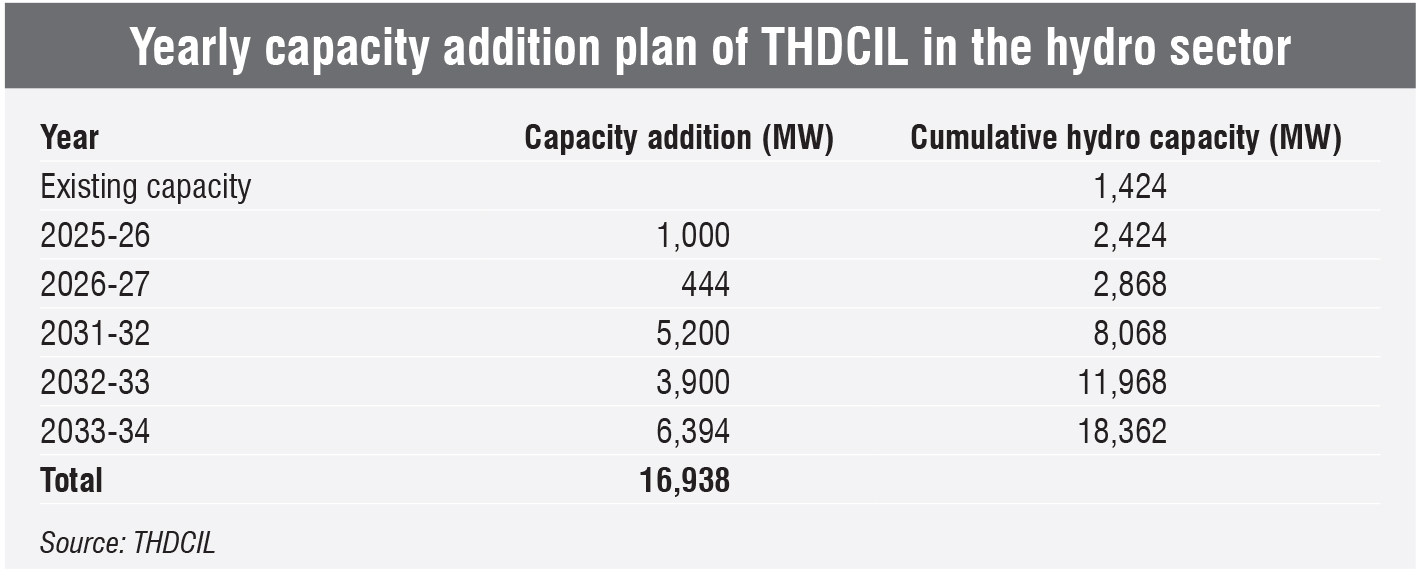
In the coming years, the company aims to capitalise on opportunities across hybrid, floating solar and green hydrogen fuel projects, and strengthen electric vehicle charging stations all over India. The plan is to expand from their current 1,424 MW capacity to over 18,000 MW by 2033-34, representing more than a 12-fold increase in capacity. While challenges in the hydropower sector are substantial, the PSU’s approach towards risk mitigation and diversification, combined with supportive government policies and technological advancement, indicates a positive outlook for the company.