

The Economic Survey of India 2024-25 has highlighted a significant progress in energy generation from non-fossil fuels and renewable sources. It mentions that India’s installed power capacity reached 456.7 GW as of November 2024, reflecting a 7.2 per cent year-on-year increase. The renewable energy sector witnessed substantial growth, with capacity reaching 209.4 GW by December 2024, marking a 15.8 per cent rise, now accounting for 47 per cent of the total installed capacity. Meanwhile, as of November 2024, India’s non-fossil fuel electricity generation capacity stood at 213.7 GW, accounting for 46.8 per cent of total capacity, with a target of 50 per cent by 2030.
On renewables
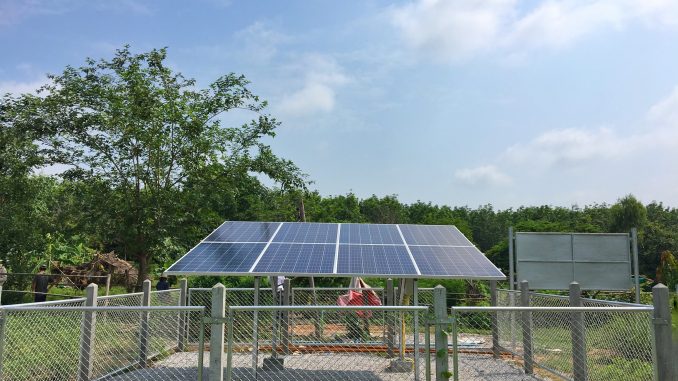
- The Survey stated that as of January 9, 2025, rooftop solar systems for more than 700,000 households have already been installed under the PM Surya Ghar: Muft Bijli Yojana. The scheme targets rooftop solar installations in 10 million households, with an expected capacity addition of 40,000-45,000 MW by 2027. In the decentralised solar space, 397 MW has been installed as of December 2024, along with the solarisation of 728,000 agricultural pumps under the Pradhan Mantri Kisan Urja Suraksha evam Utthaan Mahabhiyan (PM-KUSUM) scheme. Further, the Ministry of New and Renewable Energy has expanded PM JANMAN to provide offgrid solar systems to 100,000 unelectrified households and solar lighting for 1,500 multi-purpose centres in tribal areas.
- The Solar Parks and Ultra-Mega Solar Power Projects Scheme, targeting 40,000 MW, has sanctioned 55 solar parks with a combined capacity of 39,900 MW across 13 states, with 12,200 MW already commissioned as of December 31, 2024.
- Offshore wind segment has also been given a fillip with a viability gap funding (VGF) scheme, allocating Rs 74.53 billion for 1,000 MW of wind projects off Gujarat and Tamil Nadu and port upgrades for logistics.
- The survey also mentions the National Bioenergy Programme which supports waste-to-energy, biomass, and biogas projects, with biomass power and cogeneration projects reaching 9.8 GW (grid-connected) and 0.92 GW (offgrid) as of December 2024. Waste-to-energy projects stand at 249.74 MW (grid-connected) and 370.19 MW (offgrid), while 5.1 million small biogas plants and 361 medium-sized plants contribute a total capacity of 11.5 MW.
On power sector
In the power sector, while transformation capacity additions gained momentum, transmission line construction faced delays due to heavy monsoon conditions. Government initiatives such as the Deen Dayal Upadhyaya Gram Jyoti Yojana (DDUGJY), Integrated Power Development Scheme (IPDS), and Pradhan Mantri Sahaj Bijli Har Ghar Yojana (SAUBHAGYA) have electrified 18,374 villages and provided electricity to 29 million households, with a total investment of Rs 1.85 trillion. Moreover, the Revamped Distribution Sector Scheme, launched in July 2021 with an outlay of Rs 3 trillion, has approved projects worth Rs 2.8 trillion, enhancing power distribution efficiency and reliability. Consequently, urban power supply improved from 22.1 hours in FY 2013-14 to 23.4 hours in FY 2023-24, while rural supply increased from 12.5 hours to 21.9 hours. The energy demand-supply gap has significantly reduced from 4.2 per cent in FY 2013-14 to 0.1 per cent by December 2024.
On GECs
Moreover, the green energy corridors (GEC) continue to strengthen renewable integration, with GEC-I achieving 9,136 circuit kilometres of transmission lines and 21,413 MVA substations, while GEC-II expands to seven more states.
On improving consumer experience with rooftop solar, EV charging and electricity connections
To enhance the energy infrastructure the Survey mentions several measures that have been undertaken to simplify rooftop solar installations, support EV charging, and expedite new electricity connections.
- Approvals for rooftop solar systems up to 10 kW no longer require feasibility studies, and timelines for larger systems and commissioning have been significantly reduced.
- Consumers can now obtain separate electricity connections for charging electric vehicles.
- Timelines for obtaining new electricity connections have been reduced to three days in metropolitan areas, seven days in municipal areas, and fifteen days in rural areas.
- Residents of group housing societies and residential colonies can choose either individual or single-point electricity connections. This has promoted transparency and flexibility.
- If a consumer disputes their meter reading, the licensee must install an additional meter within five days to verify consumption over three months, ensuring billing accuracy.
The complete Economic Survey 2024-25 can be accessed here

