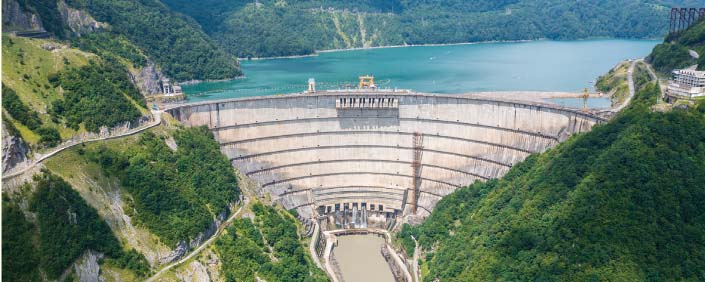
 Technology developments and innovations have kept pace with the uptake of hydropower projects. The sector has experienced several advancements in technology aimed at enhancing efficiency, minimising environmental impacts and broadening the applicability of hydropower in regions that were once considered unsuitable.
In the hardware space, the adoption of advanced turbine designs has been increasing. Conventional hydropower turbines can adversely affect fish population. New designs feature improved blade shapes and slower rotation speeds to reduce fish injury and mortality. These turbines are also engineered to function more efficiently at lower water flow rates. In addition, unlike traditional turbines that maintain a constant speed, variable speed turbines adapt to changes in water flow, optimising power generation and enhancing efficiency, particularly in low-flow scenarios.
Increased technology developments are also under way in the small-hydro space, such as modular hydropower systems that are simpler to install and maintain, making them well suited for remote or off-grid areas. These systems typically do not necessitate dams or extensive infrastructure, thereby reducing their environmental footprint. There is also an increasing focus on hydrokinetic and in-stream turbines that harness energy directly from river currents, tidal movements or ocean currents without requiring dams. They hold significant potential for creating decentralised power solutions.
Significant technology developments are also occurring in civil engineering and construction techniques for hydro projects. For instance, the adoption of 3D printing and prefabricated components is decreasing both the time and expenses involved in building new hydropower facilities or upgrading the existing ones. In this space, augmented reality and virtual reality (AR and VR) are being used to revolutionise hydro project development. VR creates 3D models for simulating operations and visualising design changes before construction, while AR overlays digital information on the physical world, assisting maintenance with real-time data and visual guides. Together, AR and VR enhance design processes, streamline maintenance and improve stakeholder engagement by providing immersive, interactive tools for both planning and operation. In addition, utilising low-carbon concrete and other sustainable materials is minimising the environmental impact of hydropower construction projects.
Other innovations in the hydropower space include setting up hybrid projects in a bid to increase round-the-clock availability of renewables and enhance the utilisation of existing transmission infrastructure. Installing floating solar projects on hydropower reservoirs allows utilities to enhance renewable energy generation while also decreasing evaporation rates, thereby promoting water conservation. Pre-existing transmission infrastructure further supports the development of these hybrid projects. Such initiatives are also being taken globally in a bid to power electrolysers for green hydrogen production. Pumped hydro storage is another upcoming avenue in the hydropower space. Innovations in this space include setting up closed-loop systems in which, unlike traditional pumped hydro storage that involves moving water between two natural bodies, isolated reservoirs are used. This reduces the environmental impact and allows for greater flexibility in site selection. New methods explore using abandoned mines or caverns as reservoirs for pumped storage, providing energy storage solutions without requiring large surface land areas.
While these innovations focus on hardware and physical infrastructure, advancements in digitalisation to improve operations and maintenance (O&M) and asset management of hydropower projects are even more interesting.
Increased digitalisation and innovations in hydro O&M
Asset management and the O&M of hydropower plants have evolved from traditional reactive and fixed-interval maintenance methods to more proactive, preventive and risk-based strategies. The focus is now on reducing downtime for individual generating units and the entire plant, enhancing operational reliability and ensuring uninterrupted electricity generation to efficiently and sustainably meet grid demands.
The adoption of digital technologies in hydroelectric projects (HEPs) offers substantial potential for maximising asset value and boosting productivity. These technologies help optimise O&M costs while improving plant safety and efficiency. Digital controls enhance the performance of turbines, plants and equipment, resulting in lower O&M costs, higher operational efficiency and better asset management. They also provide more precise measurements of parameters such as flow, pressure and power, which improves overall HEP efficiency and aids in better reservoir management.
In a digital power plant, continuous data collection enables the analysis and identification of performance irregularities and potential faults. Intelligent software can detect these faults before they happen, reducing downtime. Advanced real-time monitoring systems establish normal operational parameters and generate alerts when anomalies are detected, enabling a shift from corrective to preventive and predictive maintenance. This approach has led to fewer equipment failures and plant outages, resulting in cost savings, increased power generation and improved overall performance. Digital solutions facilitate remote plant operations, while analytical tools provide operators with comprehensive control over maintenance activities, allowing for more efficient scheduling, better planning, reduced maintenance lead times and improved accuracy in required tasks.
Digitalisation also enhances the integration of HEPs with other renewable energy sources, supporting better decision-making and greater operational efficiency. Advanced technologies can be applied to modernise operations in older HEPs. Continuous data analysis enables early detection of parameter deviations, allowing digital maintenance systems to learn normal operating modes and optimise maintenance schedules well in advance.
Digital tools also improve generation forecasting, aiding in short- and mid-term scheduling for flexible generation. By leveraging these tools, operators can enhance real-time flexibility, increase system reliability and boost revenues from flexibility markets.
In the asset management space, several technological innovations are taking place, which have the potential to disrupt the sector. One such technology is digital twin, which utilises artificial intelligence (AI), mathematical models and real-time plant operation data, including upstream and downstream hydrology measurements, to create virtual models of HEPs. These digital twins replicate plant operations in a virtual environment, enabling the simulation of different operational scenarios. As intelligent models, they learn plant behaviour through input data, improving accuracy over time with additional data and measurements.
Two, AI and machine learning (ML) can inform and digitalise O&M activities. AI and ML facilitate predictive maintenance, minimising the frequency of asset health checks and identifying risks early.
Three, internet of things (IoT) enhances HEP operations through real-time monitoring and detailed asset health insights. Embedded sensors play a crucial role in this process by measuring various parameters such as wear, vibration and temperature. These sensors collect high frequency time-series data, which is then analysed to assess asset conditions, identify trends and detect potential issues. By continuously monitoring these metrics, IoT-enabled systems provide real-time alerts for anomalies, support predictive maintenance strategies and automate reporting processes. This comprehensive sensor data not only improves visibility into the plant’s operational status but also enables more effective maintenance scheduling and optimisation of plant performance.
Four, remote monitoring technologies such as drones and computer vision have the capacity to transform asset inspection processes. They minimise the requirement for human personnel to assess equipment condition, especially in remote or hazardous locations. When integrated with AI and ML, drones can autonomously detect issues. During the construction phase, drones and diving robots equipped with sensors and actuators facilitate progress monitoring and accurate digital surface modelling.
Challenges and the way forward
India’s hydropower sector plays a vital role in ensuring energy security and sustainability. Technological innovations in project infrastructure and O&M practices are crucial for maintaining the efficient, safe and reliable operations of these plants. They are crucial for optimising performance, minimising downtime and ensuring plant longevity. However, several technical challenges are faced in the hydropower sector, especially those related to old projects that require modernisation to integrate digital technologies. However, upgrading ageing infrastructure with these tools can be complex and expensive. In addition, older hydroelectric plants nearing the end of their operational life face financial limitations for replacement and upgrades.
Despite this, hydropower plants are preparing for greater uptake of digitalisation tools. However, increased connectivity and dependence on digital technologies make HEPs more vulnerable to cybersecurity threats, necessitating strong security measures to protect critical infrastructure from potential attacks. There are also infrastructural challenges to the digitalisation of HEPs, including insufficient network connectivity between power stations and remote control centres, concerns about commercial confidentiality and a lack of adequate IT infrastructure within generation companies. Skill gaps are another obstacle, as the fast pace of technological advancement requires greater IT knowledge and expertise for the design, implementation and operation of digital technologies.
Addressing these challenges and encouraging the adoption of emerging technologies and innovative methods in HEPs can unlock the full potential of the hydropower sector going forward.