

Incorporated in 2004, Gujarat Urja Vikas Nigam Limited (GUVNL) oversees the bulk purchase and sale of electricity to four discoms and other private distribution licensees. The company also coordinates and supervises the activities of its six subsidiary companies, managing their overall loan portfolio. Its subsidiaries include Gujarat State Electricity Corporation Limited for generation; Gujarat Energy Transmission Corporation Limited for transmission; and Dakshin Gujarat Vij Company Limited, Madhya Gujarat Vij Company Limited, Uttar Gujarat Vij Company Limited and Paschim Gujarat Vij Company Limited for distribution. Renewable Watch provides an overview of GUVNL’s current financials and key performance parameters, recent tender auctions and the initiatives undertaken by the company…
Current financials and key performance parameters
 GUVNL has witnessed positive trends in its financials and key performance parameters. It witnessed a 25 per cent increase in its revenue from sale of power from Rs 544 billion in 2021-22 to Rs 682 billion in 2022-23, and an 8 per cent increase in its accumulated profit retained earnings from Rs 5.46 billion to Rs 5.9 billion during the same period. However, its profit after tax decreased from Rs 17.12 billion to Rs 15.18 billion in 2022-23. On the transmission side, GUVNL’s network expanded from 70,378 ckt km to 72,907 ckt km and the number of substations increased from 2,246 to 2,312 from 2021-22 to 2022-23, respectively. On the distribution side, its high tension (HT) line length reached 475,493 ckt km from 461,491 ckt km, while the number of transformers reached 1,868,179 from 1,768,524 and feeders from 21,493 to 20,499 during the same period. Further, the company’s efficiency parameters improved over the years with transmission and distribution losses at 14.75 per cent in 2022-23 from 18.29 per cent in 2018-19 and aggregate technical and commercial losses at 15.26 per cent from 18.53 per cent during the same period. Its average realisation was about Rs 7.94 per unit in 2022-23 in contrast to Rs 6.38 per unit in 2018-19, while its average cost to serve increased to Rs 7.80 per unit from Rs 6.26 per unit during the same period. These trends are primarily driven by a rise in sales volumes to industrial customers, particularly in the HT sector, improved average tariff realisation, prompt subsidy disbursements from the state government to GUVNL, and regulatory clarity with the timely issuance of tariff orders and revisions, which ensure that cost variations are adequately passed through.
As of June 2024, Gujarat has approximately 28,406 MW of installed renewable capacity comprising 1,990 MW of large hydro, 92 MW of small-hydro, 113 MW of biopower, 14,359 MW of solar and 11,853 MW of wind. Of this, GUVNL’s portfolio accounts for approximately 10,143.5 MW (35 per cent of the total state capacity) of renewable installed capacity in the state, with 772 MW of large hydro, 30 MW of biomass, 10 MW of bagasse, 7.5 MW of municipal solid waste, 4,923 MW of solar and 4,373 MW of wind projects, according to the presentation by H. N. Shah, general manager, GUVNL, at Renewable Watch’s 12th Edition of Wind Power in India conference.
 Recent tender auctions
GUVNL has been proactive in tender activity and recently auctioned tenders for different segments. In June 2024, results for GUVNL’s auction to develop 500 MW of grid-connected wind-solar hybrid power projects, with an additional green shoe option of 500 MW, were announced. KPI Green Energy and Juniper Green Energy won 50 MW and 120 MW, by quoting Rs 3.33 per kWh and Rs 3.34 per kWh, respectively. JSW Energy and Hinduja Renewables Energy won 180 MW and 150 MW respectively by quoting Rs 3.39 per kWh. During the same month, results for its 500 MW of grid-connected solar power projects Phase XXIV tender were announced. The tender was announced with a greenshoe option of an additional 500 MW. KPI Green Energy won 120 MW by quoting the lowest tariff of Rs 2.67 per kWh. Meanwhile, Avaada Energy won 200 MW and Solarcraft Power India 5 (BluPine Energy) won 40 MW by quoting Rs 2.68 per kWh and Rs 2.69 per kWh, respectively. Hinduja Renewables Energy won 130 MW and NRC Industries won 10 MW by quoting a tariff of Rs 2.72 per kWh. In addition, for GUVNL’s 250 MW/500 MWh standalone battery energy storage system tender Phase III, Gensol Engineering Limited was the winning bidder, securing the contract worth Rs 13.4 billion.
The way forward
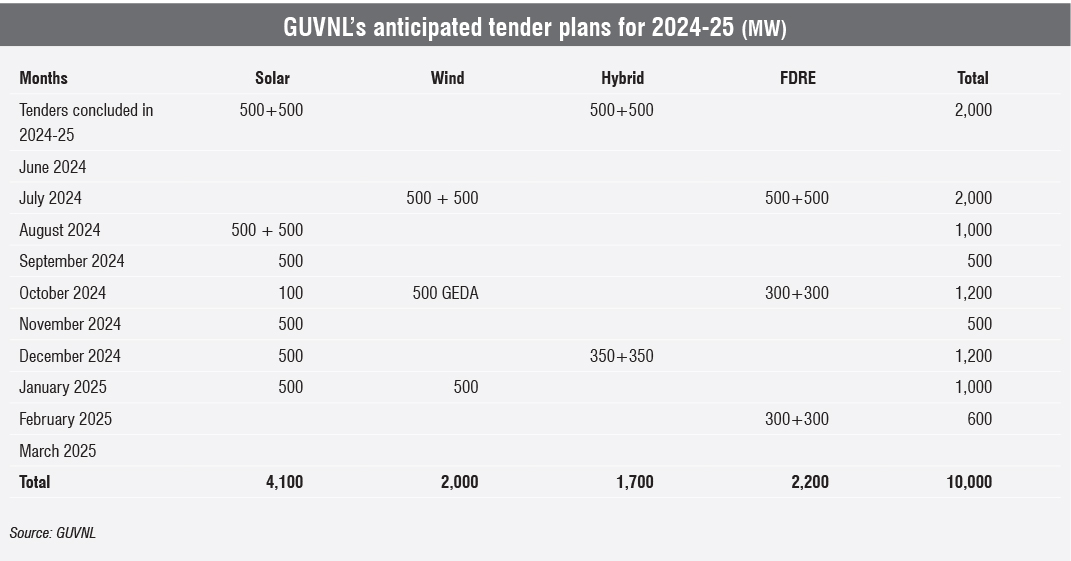
GUVNL plans to tender about 10 GW during 2024-25, of which 4.1 GW is solar, 2 GW is wind, 1.7 GW is hybrid and 2.2 GW is firm and dispatchable renewable energy. Of the total capacity, about 2 GW has been tendered as of June 2024. In addition, Between October 2024 and March 2025, close to 4.5 GW is planned to be tendered.
Gujarat plans to expand its renewable energy capacity by adding 22.54 GW of wind power and 24.69 GW of solar power between 2024-25 and 2030-31, raising its total renewable energy capacity to 73.24 GW. To achieve this, GUVNL intends to release tenders for about 10 GW of new renewable energy projects annually until 2028, aiming to source 50 per cent of its energy from renewables by 2030. GUVNL’s renewable energy partnerships have grown significantly from 970 MW in 2017-18 to 13,085 MW in 2023-24. Going forward, GUVNL plans to increase this to 2 GW in FY2025 and further to 8 GW by FY2028.
Renewable energy developers in Gujarat primarily encounter challenges related to land acquisition and connectivity. To accelerate renewable energy projects, the state government has introduced several initiatives to ease the woes of the developers. It offers wasteland at concessional rates for projects intended for sale to discoms. In addition, recently, a single-window clearance portal called
Akshay Urja was introduced to streamline the approval process.
The rapid growth of renewable energy projects is driving a surge in demand for grid evacuation infrastructure. To ensure developers in Gujarat are able to make informed decisions, GUVNL recently published substation-wise information to address this gap. Additionally, to enhance developer-friendliness in the bidding process, GUVNL has released its annual bid plan, a simplified request for selection and power purchase agreement documents.
With ambitious tendering plans and initiatives to ensure the ease of doing business, GUVNL will play a significant role in achieving Gujarat’s goal of 50 per cent renewable capacity by 2030.
By Jayati Arora
