

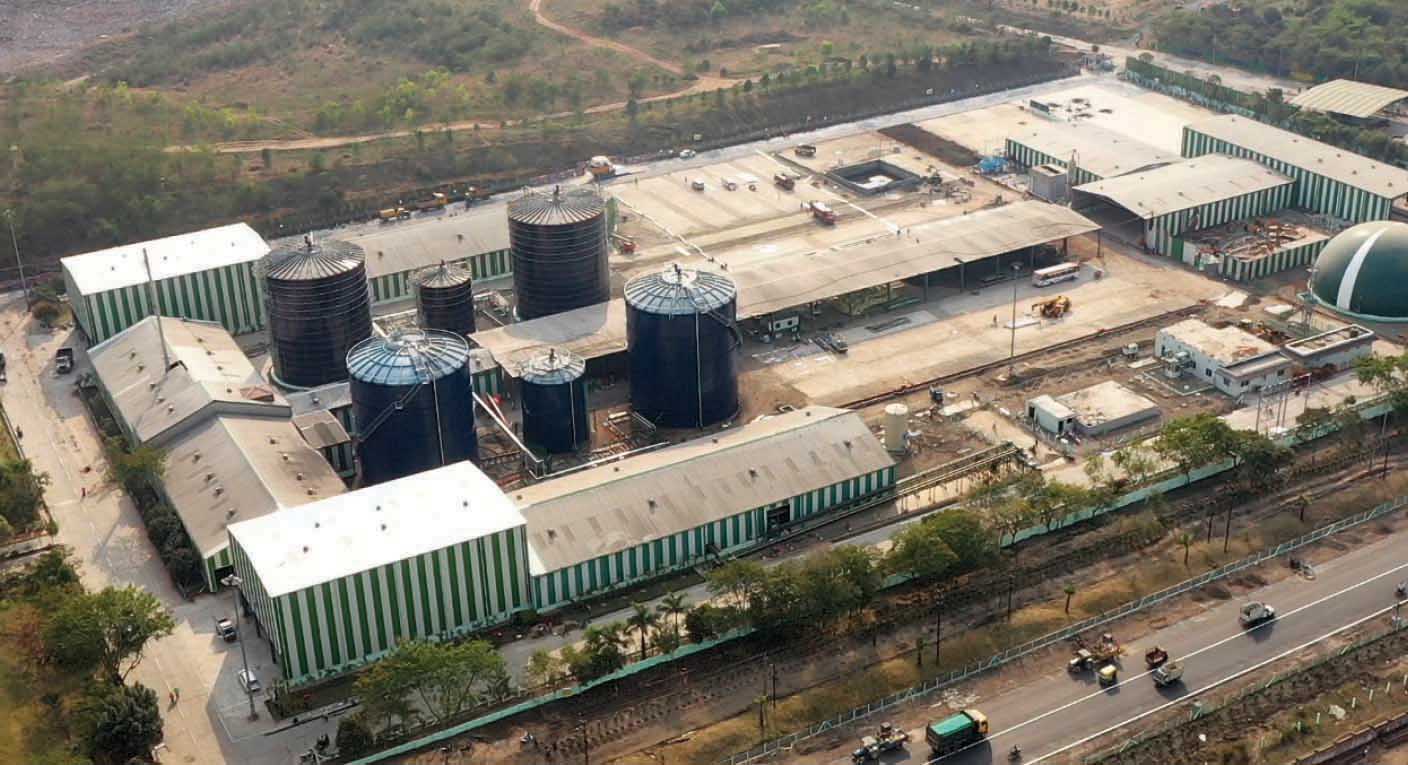
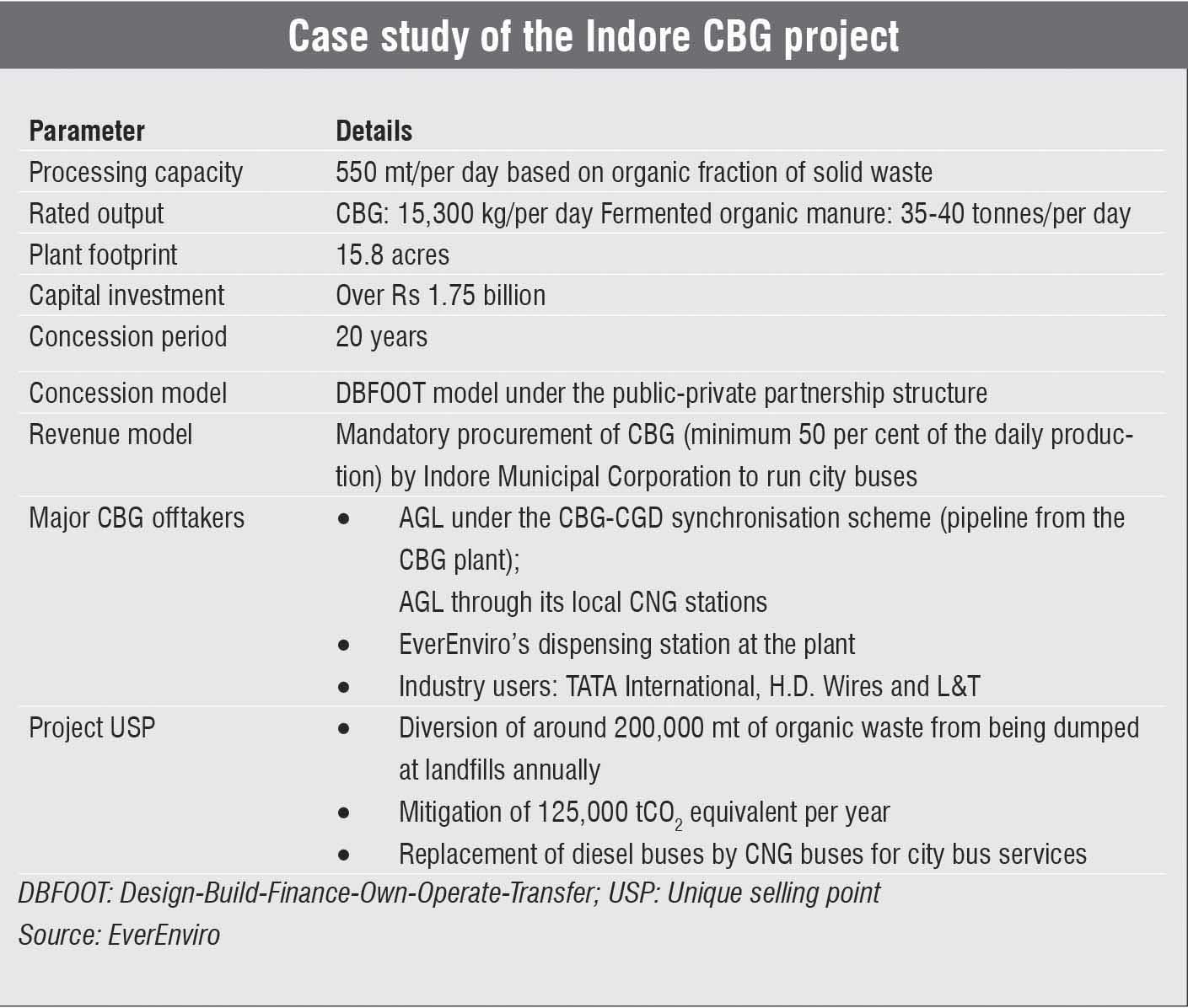
EverEnviro was established in 2019 by EverSource Capital, with anchor investments from the governments of India and the UK. It is building a strong portfolio in the compressed biogas (CBG) space. One of EverEnviro’s key CBG projects is in Indore, which utilises 500-550 metric tonnes (mt) per day of organic fraction of solid waste (OFSW) to produce 15-16 tonnes of CBG every day. The plant was inaugurated on February 19, 2022. In addition, the company currently operates two CBG plants based on paddy straw as feedstock in Punjab (Sangrur and Patiala), and another two CBG plants based on press mud (agro-industrial residue from the sugar industry) in Uttar Pradesh (Balarampur and Lakhimpur Kheri). These five operational CBG plants contribute towards the mitigation of 750,000 tonnes of greenhouse gas emissions (CO2 equivalent) annually.
Additionally, 18 CBG plants in Punjab, the National Capital Territory of Delhi, Uttar Pradesh and Madhya Pradesh based on paddy straw, municipal solid waste (MSW)(organic fraction) and press mud are at various stages of construction. This positions EverEnviro as one of the key CBG producers in India, with mandates to produce 340 tonnes of CBG per day. Overall, EverEnviro has invested over Rs 11 billion in the CBG sector to date.
Currently, EverEnviro is in advanced stages of forming joint ventures with two major oil and gas marketing companies in India – Indian Oil Corporation Limited and Oil and Gas Corporation Limited – to set up multiple CBG plants across India. It is also in discussions with Indraprastha Gas Limited (IGL) to set up CBG plants in IGL’s geographical areas. In the next five years, EverEnviro intends to achieve up to 1,000 tonnes per day of CBG generation based on multiple feedstocks covering all the geographical areas of the country.
Production technologies
According to Deepak Agarwal, executive director, business development and strategy, EverEnviro, CBG plants can be divided into three sections based on the technology deployed:
- Pre-processing section: This is the feedstock preparation section for feeding into the anaerobic digestion for the production of raw biogas. This section plays a major role because different feedstock types require different pre-processing technologies to prepare the most appropriate feed material, which gets digested to the maximum extent while minimising the duration of digestion.
- Anaerobic digestion: This is the core section of the technology where raw biogas is produced through the digestion of organic materials. The technology varies based on the requirement of temperature conditions to be maintained (mesophilic or thermophilic) in the digesters.
- Biogas upgradation: Based on the capital and operations and maintenance (O&M) costs involved and the quality of CBG desired, the technology varies. Options include chemical scrubbing, vacuum pressure swing adsorption and membrane-based separation of methane from other gases.
EverEnviro has successfully cracked the technology part for MSW-based CBG production in Indore, where CBG output is already exceeding the plant’s design production capacity and is working on further enhancing the yield. The company is working towards developing technology to achieve the desired yield for CBG production from paddy straw and press mud as feedstock.
Supply chain management and offtake
EverEnviro follows a comprehensive approach in utilising all three feedstocks OFSW, agro-waste, and agro-industrial waste, for CBG production.
- Paddy straw-based projects: The company has established sustainable supply chain models for paddy straw projects by actively promoting over 100 village-level entrepreneurs. Additionally, it conducts workshops to educate farmers about the drawbacks of crop burning, fostering a holistic and responsible approach to waste utilisation.
- Press mud-based projects: The company has secured long-term partnerships with sugar manufacturers such as Bajaj Hindustan Sugar Limited and Balarampur Chini Mills Limited, ensuring a reliable and competitive supply of press mud for projects.
- MSW-based projects: Under a concession agreement signed with EverEnviro, urban local bodies are obligated to provide a guaranteed supply of source-segregated organic fraction of solid waste to CBG plants throughout the project duration. This ensures a consistent and sustainable source of feedstock for MSW-based initiatives.
EverEnviro has built in-house capabilities to ensure the offtake of CBG, with a dedicated team working to secure long-term CBG offtake agreements under the Sustainable Alternative Towards Affordable Transportation (SATAT) and CBG-city gas distribution (CGD) synchronisation schemes, as well as for industrial users. From the Indore project, CBG is being sold to the local CGD entity Aavantika Gas Limited under the CBG-CGD synchronisation scheme. Additionally, it is being distributed at local CNG stations using cascade-based transportation and to local industrial users such as TATA International Limited, Larsen and Toubro Limited (L&T) and H.D. Wires Private Limited, thereby covering all segments of CNG end users (domestic, transport and industrial and commercial). The CBG produced from the plant has over 96 per cent methane content as against the 90 per cent requirement in national regulations.
Key incentives available and policy suggestions
The government has been proactive in promoting the CBG sector by providing various incentives. In terms of capital financial assistance, CBG plants get Rs 40 million per 4,800 kg per day of production capacity, with a cap of Rs 100 million per project. In addition, under the Crop Residue Management Scheme, the central government provides a 50 per cent subsidy for the procurement of crop residue management vehicles and equipment. To promote organic fertilisers, organic manures such as fermented organic manure (FOM), liquid fermented organic manure (LFOM) and phosphate rich organic manure (PROM) are included under the Fertiliser (Control) Order standards. There is a mandatory offtake of FOM and other organic and biofertilisers with chemical fertilisers, which is known as the “basket approach”. This involves a ratio of three to four bags of compost to six to seven bags of fertilisers. Furthermore, market development assistance is provided, amounting to Rs 1,500 per mt, on the sale of FOM/LFOM/PROM in packed or loose form by CBG manufacturers as well as fertiliser marketing companies.

For the promotion of CBG, two key schemes include the SATAT scheme and the CBG-CGD synchronisation scheme. In addition, exemption is provided on excise duty for the sale of CBG through pipelines. Going forward, there will be mandatory blending of CBG in the CNG (transport) and PNG (domestic) segments, starting from April 2025, and the blending requirement will reach 5 per cent by March 2028.
However, much more needs to be done to give a fillip to the sector. Agarwal’s key policy suggestions include the availability of pipeline connectivity up to the CBG plant from the CGD network, issue of clarifications to avoid double taxation CBG sale via the CNG pipeline network, sale of CBG to OGMCs on a take-or-pay/supply-or-pay basis and issue of guidelines on the monetisation of the Green Credit Scheme.
Overall, it will be interesting to see how EverEnviro navigates the challenges related to supply chain, offtake and technology efficiencies while maintaining profitability and building a stronger portfolio with larger projects.
Based on an interview with Deepak Agarwal, Executive Director – BD and Strategy, EverEnviro, with Renewable Watch

