

By Mandvi Singh, Director, Renewable Energy; and Abhishek Patil, Senior Programme Associate, iFOREST
As India races toward 500 GW of non-fossil capacity by 2030, the central question is no longer whether renewable energy can scale — but whether it can do so sustainably and inclusively. Land is now the decisive bottleneck, with large solar parks increasingly competing with farms for space, water and livelihoods. In this scenario, Agrivoltaics (Agri-PV) offers a way out – co-locating solar panels and crops so land produces both power and food.
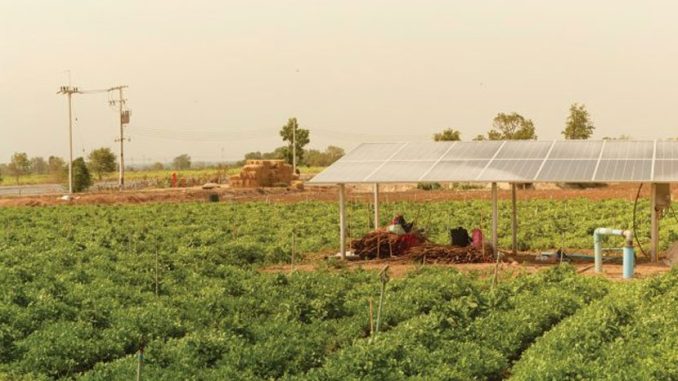
Agri-PV uses elevated solar structures that allow farming to continue underneath and between the panels. When properly designed, it can maintain or even enhance crop yields, generate clean electricity, moderate microclimates and diversify farmer income. Globally, countries such as Japan, Germany and France have demonstrated that agri-PV can boost both land productivity and rural earnings. With abundant sunshine and 146 million small land parcels, India should be a natural leader.
The policy base is already in place. Under the Pradhan Mantri Kisan Urja Suraksha Evam Utthaan Mahabhiyan (PM-KUSUM) Component A, farmers can install 0.5-2 MW solar plants and sell power to distribution companies (discoms), with guidelines that implicitly permit agri-PV and mandate continued cultivation on agricultural land. Yet adoption remains limited: of the 10,000 MW sanctioned, only 587 MW has been installed across six states, and just a handful of these projects qualify as agri-PV.
The current iteration of PM-KUSUM will conclude in March 2026, and the government has already signalled the launch of a 2.0 version. This makes it essential to closely examine the performance and limitations of the present phase – particularly its implications for agri-PV – before designing the next.
Who benefits and who does not
The current beneficiaries of KUSUM-A are largely well-capitalised individuals with land near substations, access to collateral and familiarity with solar markets. Small and marginal farmers, the backbone of Indian agriculture, remain effectively excluded. Requirements such as 4 acres per MW, distance-from-substation rules, lack of developer incentives, low tariffs and collateral-based lending have kept participation narrow and inequitable. If agri-PV is to become truly farmer-centric, schemes must support collectives such as farmer producer organisations, with shared infrastructure and tailored financial products.
Finance: The hardest hurdle
Financing remains the biggest roadblock. Nearly three-fourths of KUSUM-A projects are stalled due to loan delays. Despite priority sector lending status of these projects, banks remain cautious because of high collateral requirements and limited familiarity with decentralised solar. Meanwhile, agri-PV raises capital costs by 15–25 per cent. Tariffs of Rs 3-Rs 3.45 per kWh under KUSUM-A are barely viable for small producers grappling with higher capex and longer payback periods. With project costs averaging Rs 40 million per MW and modest net returns after loan servicing, many farmers ultimately opt out. Performance-linked incentives, tariff rationalisation, concessional credit, blended finance and payment guarantees are essential to bridge this viability gap and make agri-PV investible for small and marginal farmers.
Regulatory and institutional barriers
Land-conversion clearances, inconsistent state procedures and limited hand-holding by state implementing agencies and discoms are further slowing down KUSUM-A projects. Institutional capacity varies sharply across states, creating long queues and cost overruns. Recognising agri-PV as an agricultural activity and creating state-level facilitation cells will remove much of this friction.
Technology and knowledge gaps
Dual-use agriculture requires clarity on panel height, spacing, crop choices, irrigation design, shading impacts and operations and maintenance. This knowledge is scarce among smallholders. Large-scale capacity-building, demonstration plots and standardised guidelines, led by agricultural universities and nodal agencies, are essential for achieving meaningful scale.
A rural transformation opportunity
Despite barriers, agri-PV remains one of India’s most promising pathways for aligning clean energy with farmer prosperity. Each megawatt of decentralised solar can generate 24 job years, spur local manufacturing and reduce land conflicts by embedding solar within farms. The approach also supports climate-resilient agriculture and rural income diversification.
To mainstream agri-PV, India must do the following:
- Provide explicit support to farmer producer organisations (FPOs), cooperatives and rural enterprises to aggregate land, pool risks and negotiate finance collectively.
- Enable viable tariffs, low-cost credit lines, blended finance and crop-plus-solar insurance products.
- Embed agri-PV within agricultural, rural development, irrigation, crop diversification and climate-adaptation missions.

