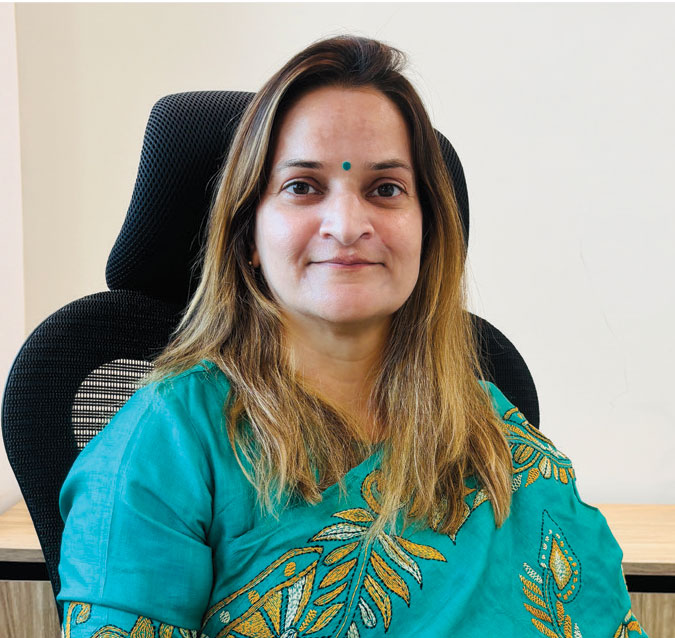
 Since its incorporation in 2009, Arunachal Pradesh Power Corporation Private Limited (APPCPL) has grown from a regional player in the north-eastern region to a pan-Indian power trading company with a strong presence across markets. In an interview with Renewable Watch, Neha Aggarwal, Managing Director, APPCPL, discussed the company’s evolving portfolio, regulatory challenges, the growing role of green power in trading and future opportunities. Edited excerpts…
How has APPCPL’s power trading portfolio evolved in recent years?
APPCPL is a leading power trading company, consistently ranking among the top five in India. Its best position was achieved in 2018, when it ranked second and traded 11 per cent of the total power traded in the country. From its origin as the first and only power trading company in the north-eastern region, APPCPL has since expanded to a pan-India presence. The company has achieved impressive growth, with a 16 per cent CAGR in volume, totalling more than 60,000 MUs since its inception and a 31 per cent CAGR in revenue. APPCPL offers a comprehensive suite of services, including banking, bilateral contracts, renewable energy solutions and consultancy services, all supported by a 24/7 operational control room.
How much of your current traded volume is green power?
Green power is still minimal. This is because most renewable projects are PPA-bound, with very little merchant capacity available. Renewables are also infirm power, which makes it difficult for buyers like discoms or industries to plan their demand forecasting. Solar is somewhat reliable year-round, though variable. Meanwhile, wind power is highly seasonal. So, the share of renewables in the trading volume is only about 10-20 per cent of total volume traded by APPCPL.
How have APPCPL’s Energy Portfolio Management services optimised energy sourcing and cost efficiency for clients?
Our Energy Portfolio Management services have achieved significant success through innovative strategies like the introduction of power banking to most discoms, which is a non-monetary power flow transaction for discoms. By optimising energy sourcing, we have enabled discoms to sell their excess power as green energy, which they were previously selling as non-renewable power, resulting in cost efficiency and revenue growth for them while promoting sustainable energy practices. We have assisted our client by arranging most optimum power sale/purchase solutions in a time bound manner.
What innovative analytics tools or approaches has your team developed recently?
APPCPL developed a trading software that enables clients to directly place bids for power sale and purchase on power exchanges, eliminating manual intervention and minimising errors.
Which of your advisory services are seeing the most traction?
Advisory services regarding the optimal use of renewable energy, portfolio management and regulatory compliance are seeing the most traction among clients. We help clients maximise the value of their solar assets by optimising power trading. We assist generators and consumers in buying and selling solar power at competitive market prices, ensuring maximum revenue and cost savings. Also, by providing strategic advisory services, we help clients navigate complex regulations, including open access policies and renewable consumption obligations (RCOs), preventing legal and financial issues and ensuring compliant market participation.
What are the most pressing regulatory challenges APPCPL’s clients face today? What are the solutions to these regulatory hurdles?
As a market-focused player, APPCPL faces primary challenges in regulatory risks and commercial hurdles. The Central Electricity Regulatory Commission (CERC) and state electricity regulatory commissions heavily influence the market, and changes in tariff rules, open access charges and policies can impact trading profitability.
To overcome these challenges, APPCPL adopts a proactive approach by staying updated on regulatory changes and offering expert advice to clients on complex policies like renewable energy certificates/RCOs and open access, as well as leveraging power exchanges. This strategic focus enables APPCPL to comply with regulations, optimise trading margins and deliver value to clients.
What are the biggest challenges you foresee, in scaling APPCPL’s footprint, and how do you plan to address them?
As APPCPL scales its renewable and energy services, we anticipate challenges in the policy and regulatory environment as India’s power sector is undergoing a significant transformation due to frequent policy updates, especially regarding renewable energy goals, tariffs and open access rules, which are substantially affecting the sector. On the operational challenges front, managing renewable energy portfolios is certainly complex, especially with less accurate forecasting tools available currently, making grid stability crucial.
The financial challenges include managing working capital requirements and mitigating credit risks associated with state-owned discoms. Other major concerns include fluctuating market prices and ensuring liquidity in the power market, which are key market-related challenges. To address these, we stay agile and adapt to changing landscapes by closely monitoring and engaging with policymakers, diversifying funding sources and implementing robust risk management practices. We also focus on building strong relationships with creditworthy counterparties. By taking a proactive and strategic approach, we aim to navigate these challenges and continue growing our business in India’s dynamic power market, capitalising on opportunities in renewables.
What policy reforms or regulatory initiatives would you advocate for to bolster India’s renewable energy market?
With more than 15 years of experience in India’s power market, to promote open access, I suggest standardising rules and procedures across states and reducing procedural complexities and timelines. This would facilitate the seamless integration of renewable energy into the grid.
To enhance power exchange flexibility, I recommend promoting market-based mechanisms like green energy certificates and introducing a green real-time market trading platform. This would create a competitive environment for clean energy and optimise renewable energy utilisation.
For captive solar, I advocate for fiscal incentives, tax benefits and subsidies to encourage industries to generate their own green power. Streamlining regulations and introducing net metering policies in all states would also be essential.
Furthermore, I emphasise the need for regulatory certainty, contract enforcement and grid infrastructure upgrades to support large-scale renewable energy integration. By implementing these reforms, India can create a conducive environment for renewable energy growth, attract investments and achieve its sustainability goals. A proactive and strategic approach would enable the country to transition towards a cleaner and more sustainable energy future, aligning with global climate objectives.
What is your take on electricity derivatives?
Electricity derivatives are primarily meant for the retail market, as they do not involve the physical delivery of power. Anyone who invests in portfolios or commodity exchanges can participate. However, discoms cannot take part because regulators will not allow them to pass on risks to consumers through tariffs. So, derivatives are mainly for investors, not regulated entities like discoms.
Among the various green power trading products, which do you think has the most scope going forward?
As a trader, I would say the bilateral sale of renewable power. It addresses the challenges of infirm power by allowing customised, one-on-one contracts between buyers and sellers. Discoms, being the bulk consumers, prefer predictable and customised power supply. In bilateral arrangements, both buyers and sellers are more secure compared to trading on exchanges, where discovered prices are unpredictable and scheduling is rigid.
Could you elaborate on your views about exchanges versus bilateral trading?
On exchanges, buyers and sellers place bids, and price discovery decides clearance. This makes long-term planning difficult, especially for fulfilling renewable purchase obligations. Real-time markets are primarily for managing the residual loads and not for long-term planning. Bilateral contracts, on the other hand, ensure security for both buyers and sellers at an agreed price.
What are the next steps for APPCPL?
APPCPL is planning to expand its business by adding a generation portfolio to complement its trading operations, with a focus on small-scale renewable projects. Currently in the planning stages, the company is exploring options such as solar and small-hydro projects to diversify its energy offerings and strengthen its presence in the renewable energy sector.
Will these projects be merchant power plants or non-merchant power plants?
We are still in the initial stages of planning. If it is a greenfield project, then it will require a long-term PPA for financial closure, making it a PPA-bound project. However, if we acquire a project that is already partly developed without a PPA, then we are open to merchant capacity as well.
What are your future plans in the power trading space?
APPCPL, a leading power trader, currently offers comprehensive power trading services. We are expanding into advisory services, including tariff filing and bidding-related advisory, to provide holistic solutions to clients. This strategic move will leverage our expertise, drive growth and strengthen our market position in the power sector.
APPCPL currently serves discoms, generators, and commercial and industrial clients nationwide. We are tapping into new markets and providing tailored services to meet clients’ unique needs, further establishing our presence in India’s power sector.
APPCPL has a pan-India presence, catering to clients across the country. We are now focusing on international expansion, planning to extend our power trading services to the BBIN countries (Bangladesh, Bhutan, India and Nepal). This strategic move will enable us to tap into new markets and strengthen our regional presence.