

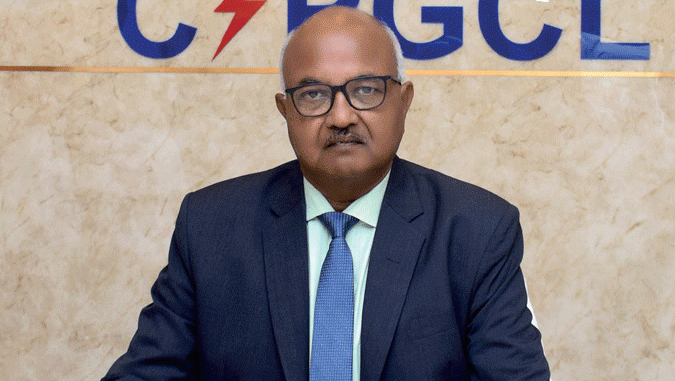
Chhattisgarh State Power Generation Company Limited (CSPGCL), which has a large base of thermal and hydro assets, is actively looking at diversifying its portfolio. In recent years, CSPGCL has taken steps to tap renewable energy sources, including hydro, solar and battery storage-based systems. It is also playing a pivotal role in advancing the pumped storage segment, and is making strategic investments to modernise ageing power assets and meet the state’s growing power demand. In a recent interview with Renewable Watch, Sanjiv Kumar Katiyar, Managing Director, CSPGCL, talked about the company’s installed power capacity, diversification initiatives, upcoming clean energy projects, asset modernisation plans, and long-term vision. Edited excerpts…
What is the current status of the power sector in Chhattisgarh?
Chhattisgarh has a total installed power generation capacity of 23.83 GW. This includes approximately 22.1 GW from thermal sources, 0.28 GW from biomass, 1.2 GW from solar and 0.25 GW from hydropower.
How has the state’s energy mix evolved over the years? How is it expected to change?
In 2000-01, when Chhattisgarh was formed, 99 per cent of power generation was from coal. The only source of green power was the 120 MW Hasdeo Bango hydropower station. Now, in 2024-25, the total installed capacity of the state is 23.83 GW, of which 22.1 GW (93 per cent) is from coal, 1.2 GW (5 per cent) from solar, 0.28 GW from biomass and 0.25 GW from hydro. In the future, the focus will be on renewable power, namely ground-mounted solar, rooftop solar, floating solar and pumped storage hydropower stations. However, being a coal-producing state and given the requirement to meet the growing power demand, the focus will also be on coal-based power generation projects. As per the plan submitted to the NITI Aayog, 43.3 per cent of the total power consumption of the state will be met through renewable energy by 2030.
What are the renewable purchase obligation (RPO) targets for Chhattisgarh? How well is the state prepared to meet these targets?
The RPO target for Chhattisgarh for 2024-25 is to consume 31.41 per cent renewable energy. The state has developed a resource adequacy plan to meet this target.
What are the requirements for grid augmentation to integrate more renewables in the state? What is the current status of green energy corridors in the state?
Grid augmentation has been planned in the state to accommodate renewable energy. However, currently, no green energy corridor has been sanctioned for Chhattisgarh.
What are the key ongoing renewable energy policies in the state?
The state government is framing and issuing various policies for promoting renewable energy generation. To this end, the following policies are already in place:
- Chhattisgarh Solar Energy Policy, 2017-27
- Chhattisgarh State Pump Storage-based Hydroelectric Policy, 2022 (Amended in 2023)
- Chhattisgarh State Small Hydro Power Policy
In addition to the above, the policies framed by the central government, including Pradhan Mantri Kisan Urja Suraksha evam Utthan Mahabhiyan and PM Surya Ghar: Muft Bijli Yojana, are also ongoing in the state.
Please give us an overview of CSPGCL’s existing and operational capacity.
CSPGCL currently operates a total of 2,840 MW of thermal capacity, which includes:
- 4×210 MW Hasdeo Thermal Power Station (TPS)
- 1×500 MW Korba West TPS extension
- 2×250 MW Dr Shyama Prasad Mukherjee TPS, Korba East
- 2×500 MW Atal Bihari Vajpayee TPS, Marwa
In the hydropower segment, it manages 138.7 MW of capacity, comprising:
- 3×40 MW Hasdeo Bango Hydropower Station (HPS)
- 4×2.5 MW Gangrel HPS
- 2×3.5 MW Sikasher HPS
- 2×850 KW Mini Micro HPS, Korba West
Additionally, CSPGCL operates a coal mine with an annual capacity of 5 million tonnes at Gare Pelma in Raigarh district. The mine has been operational since December 2019.
What steps is CSPGCL taking to diversify its portfolio and integrate renewable energy sources?
CSPGCL has been designated as the nodal agency for developing pumped storage hydro projects in Chhattisgarh. PSPs with a cumulative capacity of 7,300 MW have been identified in Chhattisgarh – 800 MW at Bango, 2,100 MW at Rouni, 1,400 MW at Dangari, 1,200 MW at Sikaser and 1,800 MW at Kotpalli. Feasibility reports have been prepared, and clearances from the Ministry of Environment, Forest and Climate Change have been sought.
Further, terms of reference have been issued, and survey and investigation work required for detailed project reports (DPRs) is currently under way. CSPGCL has signed memorandums of understanding (MoUs) with NTPC Limited, THDC Limited and SJVN Limited for developing these projects through joint ventures.
In addition, around 5,000 MW of pumped storage projects have been allocated to the private sector. These are self-identified projects and are currently at various stages of securing environmental clearance.
CSPGCL is also pursuing solar and floating solar projects. An MoU has been signed with NTPC Green Energy Limited for the development of 2,000 MW of renewable energy. The process of forming a joint venture for this initiative is in progress.
Are there any upcoming solar or hybrid energy projects that CSPGCL is actively planning or executing?
Yes, CSPGCL is planning to set up a 500 MWh solar project with battery storage through a joint venture with NTPC Green Energy Limited.
Additionally, a 32 MW solar project with battery storage is being planned on abandoned ash dykes, and a 7 MW floating solar project with battery storage is planned on the balancing reservoir at the Atal Bihari Vajpayee TPS, Marwa. Feasibility reports for both projects have been prepared.
How is CSPGCL addressing the challenges of ageing thermal assets while maintaining grid reliability and efficiency?
The four 210 MW units at the Hasdeo TPS, Korba West, commissioned between 1983 and 1986, were initially scheduled for phased retirement in 2025-26. However, in line with the Ministry of Power’s guidelines, these units are now planned to remain operational until at least 2030. Renovation and modernisation work has been initiated across all four units, some of which have already been completed, with the remainder scheduled for completion by 2026. These upgrades are intended to ensure continued grid reliability and support during the transition period.
What has been CSPGCL’s experience with modernising TPPs?
Capex for renovation and modernisation activities is being approved by the Chhattisgarh State Electricity Regulatory Commission, which has facilitated smooth implementation.
How has CSPGCL performed financially?
CSPGCL has remained a profit-making organisation over the past five years. In FY 2023-24, the company recorded a profit after tax of Rs 7.09 billion (audited).
What policy or regulatory changes would help you accelerate the shift to renewables?
The Chhattisgarh government has already issued policy frameworks to support and accelerate the transition towards renewable energy. These policies have provided an enabling environment for CSPGCL’s diversification initiatives.
How are you working with discoms and local bodies to ensure last-mile connectivity with clean power?
CSPGCL is focused on installing solar and floating solar projects with battery storage to support the last-mile delivery of clean power. Additionally, it is implementing pumped storage hydropower projects through joint ventures with public sector undertakings such as NTPC Limited, THDC Limited and SJVN Limited to enhance grid reliability and power availability across the state.
What are CSPGCL’s future plans? What is your outlook for Chhattisgarh’s power sector?
To meet the growing power demand in the state, CSPGCL has placed an order with Bharat Heavy Electricals Limited for the installation of a 2×660 MW supercritical thermal power project at Korba West. These units are scheduled to be commissioned in 2029 and 2030. Further, the DPR is in the final stages of preparation for an 800 MW thermal unit at the existing Atal Bihari Vajpayee TPS, Marwa.
In the hydropower segment, a proposal from NHPC Limited for developing a 1,000 MW pumped storage hydropower project is under active consideration. This project, too, is being pursued through a memorandum of understanding and potential joint venture arrangements.
