By Devangshu Datta
A review of data by the Central Electricity Authority (CEA) indicates that power demand grew by a moderate 3 per cent year on year in FY 2025, compared to FY 2024 when power demand grew 7.8 per cent year on year over FY 2023. The slowdown was not a surprise.
Power demand is correlated to GDP, and FY 2025 saw a slowdown in GDP growth (estimated at 6.5 per cent) compared to FY 2024 when GDP grew by over 9 per cent. Unseasonal rains in May 2025 also lowered demand in the first quarter (Q1) of FY 2026 (April-June 2025). However, long-term demand should continue to grow at a CAGR of over 5 per cent on the basis of anticipated GDP growth.
Capacity addition did pick up in FY 2025 with an emphasis on renewables. About 33 GW of new capacity was added, with renewables contributing 29 GW (solar alone contributing 24 GW). However, there were disappointments in terms of slippages in the commissioning of new capacities, and merchant tariffs for companies such as JSW Energy were considerably lower. Nonetheless, Tata Power and NTPC Limited both benefited from favourable tariff orders.
Seasonal factors influence demand patterns.. FY 2025 started with a heat wave (up 7.5 per cent year on year in Q1 FY 2025), but this was followed by a surplus monsoon, leading to a dip of 0.7 per cent year on year in demand in Q2 FY 2025. The second half of FY 2025 saw a slight recovery at 2.8 per cent year on year, leading to an overall 3 per cent growth.
Cumulative all-India electricity demand in January-March 2025 (Q4 FY 2025) stood at 416 BUs, compared to 400 BUs for Q4 FY 2024. For Q4 FY 2025, electricity demand improved with the early onset of summer and peak demand reaching 238 GW during Q4 FY 2025. There was an improvement in merchant prices, as day-ahead market (DAM) prices on the Indian Energy Exchange (IEX) in Q4 FY 2025 hit Rs 4.40 per kWh compared to Rs 3.70 per kWh during Q3 FY 2025, but this was still down 9 per cent year on year compared to Q4 FY 2024. By May 2025, however, DAM had stabilised at just above Rs 5 per kWh.
Renewable generation was up 25 per cent year on year to 60 BUs in Q4 FY 2025, while coal-based generation increased 2 per cent year on year to 341 BUs in Q4 FY 2025, and hydro generation increased 23 per cent year on year to 25 BUs. Gas-based generation declined 30 per cent year on year to 5 BUs. The IEX achieved the highest-ever quarterly electricity volume traded at 31,747 MUs in Q4 FY 2025, marking an 18 per cent year-on-year increase.
The CAGR in demand over the past 10 fiscal years (2015-25) is about 4.6 per cent, and the CAGR in the past five fiscal years (2020-25) is 6.6 per cent. So, a projection of approximately 5.5 per cent CAGR in demand for the next five years (2025-30) is reasonable. Roughly, India can expect around 2,200 BUs of power demand by FY 2030. Capacity additions over the same period will have to keep pace to meet this growing demand.
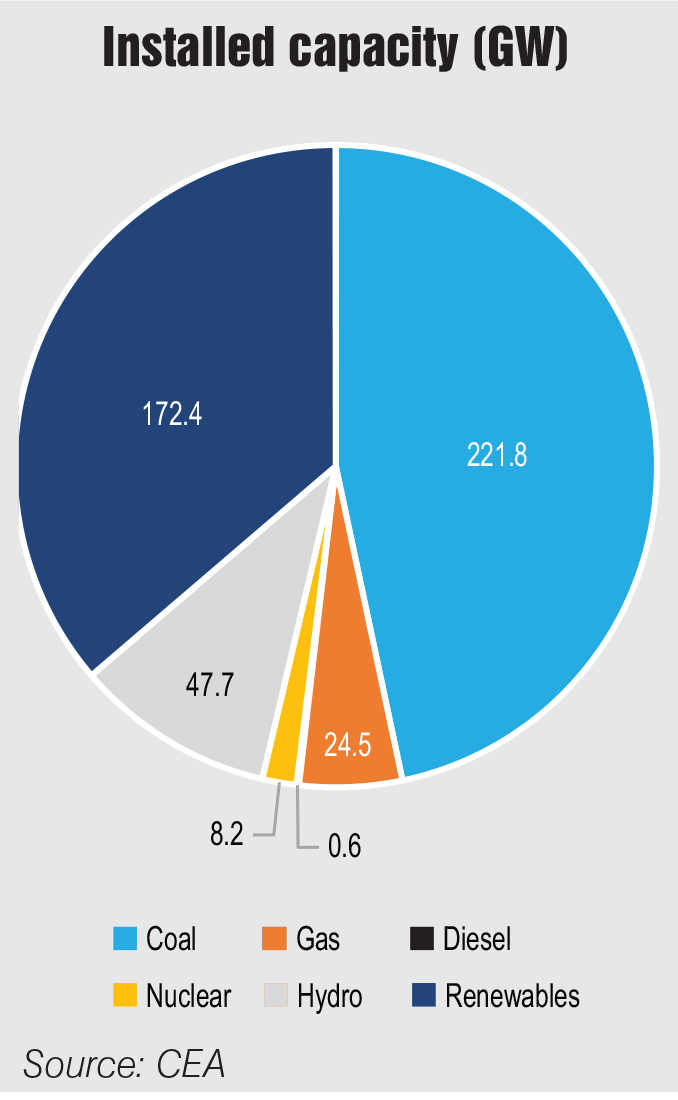
The capacity addition of 33 GW (28.7 GW renewables, 4.2 GW coal and 0.8 GW hydro) in FY 2025 was an improvement in FY 2024, when 26 GW was added (18 GW renewables and 6 GW coal). The past two fiscals have seen a sharp increase in capacity addition compared to the long-term average of 15 GW annual capacity additions. There were some acquisitions as well, such as NTPC Green Energy Limited’s acquisition of Ayana Renewable Power (2.1 GW) and JSW Energy’s KSK Mahanadi (1.8 GW) takeover.
The managements of Tata Power and JSW Energy have commented in their latest earnings calls that they expect peak demand to hit a record 270 GW in the summer of FY 2026, well above the record demand of 250 GW hit in May 2024. The CEA forecasts peak demand requirements of 366 GW by FY 2032, necessitating capacity enhancements across both thermal and renewable energy. India targets an increase of installed capacity to 610 GW by FY 2027 and 900 GW by FY 2032 from the current installed capacity of 475 GW as of March 2025.
There is 34 GW of under-construction thermal coal capacity, which will be commissioned over the next six to seven years. However, there is a need to accelerate the pace of renewable capacity additions. Capacity additions per annum should improve further to over 40 GW in FY 2026, and to 46 GW by 2030, if all the anticipated renewable capacity does come on stream.
Notwithstanding the impressive capacity additions registered in FY 2025, many companies missed their respective addition targets during FY 2025, and Power Grid Corporation of India Limited (Powergrid) missed its transmission and distribution guidance. Profitability was affected by lower merchant tariffs (down 16 per cent year on year).
Among PSUs, NTPC Limited added 4 GW capacity (including 2 GW through the Ayana acquisition), against the guidance of 6 GW. NHPC Limited was unable to complete the commissioning of Parbati III (800 MW) or any units of Subansiri Lower in FY 2025, despite the guidance of 1.5 GW capacity addition. NHPC Limited commissioned Parbati III in April 2025.
Among private players, JSW Energy added an incremental capacity of 3.6 GW in FY 2025, including the acquisition of KSK Mahanadi (1.8 GW). Tata Power gained from improved performance of Odisha discoms, full-capacity operations in its module and cell manufacturing business, a favourable tariff order in its Delhi distribution business (Rs 3 billion), and regulatory benefits (Rs 3 billion) at the Mundra plant, which is operating under Section 11 of the Electricity Act, 2003. ACME Solar saw strong growth in Q4 FY 2025 owing to capacity additions – it has an operational capacity of 2,540 MW as of FY 2025 end compared to 1,320 MW in March 2024.
Powergrid was impacted by a big miss on capitalisation (only Rs 90 billion was achieved against Rs 180 billion guidance). Management attributed the miss to challenges in land acquisition (owing to changes in the compensation policy by the central government starting June 2024), as well as tightness in terms of manpower availability.
 Coal production and offtake were muted in FY 2025. India imported 243.62 million tonnes (mt) of coal in FY 2025 (down 8 per cent year on year) compared to 264.53 mt in FY 2024. Coal India Limited produced 781 mt of coal in FY 2025, around 7 per cent less than the company’s target for FY 2025. As of May 2025, Coal India had around 105 mt in its inventory, with other coal producers holding an additional 20 mt.
On the renewables front, India now has a cumulative module manufacturing capacity of 87,973 MW from 104 manufacturers as per the updated Approved List of Models and Manufacturers issued by the Ministry of New and Renewable Energy (MNRE). The Forum of Regulators recommends exempting electricity duty and cess on input energy for pumping to reduce running costs and encourage investments in pumped storage projects. However, the 2,000 MW Sharavathi pumped storage hydroelectric project in Karnataka is stalled, since the Ministry of Environment, Forest and Climate Change has rejected forest clearance for the project.
As per Mercom India Research, India’s solar market leaders included Adani Green (developer), Tata Power (rooftop), Jakson Green (engineering, procurement and construction), TBEA (string inverters), Sungrow (central inverters), Jinko (modules), Arctech (trackers), Goodluck (mounting structures), ArcelorMittal (open access) and TryPro (robotic cleaning).
Beside solar, the CEA forecasts total wind capacity to reach 73 GW by FY 2027 and 122 GW by FY 2032. As of February 2025, wind capacity stood at 48.6 GW (compared to 48.2 GW in December 2024). The CEA targets an annual wind capacity addition of 10 GW, which is in line with the MNRE’s tender targets of 10 GW of wind (up to FY 2028).
While the projections in solar, wind and coal are fairly clear, gas-based capacity is a question mark. The volatility of fuel pricing and the uncertainty of the administered price mechanism in gas supplies have made investors cautious, and a net 505 MW of gas capacity was decommissioned in FY 2025. However, the MoP has also directed operational gas-based power plants to run under Section 11 of the Electricity Act, 2003, if required to ensure maximum generation during peak summer months.
Nuclear is another source where capacity addition remained zero. However, the Nuclear Energy Mission has a budget allocation of Rs 200 billion to boost nuclear capacity, encourage private sector participation, and accelerate the deployment of advanced technologies like small modular reactors (SMRs). The mission aims to develop at least five indigenously designed SMRs by calendar year 2033 and supports the development of Bharat Small Reactors. To achieve the target of 100 GW of nuclear capacity by 2047, the mission seeks to scale capacity from 8.18 GW to 22.5 GW by 2031-32.
The picture across the sector is that of steady capacity growth and increasing decarbonisation. However, the missing of guidances is a cause for concern, and the targets in the nuclear segment may not be realistic.