By Chetan Singh Adhikari, Head Utilities, REConnect Energy
With the rapid growth of renewable energy sources such as solar, wind, hydro and biomass, along with the rising adoption of battery storage, accurate forecasting and scheduling (F&S) has become essential for ensuring grid stability, optimising power generation and improving energy market efficiency. Since renewable energy is inherently intermittent and weather-dependent, F&S helps grid operators, utilities and energy producers balance supply and demand effectively. However, due to the intermittent and variable nature of renewables, integrating them into the power system presents significant challenges.
Globally, advanced artificial intelligence (AI)-driven forecasting models and smart grids are improving F&S capabilities. India is also making rapid strides in regulatory frameworks related to F&S. This article provides an overview of the current status, challenges, upcoming technologies and strategies for improving the F&S of renewable energy in India…
Regulatory framework for F&S
The Central Electricity Regulatory Commission and state electricity regulatory commissions mandate F&S regulations for renewable energy generators. The deviation settlement mechanism (DSM) imposes penalties for forecast deviations beyond permissible limits. Day-ahead and intra-day scheduling are mandated, and generators must submit generation schedules a day in advance, with real-time updates allowed. There is regional and state-level forecasting, with Grid Controller of India Limited and load despatch centres overseeing grid-level forecasting.
Challenges
Uncertainty and variability: Solar and wind power output is highly dependent on weather conditions, making it difficult to forecast energy supply. Short-term fluctuations in renewable generation create challenges for real-time scheduling. Cloud cover, wind turbulence and seasonal variations further reduce the predictability of renewable energy generation.
Data limitations and modelling complexity: Inaccurate or incomplete meteorological data significantly affects the accuracy of renewable energy forecasts. The limited availability of historical data restricts the ability of AI and machine learning (ML) models to enhance prediction accuracyover time. Additionally, complex terrain and microclimatic effects introduce further increase challenges.
Regulatory and market challenges: Many electricity markets impose strict penalties on power producers for deviations from scheduled generation. There is a lack of standardised forecasting methodologies across different regions. In addition, integrating real-time demand-response mechanisms with renewable energy sources remains a challenge.
Integration with the grid and storage constraints: A mismatch between forecasted and actual renewable energy generation can lead to grid imbalances. There is a lack of efficient energy storage systems to counteract prediction errors. Moreover, existing grid infrastructure is not flexible enough to accommodate fluctuations in renewable energy supply.
Cybersecurity and data privacy concerns: Forecasting and scheduling systems rely heavily on internet of things (IoT) and cloud-based platforms, making them more vulnerable to cyberattacks. Strict data privacy regulations often restrict access to real-time generation data for model training.
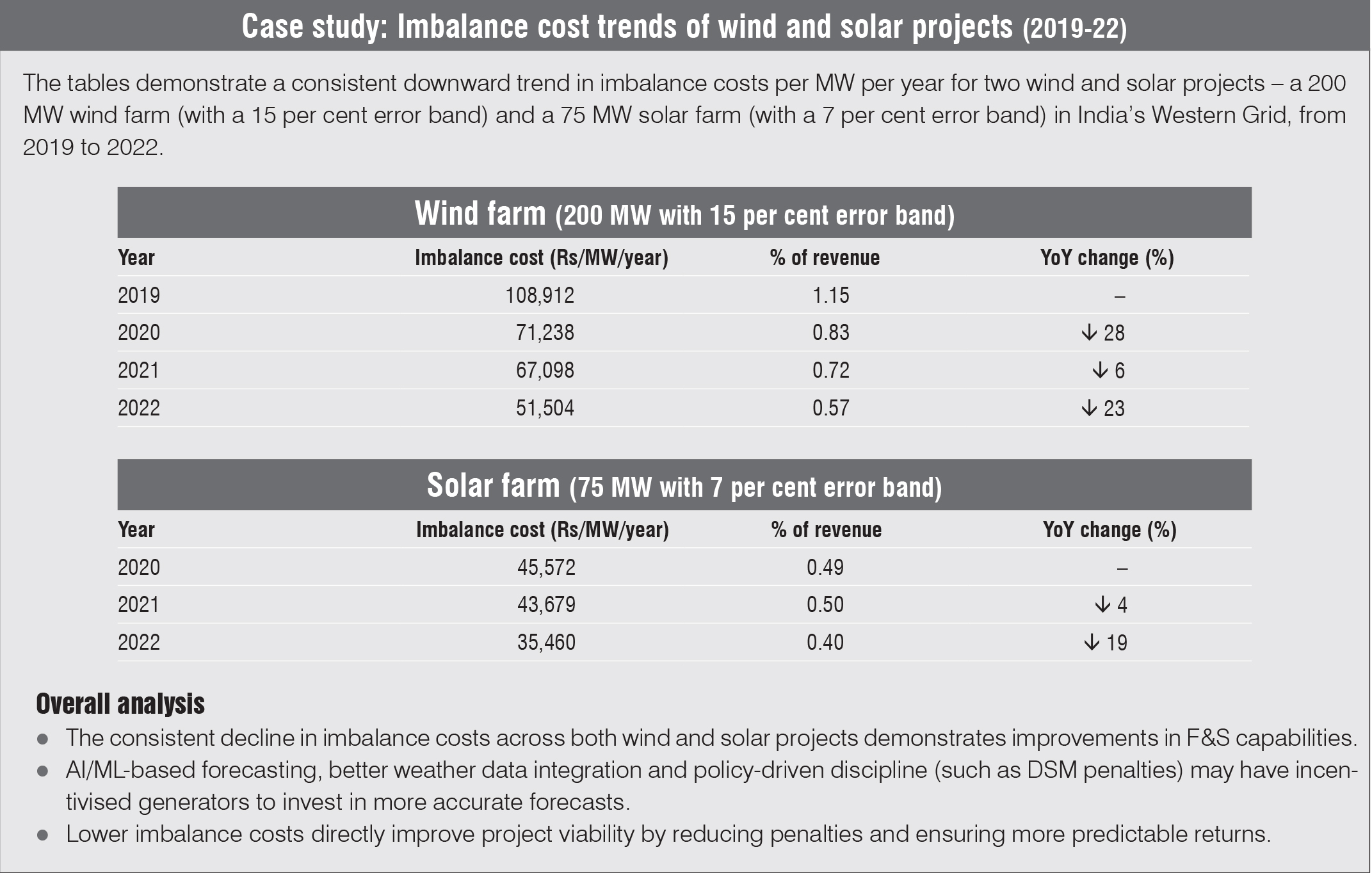
Upcoming technologies in renewable energy F&S
AI and ML: Neural networks and deep learning models significantly improve accuracy. AI-driven self-learning algorithms optimise F&S over time. Ensemble models, which combine traditional weather forecasts with real-time sensor data, enhance reliability.
Satellite and IoT-based forecasting: High-resolution satellite imagery enables the precise tracking of cloud movements. IoT-based real-time sensors measure critical parameters such as wind speed, solar irradiance and temperature, improving data accuracy. Additionally, light detection and ranging and radar technologies provide short-term wind energy predictions.
Blockchain for decentralised F&S: Blockchain technology enables peer-to-peer energy trading with real-time pricing adjustments. It also improves data security and transparency in renewable energy transactions. Blockchain reduces reliance on centralised authorities.
Quantum computing for ultra-accurate weather prediction: Quantum computing enhances computational power for highly complex atmospheric modelling. Quantum algorithms improve long-term forecasts by analysing massive data sets in real time.
Hybrid forecasting models: Hybrid forecasting models integrate numerical weather prediction techniques with AI and ML techniques. By combining short-term and long-term forecasting models, these techniques enhance accuracy.
Digital twins for grid and renewable energy integration: Virtual models simulate real-world renewable power generation and its impact on the grid. These simulations help predict fluctuations and optimise scheduling strategies.
The way forward
Strategies for improving F&S
Strengthening weather data infrastructure: Weather data infrastructure can be strengthened through investment in high resolution meteorological data collection. Going forward, weather monitoring networks should be improved for better forecasting inputs.
Regulatory and market reforms: There should be adaptive penalty structures for forecast deviations and market incentives to encourage accurate forecasting and efficient scheduling. Global standards for F&S methodologies should be established.
Advancements in energy storage: Developing grid-scale battery storage systems can help mitigate F&S errors. Hydrogen and pumped storage solutions should be integrated for energy balance.
AI-driven automated scheduling: AI-powered real-time scheduling algorithms should be implemented. There should be dynamic optimisation of dispatch schedules based on forecast deviations.
Decentralised and community-based forecasting models: The future will involve smart grids and microgrids with localised forecasting mechanisms. Moreover, there will be blockchain-enabled decentralised power trading platforms.
Collaboration between research, industry and governments: Public-private partnerships should be strengthened for the development and deployment of advanced F&S technologies. Investing in open source forecasting platforms is important for shared knowledge and innovation.