Solar energy has significantly transformed India’s power landscape, driven by falling costs, supportive policies and increased investments in technology and infrastructure. The country’s installed renewable energy capacity (including large hydro), according to the Ministry of New and Renewable Energy (MNRE), stood at 209.4 GW as of December 2024. Of this, solar capacity is over 97 GW, accounting for more than 46 per cent of the total renewable energy mix. This is significant, as solar capacity was just 10 MW in 2010. Of the current installed solar capacity, ground-mounted solar holds a significant majority, accounting for 75.1 GW. Rooftop solar and off-grid solar projects, though smaller in scale, have added approximately 15.6 GW and 4.2 GW respectively, with the remaining solar capacity, about 2.77 GW, falling under the hybrid solar category. India added over 24 GW of solar capacity in 2024 (from December 31, 2023 to December 31, 2024) and the majority of this capacity addition is attributed to ground-mounted solar.
India’s solar sector exemplifies how policy, technology and markets can converge to achieve remarkable progress. This growth reflects a well-coordinated effort involving both public and private stakeholders. Ground-mounted solar has played a pivotal role in driving India closer to its renewable energy targets. Rooftop solar, though lagging in comparison, has seen an acceleration in adoption driven by government incentives and targeted policies. Meanwhile, floating solar and hybrid systems have emerged as promising solutions to the challenges of land scarcity and grid variability respectively.
Apart from capacity expansion, India has also focused on scaling up the domestic manufacturing base by placing tariff and non-tariff barriers and providing incentives to manufacturers through production-linked incentive (PLI) schemes.

Renewable Watch presents an overview of India’s solar market – encompassing ground-mounted solar projects, rooftop solar projects, floating solar and solar pumps – as we move into 2025, covering the ongoing developments, tariff trends, recent policy initiatives, challenges faced and the path forward…
Market landscape
According to the MNRE, in FY 2024-25, Rajasthan led solar capacity additions with 5.14 GW followed by Gujarat with 3.25 GW and Tamil Nadu with 1.30 GW. These three states account for almost 61 per cent of India’s total utility-scale solar installations in the FY 2024-25. In the rooftop solar segment the country added around 4.59 GW of new solar capacity in 2024, which can be attributed to the launch of the PM Surya Ghar: Muft Bijli Yojana (PMSGMBY). Within 10 months of the scheme’s launch, more than 700,000 rooftop solar installations have taken place across the country. In the offgrid and distributed segment, around 1.27 GW of solar capacity was added in the FY 2024-25. As per the Central Electricity Authority, 50 solar parks/ultra-mega solar power projects of aggregate capacity of 39,943 MW have been envisaged for development in the country, with 18 being completed as on September 2024. Out of 39,943 MW, 21,289 MW is awarded. Of those that are awarded, a capacity of 11,416 MW has already been commissioned while 9,873 MW capacity is under construction and 18,654 MW is under award/tendering process.
In the utility-scale solar segment, Adani Green Energy Limited, ReNew, O2 Power, ACME Solar and NTPC Renewable Energy Limited emerged as the key developers. Meanwhile, JinkoSolar and LONGi, were the key Chinese companies on the supply side. JinkoSolar introduced the Tiger Neo 3.0 series, optimised for utility-scale projects, while LONGi launched heterojunction back-contact solar cells with 27.3 per cent efficiency.
However, the dominance of Chinese companies is expected to reduce due to anti-dumping tariffs, China’s reduction of tax rebates on aluminium and copper, as well as the introduction of the Approved List of Models and Manufacturers (ALMM)- II. This can prove to be a boon for Indian suppliers, who have already taken significant initiatives over the past year. Gautam Solar announced its expansion plans, with a 5 GW solar module manufacturing facility in Bhiwani, Haryana, set to become operational by April 2025. Further, in January 2024, First Solar inaugurated its new 3.3 GW production facility in Tamil Nadu. In March 2024, Luminous Power Technologies inaugurated the solar panel manufacturing facility in Uttarakhand. In May 2024, Grew Energy announced plans to build a three-stage fully backward-integrated manufacturing plant in Jammu & Kashmir at an investment of Rs 45 billion. In the same month, Adani Solar announced plans to develop a 225 MW solar power manufacturing plant in Puranpura within a year. In August 2024, AXITEC inaugurated a new manufacturing plant in Tamil Nadu, with a production capacity of 300 MW.
The key engineering, procurement and construction contractors included Jakson Green, Sterling & Wilson Renewable Energy Limited (SWREL), and Vikram Solar, which played critical roles in executing large-scale projects over the last year. Jakson Green announced a 2,500 MW solar cell manufacturing facility and launched a new range of high-efficiency solar modules with up to 23.34 per cent efficiency.
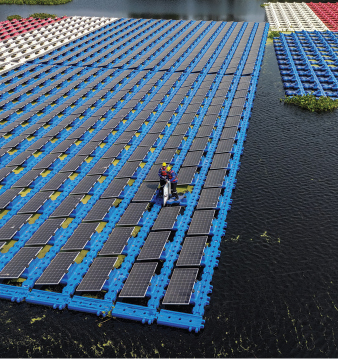
Floating solar projects gained uptake in 2024 as a practical solution to address land constraints and promote water conservation. SJVN Limited made a significant contribution by commissioning a 90 MW floating solar project in Omkareshwar, Madhya Pradesh, in August 2024. At the same site, Tata Power Renewable Energy Limited completed a 126 MW floating solar project in November 2024
Solar tariff trends
Between December 2023 and December 2024, India’s solar power tariffs exhibited notable trends. Renewable Watch Research tracked 16 auctions during this period, where a combined capacity of 19,375 MW was awarded. The lowest tariff observed was Rs 2.15 per kWh, discovered in Rewa Ultra Mega Solar Limited’s 170 MW auction in December 2024, while the highest tariff stood at Rs 2.68 per kWh, recorded in NTPC Limited’s 1,500 MW Tranche III auction in May 2024. The average tariff was Rs 2.56 per kWh for calendar year 2024. This marks a substantial narrowing of tariffs compared to 2023 when tariffs were in the range of Rs 2.51 to Rs 3.92 per kWh, with an average tariff of Rs 2.86 per kWh.
Policy developments
India’s solar energy policies in the past year demonstrated a comprehensive approach to addressing the diverse needs of the sector. These initiatives targeted residential consumers, agricultural sectors and emerging technologies, and aimed at protecting domestic manufacturers, ensuring a balanced development trajectory.
Solar pumps
In January 2024, the government amended the guidelines for the Pradhan Mantri Kisan Urja Suraksha evam Utthaan Mahabhiyan (PM-KUSUM) scheme, expanding its scope to solarise 4,900,000 pumps under Components B and C. Key changes included simplifying the land aggregation process under Component C, removing the mandatory state share provision, and extending the exemption from domestic content requirements until March 31, 2024. Farmers in the north-eastern states, hilly regions, union territories and islands became eligible for central financial assistance (CFA) for pumps of up to 15 HP, up from 7.5 HP. Additionally, cluster and community irrigation projects in high-watertable areas across all states were included. Performance bank guarantees were relaxed under Components A and C to encourage adoption.
Off-grid solar
The MNRE launched a significant off-grid solar initiative in January 2024 under the Pradhan Mantri Janjati Adivasi Nyaya Maha Abhiyan (PM JANMAN). With a budget of Rs 5.15 billion, this programme aims to electrify 100,000 households in particularly vulnerable tribal groups (PVTGs) using 0.3 kW off-grid solar power systems. Solar lighting for 1,500 multi-purpose centres in PVTG areas was also included. In October 2024, the programme expanded under PM JANMAN and the Pradhan Mantri Janjatiya Unnat Gram Abhiyan, with an additional Rs 9.15 billion allocated to solarise 2,000 public institutions.
Rooftop solar
The PMSGMBY, launched in February 2024 with a total budget of Rs 750 billion, aims to provide up to 300 units of free electricity per month to 10 million households. The scheme provides CFA for rooftop solar installations on residential properties and incentives to discoms to streamline regulatory processes and achieve implementation targets. By December 2024, over 700,000 rooftop systems were installed, reflecting the scheme’s rapid progress.
In October 2024, the MNRE announced scheme guidelines for the Rs 5 billion “Innovative projects” component under PMSGMBY. This component encourages advancements in rooftop solar technologies, such as blockchain-based solar trading, and integration with electric vehicles and smart materials. Financial assistance of up to 60 per cent of project costs or Rs 300 million is available for selected proposals.
In January 2025, the MNRE issued several operational guidelines, including enabling utility-led aggregation (ULA) and renewable energy service company models for rooftop solar deployment. The CFA framework limits installations to a maximum capacity of 3 kW under ULA proposals and mandates compliance with domestic content requirement standards. To ensure efficient payment processing, a payment security mechanism was also established with a corpus of Rs 1 billion.
Domestic solar manufacturing
In 2024, the ALMM policy was reintroduced after several reversals. Starting in April 2024, ALMM compliance became mandatory for all solar PV projects, with no exemptions. Further, in December 2024, the MNRE introduced ALMM-II for solar PV cells, expanding the ALMM framework to include domestic solar cell manufacturing from June 1, 2026. Projects using ALMM List-I modules will also require solar cells from List-II manufacturers. Exceptions apply to projects with bid deadlines preceding the order’s issuance. Thin-film technology modules from integrated facilities remain compliant under List-I but must meet List-II standards post-2026.
India also imposed anti-dumping duties on solar glass imports from China and Vietnam to protect domestic manufacturers from undercutting practices in December 2024. Duties range from $565 to $677 per metric tonne and apply to textured toughened glass used in PV panels.
Challenges and future outlook
India’s solar energy sector has made remarkable progress, but it continues to face several challenges across various segments. For ground-mounted solar, issues related to land acquisition and grid evacuation remain prominent. While solar projects can be completed in around two years, transmission infrastructure often takes up to five years to develop, leaving projects operational but unable to despatch power for several years. This mismatch results in significant revenue losses for developers and impacts project viability.
In the residential rooftop solar segment, progress is hindered by several factors. Many state governments already provide electricity subsidies, reducing the incentive for households to adopt rooftop solar. There is also limited willingness among homeowners to give up rooftop space for solar installations, usually because of a general lack of awareness about the economic and environmental benefits of solar power.
The C&I rooftop solar segment, despite its potential, faces challenges such as restrictions on capacity sizes, stringent net metering limits and high open access charges. The constantly changing open access regulations across states create additional uncertainty for businesses looking to invest in rooftop solar.
Floating solar, although a promising alternative to address land constraints, faces its own set of challenges. High capital costs, complex operations and maintenance requirements, and the lack of standardised agreements for water rights deter rapid deployment.
For solar pumps and distributed solar, farmer adoption remains low despite generous subsidies under schemes like PM-KUSUM. Farmers often rely on free or heavily subsidised grid electricity, reducing their motivation to invest in
solar pumps.
In solar manufacturing, while module manufacturing capacity has expanded significantly, backward integration remains slow. India lags in producing critical components such as solar cells, wafers and polysilicon, increasing its reliance on imports and exposing the sector to price volatility. Further, it is hard to secure the supply chain for critical minerals needed to produce solar components.
Compared to 2023, there was a notable decline in the highest tariffs recorded in 2024, reflecting improved cost efficiencies and market competition. The average tariffs in 2023 were significantly higher, ranging up to Rs 3.92 per kWh for smaller projects in geographically constrained states like Assam. This year-on-year reduction underscores the success of India’s competitive tariff-based auction regime in optimising costs and driving down solar energy prices. However, going forward, the tariff and non-tariff barriers to promote solar manufacturing, including the recent imposition of anti-dumping duties, ALMM-II and rising input costs could drive tariffs higher in the near future. Developers may face tighter margins, and end-users could see a slight increase in solar power costs, especially in the utility-scale segment.
However, India remains well positioned to achieve its ambitious solar energy targets despite existing challenges. With a goal of reaching 280 GW of solar capacity by 2030, the country must add approximately 36 GW annually over the next five years. The record addition of 24.5 GW in 2024 demonstrates that this target is hard but still within reach, provided challenges are systematically addressed and efforts are scaled up consistently.
To maintain this momentum, targeted policies and robust infrastructure support will be critical. Priorities include streamlining land acquisition processes, accelerating grid infrastructure development and ensuring a stable regulatory framework for rooftop and open access solar projects. Strengthening domestic manufacturing through incentives for polysilicon, wafer and cell production will also be essential to reduce import dependency and mitigate supply chain vulnerabilities.
Achieving the 2030 target will require coordinated efforts from policymakers, developers and financiers. By addressing current barriers and capitalising on emerging opportunities, India can sustain its capacity additions, solidify its leadership in the global solar market and achieve its decarbonisation goals.