


Aligned with the Government of India’s ambitious electric vehicle (EV) adoption targets, the Union Budget 2024 focuses on accelerating the transition to EVs. Overall, the Indian government aims for 30 per cent of total auto sales to be electric by 2030 and has allocated significant funds to the FAME policy and the expansion of EV infrastructure. Despite these efforts, the high cost of charging infrastructure remains a significant barrier. Stakeholders require continued policy support, incentives for capital expenditure and rationalised GST rates to ensure a cost-effective and economically viable EV charging infrastructure roll-out.
India, with one of the lowest motorisation rates globally, is expected to follow the rapid growth trajectory seen in China and the US. Currently, two-wheelers dominate the market, constituting 80 per cent of total vehicle sales in 2020. To support the expanding adoption of EVs, robust charging infrastructure is vital. The accelerated transition to electric mobility presents an opportunity to improve urban air quality as EVs are zero tail-pipe emission vehicles, reduce dependence on imported oil and combat climate change. India’s goal to have 30 per cent EV sales by 2030 could result in 102 million EVs on the road. This transition necessitates a significant expansion of charging infrastructure across the country to address range anxiety and encourage EV adoption.
The Administrative Staff College of India’s (ASCI) Centre for Energy Studies is currently supporting the Telangana Mobility Valley (TMV), which aims to attract investments worth over Rs 500 billion and create about 400,000 jobs by 2030. This initiative includes the establishment of OEM (original equipment manufacturer) clusters, a dedicated energy storage park for battery production, a testing and certification cluster with test tracks and labs spread across various clusters in Telangana and dedicated partnerships with prominent institutions for research and skilling.
To support the accelerated roll-out of EV charging infrastructure, ASCI, in collaboration with the Natural Resources Defence Council (NRDC), launched a “How to Manual” for siting EV charging stations in Indian cities. The framework developed provides a step-by-step approach to identifying and prioritising sites in urban environments for setting up EV charging infrastructure. This manual, endorsed by Niti Aayog, outlines a step-wise and ground-up approach to identifying sites in urban areas for EV charging infrastructure. The model was specifically applied to Hyderabad to demonstrate its effectiveness, with the aim of supporting state nodal agencies, regulators, city authorities, charge point operators (CPOs) and power utilities.
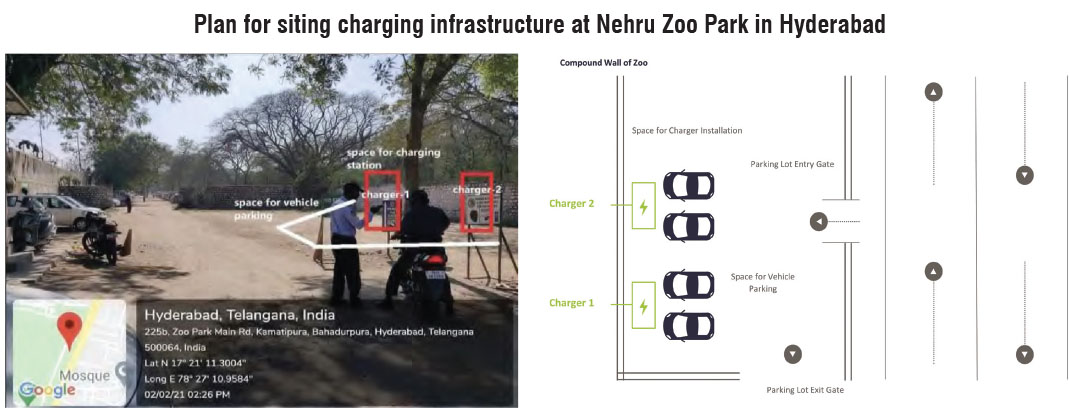 Siting studies are a critical component of the complex process of building a charging network. These studies balance the ratio between EVs and charging stations, encouraging early adoption by reducing range anxiety. Pinpointing suitable areas and making provisions for many EV charging points are important in driving this transition toward zero emission vehicles. A robust siting analysis is one of the first steps to creating an intelligent, equitable charging network. These analyses identify charging gaps and high-traffic locations, establishing benchmarks that measure success by the number of chargers deployed and geographic coverage. They also guide local jurisdictions that control the land use policy, permits, building codes and parking enforcement.
 Initially, siting studies focused solely on minimising range anxiety for EV drivers, but their scope has now expanded significantly. Modern siting studies have evolved to focus on several new objectives, including supporting multi-family housing, promoting equity by filling charging gaps in underinvested communities and aligning charging locations with areas suitable for daytime charging using peak solar power production. While these studies provide top-level information about potential sites for EV charging infrastructure, they also require ground-level assessments for local power capacity, site accessibility and the willingness of site hosts.
Many stakeholders are deeply interested in determining the optimal siting methods for EV infrastructure. International best practices identify three approaches to siting EV infrastructure: the local knowledge stakeholder approach, the modelling approach and the hybrid approach. Each offers advantages depending on the size of the community, budget and data availability.
 One of the critical factors in determining the effectiveness of an EV charging network and the need for additional chargers is the utilisation rate, which should be maximised. Factors that affect utilisation and demand include population density, employment, parking, traffic, points of interest and private chargers in the vicinity. Strategies to maximise utilisation include smart siting, supporting multiple standards and incentivising EV adoption. Further, accessibility is an important aspect, which can be improved with better site selection, charger station density, visibility, ingress, egress and proximity to busy roads.
Much of the infrastructure is yet to be built, making it crucial to formulate a scientific and workable methodology for siting. NRDC, ASCI and their partners are engaging with CPOs, power companies/ utilities, land-owning agencies and all other stakeholders involved to facilitate this process and accelerate EV uptake. This participatory approach is also essential in countries like India, where data on underground infrastructure and vacant land may not be readily available. As a result, the siting of charging infrastructure in Indian cities must largely follow a hybrid approach, involving the active participation of stakeholders. Coordination with utilities and businesses is also required to develop infrastructure efficiently and at a reasonable cost.
 Further, an integrated, efficient and timely approach is needed to implement EV charging infrastructure, its electricity supply, a transportation network and land availability. Strategic siting allows for maximum usage at minimum costs and improved accessibility. ASCI, NRDC and their knowledge partner, EV Advisors, jointly developed a seven-step approach for Indian cities. The method, informed by consultations in Hyderabad, allows stakeholders to rank potential sites based on their viability to support the deployment of EV charging infrastructure in urban environments, thereby supporting India’s EV infrastructure goals.
The approach focuses on three factors for identification and prioritisation/ranking of sites for EV charging infrastructure: costs, both civil and electrical; accessibility, considering multiple parameters like ingress, egress, space availability, surface condition, terrain, security and parking; and equitable access.
Insights from the study and the framework identify that site planning is an important component of locating EV charging in parking areas. The ideal pathway for siting involves CPOs working with site owners to follow the structured step-by-step approach captured below.
Select location and assess preliminary site feasibility: Select locations based on accessibility, utilisation and installation costs. Ideal sites should be near major roads, urban centres, public spaces and existing fuel stations, considering traffic volume and legal requirements.
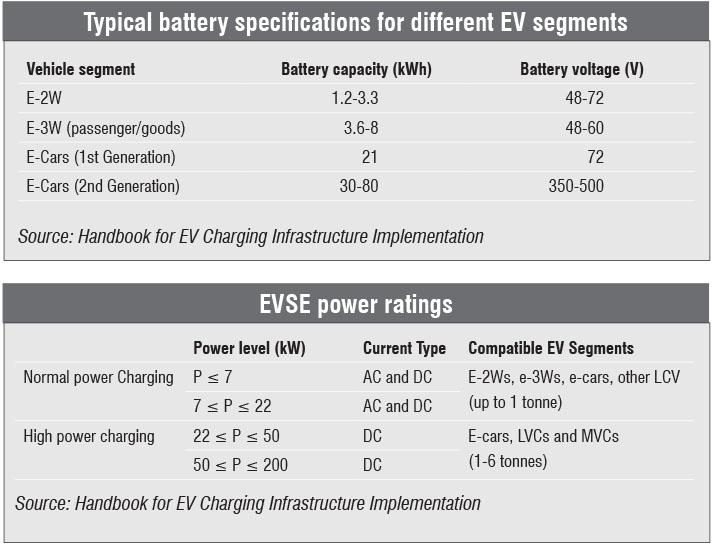
Determine use case and charging infrastructure requirements: Assess the site for specific use-case scenarios and identify the type and number of chargers needed based on prevalent vehicle segments.
Conduct a site visit: Perform a preliminary site survey to assess feasibility, take photographs and create a draft site plan. Investigate any underground infrastructure and evaluate the potential for future expansion.
Assess feasibility and financial viability: Ensure adequate physical space is available for vehicle movement and charger installation. Allocate space for parking and associated infrastructure, adhering to recommended requirements.
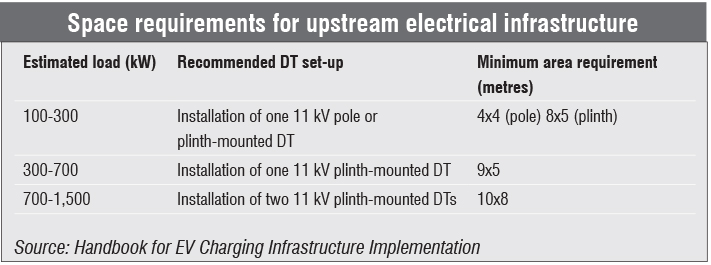
Evaluate power distribution feasibility: Determine the electricity load and connection type required for the site, considering energisation costs and additional infrastructure. Assess the potential for utilising low-tension distribution systems for economic power connections.
Assess accessibility and future expansion potential: Evaluate site accessibility, including convenience fees, 24×7 service availability, entry/exit ease and terrain. Consider potential expansion for additional chargers.
Review safety and develop a detailed site plan: Ensure site safety, considering visibility, security measures, and environmental factors. Obtain consent from property owners and confirm their rights to establish charging infrastructure on the site.
The framework developed is a step-by-step guide that Indian cities can adopt to accelerate the roll-out of state-of-the-art charging infrastructure for next-generation vehicles. Further, given the large number of considerations involved, it provides guidance to regulators and city government authorities on designing charging infrastructure schemes. The approach takes into account the critical role of CPOs and power utilities in the operation of the charging infrastructure. The proposed step-wise approach was applied for siting charging infrastructure in Hyderabad, with a detailed assessment and identification of sites for the deployment of government grant-funded EV charging stations.
Building on the study in Hyderabad, ASCI validated the model developed through detailed EV user surveys at over 50 charging station sites in the city (with about a week spent at each site), identifying the most important factors when choosing EV charging stations. The on-site survey also helped monitor and investigate aspects such as the number of vehicles visiting charging stations each day, the types and brands of vehicles and other factors. Furthermore, the team consulted with CPOs to better understand the costs of civil works and electrical infrastructure (laying power cables and additional transformers if needed). Insights from the study validated the model developed and helped further refine the weightage of various accessibility sub-parameters when ranking and prioritising sites.
Conclusion
Siting public EV charging infrastructure is crucial for developing a robust network in India and alleviating range anxiety. A structured approach involving coordination among regulators, CPOs, land-owning agencies and power utilities is essential. ASCI and its partners have proposed a framework that emphasises coordination. To support this effort, Niti Aayog and the Ministry of Power have also released the Handbook for EV Charging Infrastructure Implementation, which outlines a similar process to better site EV charging infrastructure across the country. Going forward, state-specific programmes should focus on enhancing the power grid, implementing demand-side management and ensuring financial viability for charging operations to meet India’s EV targets and climate objectives.
By Professor Rajkiran V. Bilolikar, Director; Amartya Awasthi, Assistant Professor; Raghav Panjiray – Consultant, Strategic Communication, Centre for Energy Studies, Administrative Staff College of India