

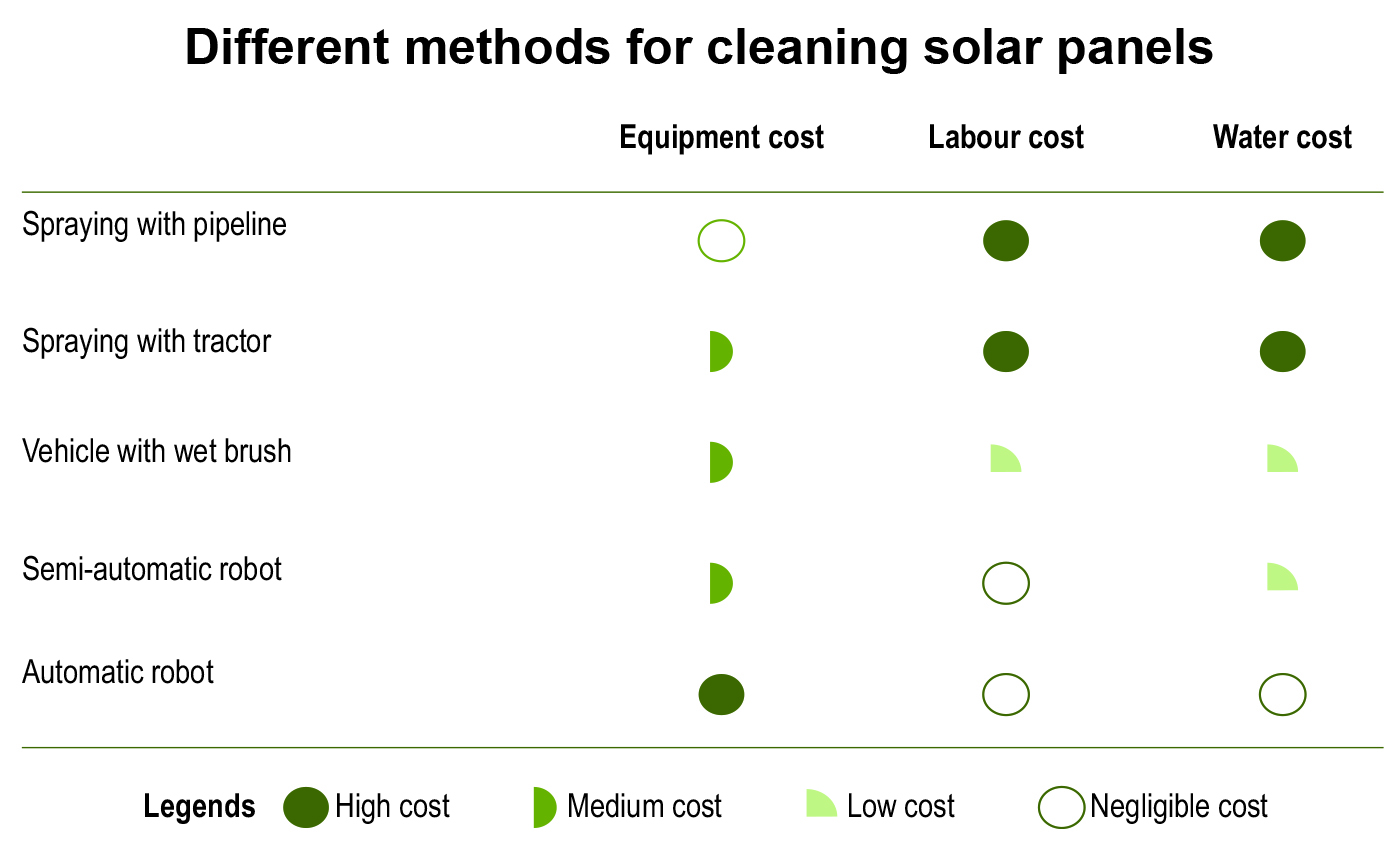
 Solar modules require frequent cleaning to remove dust and other impurities from the panel. Commonly, in India and in many other parts of the world, solar panels are cleaned manually with water using basic tools like hosepipes for smaller projects or spraying water using tractors in larger projects. This is an effective method of cleaning; however, it is not very cost or time-efficient as large solar power projects are spread across acres and acres, and require frequent cleaning.
Further, water availability is also becoming a major concern in many parts of the country. According to industry experts, the amount of water needed to clean a single solar panel is 3-5 litres in normal areas and 7-8 litres in arid areas. In a country like India, where a large number of solar projects are coming up in the arid and semi-arid regions of states like Rajasthan, Gujarat and Madhya Pradesh, this can lead to a challenging situation – not just for module cleaning but also in terms of water availability for local communities. Thus, waterless cleaning solutions are the need of the hour as water is increasingly becoming a costly and scant resource in many regions.
To address this issue, manual waterless cleaning systems are being adopted that use techniques such as dry brushing, air pressure or specialised cleaning pads to remove dust and dirt. These waterless solutions have the added benefit of reducing the risk of mineral deposits on the panels. However, since these waterless cleaning systems are manual, they do not address the concerns regarding the significant time and manpower requirements, and thus, automated module cleaning using robots emerges as a viable solution in such cases.
Such robots and semi-automated cleaning systems have gained tremendous popularity in recent years, especially in the case of large utility-scale solar projects. Although incorporating such robots may be expensive in the beginning, the long-term benefits in terms of improved cost-efficiencies, reduced labour requirements and improved performance far outweigh the capital expenditure. Further, at challenging project sites, where frequent manual intervention is not safe, these robots can reduce the risk of accidents. Most of these robots are equipped with sensors to position themselves and use robotic arms or tracks to move along the solar panel surface. They can use either water-based or brushing-based mechanisms to clean panels.
Robotic solutions are now being integrated with advanced digital technologies such as artificial intelligence (AI) and internet of things to further enhance efficiency. Such robotic cleaning solutions can autonomously predict when cleaning is required based on the dirt deposition on these panels. They follow predefined cleaning patterns and many of the recent models are now equipped with smart monitoring and control functions. Advanced robots are also designed to collect data on system performance, which can be used for valuable analysis later.
With the expansion of the Indian solar market in recent years, marked by large multi-GW portfolios with project sizes going up to hundreds of MW, there has been a clear trend towards the increasing uptake of solar robotic solutions. For instance, Airtouch Solar, an Israeli robotic cleaning solutions provider, announced the signing of multiple large contracts in the past few months. It signed agreements with companies such as Adani Green Energy Limited, ReNew and ACME to supply and install water-free robotic cleaners. Similarly, another robotic solar cleaning company, Sunpure reported multiple contracts in the past few months including agreements with Juniper Green Energy Private Limited and AmpIn Energy Transition Private Limited.
Some innovative products and companies in this space are:
 Aegeus Technologies has a solar panel cleaning robot called Unicorn, which provides users with the flexibility to choose the cleaning frequency. Further, it is self-cleaning and self-powered and can be deployed over both rooftops and ground-mounted projects. It has the capability to differentiate dust from bird droppings or panel breakage, and does not require water for cleaning. Instead, it has three cleaning mechanisms – a microfiber that wipes the panel surface, controlled airflow, and gravity to ensure the downward flow of dirt and grime.
- Airtouch Solar has autonomous robotic solutions with features like wind blowing for removing heavy soiling particles, automatic self-cleaning, and microfibre dust wipers.
- Founded in 2013, Ecoppia has a suite of fully autonomous robots and a cloud-based module cleaning platform. Ecoppia’s H4 robot is a smart solution suitable for both fixed tilt and single-axis tracker solar projects. The product comes with various features such as helix technology for enhancing cleaning quality, speed adaptability, bidirectional cleaning and a flexible frame.
- Hekabot offers automatic panel cleaning robots equipped with the AL and SS304 hardware that help to reduce the weight of robots. Further, the robot can detect soiling and clean it with three layers of brushes and controlled airflow without using any water. The robots are integrated with AI and data-driven technology.
- Indisolar’s robots are self-powered and automatic and use soft nylon bristled brushes that rotate at high speeds and lift the dust away from the panels. These robots travel on a rail tube length-wise and return to their docking positions in one cleaning cycle.
- Skilancer Solar designs and manufactures automatic, self-powered, waterless robotic cleaning solutions for rooftop and utility-scale solar projects. These robots are centrally controlled and use AI, allowing users to control them remotely. Further, users can get solar plants’ generation reports from these robots, and also get regular performance reports on the robots.
- Tamil Nadu-based company Sleepwalkers has introduced Zero Dirt-BOLT to remove dust from solar panels without using water. This automated device does not need rails to travel and can be used for both rooftops and ground-mounted projects. It can work for fixed tilt as well as single-axis trackers. The robot has a lithium-ion battery to power it, and can go up to 2-3 km in a single charge. Further, depending on the project location, it can clean more than 2 MW of solar panels in a day. The company manufactures such robots in automatic and semi-automated variations, and they have dry, wet and hybrid cleaning techniques.
- Beijing-based Sol-Bright Technology introduced its Gen.6 automatic robotic cleaning systems, which are suitable for utility-scale solar projects in India. The product has a lightweight design, an aluminium frame to reduce corrosion, can withstand high winds and uses gear transmission. It features a roller brush that rotates at a speed of 130±10 rpm and dry cleans the panels.
- Taypro Private Limited provides various autonomous solar cleaning robots, including Taypro 2.0, which is a waterless semi-automatic robot, and Taypro 2.1, a waterless automatic cleaning robot as well as anti-duct solar shields.
Outlook
According to a market study by Coherent Market Insights, the global solar automatic robotic cleaning market will grow at a rate of 11.2 per cent between 2021 and 2028, and is expected to cross $380 million by 2028. Further, battery-based autonomous solutions are expected to dominate the market. As ground-mounted solar projects are often larger in size, there is expected to be a higher uptake of robotic cleaning solutions in this space rather than in the rooftop solar segment.
However, the choice of cleaning technology largely depends on the project site and the costs involved. If automatic robots are being used, they need to be integrated right at the design stage to optimise and incorporate module mounting structures accordingly at the very beginning. In the case of semi-automatic robots, they require manpower since they are “pick and place” robots and need to be transferred manually from one table to another. While semi-automatic robots are cheaper
than automatic robots, they still require manual handling.
Further, the cleaning technique and products utilised should be in line with the solar module manufacturer’s warranty and product maintenance guidelines. If water is being used, then only clean water should be used. Moreover, in any cleaning technique, no undue pressure should be applied to the panel surface. Finally, utmost attention should be paid to the safety of the maintenance personnel who are deployed for cleaning solar modules.

