

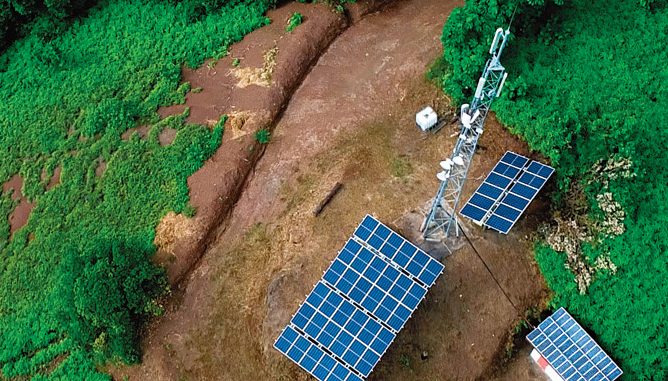
The telecom industry is undergoing a significant transformation towards environmentally conscious operations, with the integration of renewable energy and sustainability practices into network operations. The industry’s high carbon footprint, coupled with the surging demand for connectivity, has enabled a shift towards greener networks. Moreover, energy costs continue to account for 20-40 per cent of network operating expenses on average and 80-90 per cent of network spending, excluding site rental costs. In view of this, conventional backup power sources, such as diesel generators (DGs), are being replaced with renewable energy in telecom networks.
Need for sustainability
According to the GSMA, telecom operators are responsible for 2-3 per cent of global energy consumption. The European Commission forecasts that emissions from the ICT sector, if left unmitigated, could account for 14 per cent of global emissions by 2030. While power consumption per unit of network traffic has decreased over the past decade, 5G networks are expected to reverse this trend, requiring significantly more energy – up to 140 per cent more in some scenarios – than 4G networks, primarily due to the increased need for cell towers. This is despite the fact that individual 5G network components are more efficient than previous technologies. For example, rectifiers have already achieved 98 per cent energy efficiency. Furthermore, data traffic is set to escalate sharply by around 60 per cent with the proliferation of connected devices. According to a report by the Japan Science and Technology Agency, the global IP traffic is estimated to increase by 30 times by 2030 from the present, and 4,000 times by 2050. Its electric power consumption is estimated to reach 42 PWh per year in 2030 and 5,000 PWh in 2050, significantly higher than the current 24 PWh. These factors have prompted telcos to adopt an accelerated approach to achieve their net-zero targets.
Telcos ramp up initiatives
Bharti Airtel
Bharti Airtel has committed to reducing absolute Scope 1 and 2 greenhouse gas (GHG) emissions by 50.2 per cent and Scope 3 GHG emissions by 42 per cent by financial year 2031 (using 2021 as the base financial year). The first two categories represent the direct emissions generated by telco operations and purchased energy, while Scope 3 accounts for indirect emissions, including the supply chain. The telco has committed to achieving net zero emissions (aligned with 1.5 °C emission scenarios) by 2050, following recommendations from Science-Based Target Initiatives (SBTi). Airtel is expanding the use of green energy across its operations and with its partners by utilising open access green energy and solar power.
During financial year 2023, the operator consumed 156,698 MWh of renewable energy in its operations. It claims that its 5G towers will generate 86 per cent lower carbon emissions for every GB compared to what 4G towers would consume during peak hours. By the end of 2022-23, 177 of its network sites had been solarised, with an installed capacity of over 1.2 MWp at telecom tower sites spread across the country. To lower its reliance on fossil fuels, Airtel has implemented several energy-saving and emission-reduction strategies across its network infrastructure. For example, under the Project Green City initiative, 43 per cent of network sites, including those owned by both Airtel and its partners, have been tagged as green sites, consuming less than 100 litres of diesel per quarter. To optimise energy use and reduce the dependence on diesel, Airtel has installed lithium-ion (Li-ion) and valve-regulated lead-acid batteries. Through increased utilisation of passive infrastructure, the telco’s site-sharing strategy with partners has optimised resource usage and significantly reduced carbon emissions. Around 39 per cent of its newly rolled-out sites are co-located. Further, Airtel has implemented an auto-resource shutdown feature at over 160,000 sites, including all 4G sites, thereby reducing energy requirements during non-peak hours. It is also leveraging artificial intelligence and machine learning solutions to deactivate radios with less load while other cells manage the traffic.
Reliance Jio
Reliance Jio has set a SBTi validated target of 76 per cent reduction in its absolute Scope 1 and Scope 2 GHG emissions and 66.5 per cent in absolute Scope 3 GHG emissions by financial year 2028, compared to the base financial year of 2020. The telco has also committed to increasing its annual sourcing of renewable electricity from 1.2 per cent in financial year 2020 to 100 per cent by financial year 2029, and to continue sourcing 100 per cent renewable electricity through financial year 2030. In addition to setting up 161 MW of solar power at over 17,000 sites, Jio has started using wind power and methanol fuel cells to reduce its carbon footprint. The operator has minimised its use of DGs by implementing initiatives such as DG run-hours optimisation and time division duplex (TDD). With the increased use of renewable energy, Jio reduced its carbon emissions by 156,959 tonnes. The operator’s total energy consumption during financial year 2023 was 5.28 million MWh, with 0.13 MWh sourced from renewable sources.
Jio has joined the SBTi campaign to accelerate the move towards the 1.5 °C future and has set targets to significantly reduce its carbon footprint and emissions from network operations. The telco has implemented initiatives to optimise energy consumption across all facilities. These include energy-saving technology solutions in the 2.3 GHz TDD band, which entails turning off radios during non-traffic hours; smart lighting systems and motion sensors for lighting load reduction in all server halls; DG demobilisation for identified sites where low-utilised DGs are replaced with a 100 amp-hours additional Li-ion battery; and optimisation of DG run-hours by prioritising batteries to run site operations in the absence of grid power.
Vodafone Idea Limited
While Vodafone Idea Limited (Vi) has not yet announced a net-zero target, it has taken steps to reduce its GHG emissions across operations. With over 75 per cent of the telco’s base transceiver stations (BTSs) being outdoor, it has achieved a 25 per cent reduction in energy consumption compared to indoor BTSs. Vi’s diesel elimination project to reduce its carbon footprint covered over 13,000 sites in financial year 2023, with solar-based generation at over 1,000 co-owned sites. More than 95 per cent of them were deployed at existing 2G sites and/or shared sites. According to the telco, 100 per cent of the telecom hardware it procured is low-power-consuming equipment. The company continued its active energy-saving equipment initiatives such as using power-saving features during low-traffic periods. All new packet core deployments as well as new mobile satellite service/voice over LTE circuit-core deployments by Vi utilise cloud architecture.
Global scenario
On a global scale, 24 per cent of the electricity used by operators in 2022 was from purchased renewables, up from 18 per cent in 2021. According to GSMA data, 62 operators, representing 61 per cent of the industry by revenue and 46 per cent by connections, committed to adopt science-based targets science-based targets to rapidly decrease their direct and indirect emissions by 2030. A large number of operators have also set targets to achieve net-zero emissions by 2050 or earlier, accounting for 39 per cent of mobile connections and 43 per cent of global revenue.
Policy support
The government has taken a series of initiatives to promote sustainable strategies and initiatives in the telecom industry. Most recently, the Ministry of Power notified the second amendment to the Green Energy Open Access Rules, 2022. The new notified rules allow any consumer with a contracted demand or sanctioned load of 100 kW or more, either through a single connection or multiple connections aggregating 100 kW or more within the same electricity division of a distribution licensee, to procure power through green energy open access. This will make it cost-effective for the telecom sector to meet its energy requirements while also contributing to the country’s renewable energy use targets.
Towards a greener future
The integration of renewable energy in telecom networks is the right path forward. However, achieving sustainability goals requires a high level of collaboration among operators, infrastructure vendors and suppliers, and adoption of new business models. Innovations in the energy market and collaboration between the government and the private sector are essential to accelerate the transition to clean energy. The move towards net zero will also depend significantly on technological advancements and the integration of sustainability into business practices.
