Within a solar power project, balance-of-system (BoS) equipment plays a critical role in ensuring efficient and reliable operations. Mounting structures and trackers form the backbone of BoS, directly influencing energy output, project economics and long-term performance. As solar capacity additions accelerate, demand for solar trackers and mounting structures has also risen. Further, with declining solar tariffs, the industry’s focus has increasingly shifted towards innovation in mounting and tracking solutions to achieve higher efficiency and improve overall project viability.
Meanwhile, the growing emphasis on distributed segments such as rooftop solar and solar water pumps has intensified the need for flexible and cost-optimised mounting and tracking solutions. While the adoption of these technologies has delivered meaningful gains in power generation, it has also introduced new challenges, including higher installation and operations and maintenance (O&M) costs, as well as increased land requirements.
An overview of the two technologies and key innovations in the solar BoS space…
Mounting structures
Mounting structures are used to hold solar panels securely and position them at the right angle for maximum power generation. Broadly, mounting structures are classified into three types: fixed-tilt, seasonal-tilt and tracker-based systems. In fixed-tilt systems, panels are permanently installed facing south, whereas seasonal-tilt structures allow the angle to be adjusted periodically through the year. Meanwhile, tracker-based systems follow the sun’s movement to maximise electricity output.
Trackers
Solar trackers are systems that move photovoltaic (PV) panels to follow the sun’s path, allowing panels to capture more sunlight during the day compared to fixed-tilt systems. Based on movement, trackers are classified as single-axis, which rotate along one direction, and dual-axis, which move both horizontally and vertically for higher energy output. Trackers also vary by drive mechanism. Active trackers use motors for precise movement, while passive and manual systems are simpler but less accurate. Control systems can be open loop (pre-programmed), closed-loop (sensor-based), or hybrid, combining both approaches to improve accuracy and reliability.
Recent technology developments
Recent developments in solar trackers and mounting structures are increasingly focused on improving efficiency, reducing costs and adapting systems to site-specific conditions. Manufacturers are placing greater emphasis on faster installation, higher energy output and smarter system design.
In recent months, key developments in the solar tracker space include the launch of the NX Anchor solar tracker foundation system by NextPower in India. Designed to work with NX Horizon trackers, the system helps accelerate solar project installation, lower overall costs and improve reliability across different soil conditions.
Similarly, Arctech has launched SkyWings, a solar tracking solution enabled by patented bidirectional slew drives. It is a dual-row solar tracker designed with a multi-point drive mechanism. In another development, Antaisolar has inaugurated an intelligent solar tracking system, AT-Spark. Designed for large utility-scale solar projects, it offers a fully integrated solution that improves performance from project installation to long-term operation.
Furthermore, artificial intelligence (AI) is poised to play a transformative role in enhancing the performance of solar tracking systems by leveraging real-time weather data and predictive analytics. Digital twin technology is emerging as another powerful tool for optimising solar trackers as it identifies power anomalies, prioritises repairs and improves efficiency, providing comprehensive management for solar and wind energy assets.
One of the biggest product innovations when it comes to mounted structures is the launch of pre-assembled and modular mounting kits, which significantly reduce on-site installation time and labour costs. At the same time, the use of lightweight aluminium mounting structures is increasing, particularly for rooftop projects in coastal and high-humidity zones. Given India’s wide geographic and climatic diversity, region-specific mounting solutions are gaining uptake. Manufacturers now design structures based on local wind speeds, soil conditions, humidity and temperature levels, and seismic safety requirements. This location-based engineering improves structural strength, ensures long-term reliability, and supports consistent project performance.
Key challenges
While module-mounting structures and trackers are critical to the performance of a solar power plant, they also present several persistent challenges for developers and engineering, procurement, construction players. According to Freyr Energy, in solar plants, mounting structures already make up 8-10 per cent of the total project cost. A key challenge developers face while integrating solar trackers is additional costs associated with the technology. According to KP Green Engineering Limited, the use of single-axis trackers provides an energy gain of 15-25 per cent, while dual-axis trackers can improve a plant’s energy output by 30-40 per cent, depending on site conditions, terrain and tracker design.
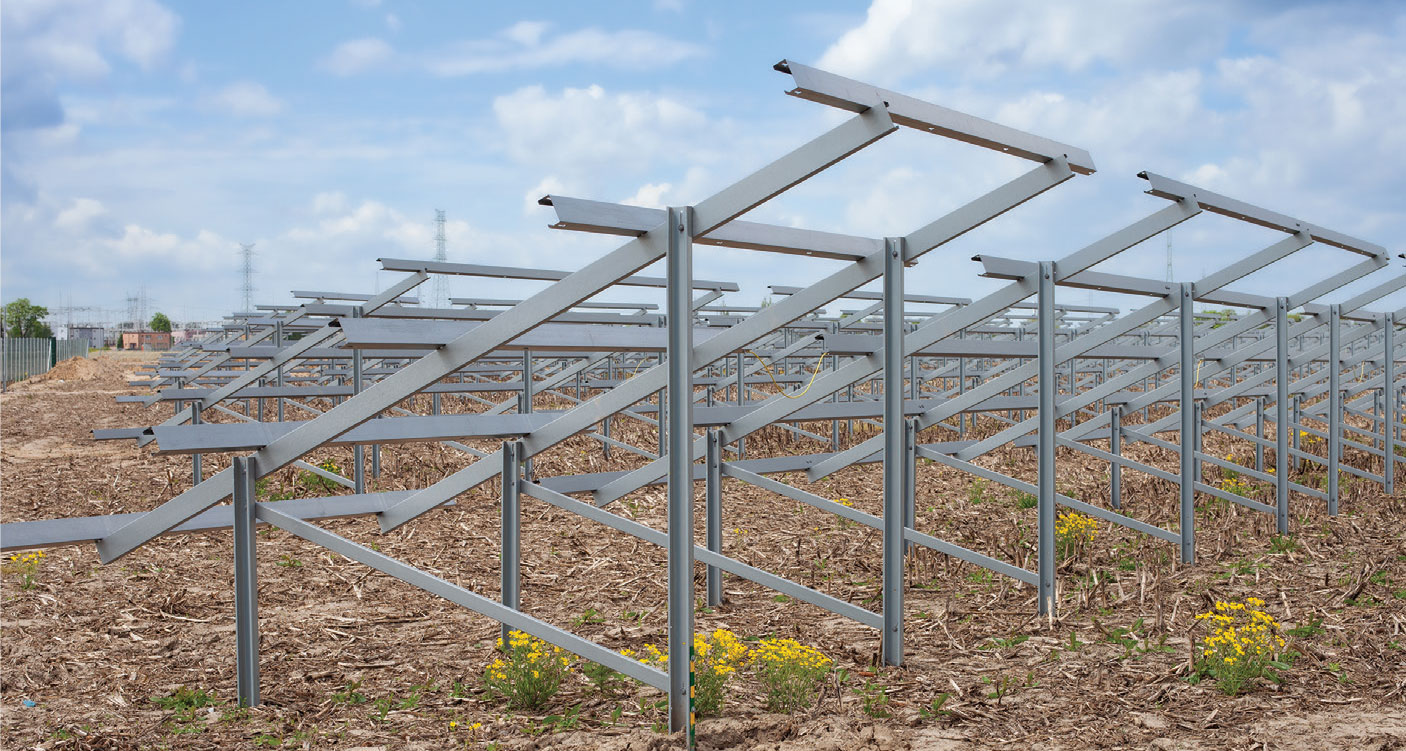 However, these efficiency gains come at a cost. Single-axis trackers add 11-14 per cent to the cost of a fixed tilt system. Trackers also increase land requirements. While fixed-tilt systems typically need about 4 acres per MWp, single-axis tracker-based projects require close to 5 acres per MWp, according to Bridge to India Research. Therefore, the feasibility of deploying trackers depends heavily on land prices. In India, land procurement is often time-consuming and complex, further limiting the widespread adoption of tracker systems despite their efficiency benefits.
Apart from higher upfront investment needed for installation, trackers and ground-mounted systems face increased maintenance requirements and design complexity, thereby increasing overall O&M costs. Further, the rapid advancement of PV module technologies, such as larger and bifacial modules, poses compatibility challenges for local tracker and structure manufacturers. These evolving designs often require frequent upgrades in mounting and tracking systems, which increases research and development costs and complicates production.
Another significant challenge is the lack of broad standardisation and mature local manufacturing for solar BoS components. This can lead to quality variations, inconsistent design practices and uncertainties in project performance. Since local manufacturing capacity for specialised BoS components is still developing, the scope for economies of scale is limited and supply chains remain fragmented. This slows down the development of a resilient and competitive domestic ecosystem for trackers and mounting structures.
Outlook and the way forward
India’s solar sector is expanding at an unprecedented pace. Of the total installed solar capacity of around 135.8 GW, as of December 2025, 103,238.35 MW comes from ground-mounted projects and 23,619.15 MW from rooftop solar, underlining the dominance of large utility-scale installations where mounting structures and trackers are critical.
The growth pipeline is equally strong. The installed capacity increased sharply from 94.17 GW in November 2024 to 132.85 GW by November 2025, marking a rise of over 41 per cent in just one year. Furthermore, as of November 2025, solar capacity under implementation stood at 69.12 GW, tendered capacity at 35.46 GW and a massive 237.43 GW remained in the pipeline. As projects move into harsher terrains and higher wind and heat zones, the need for robust, efficient, and site-appropriate mounting systems is becoming more pronounced. Solar trackers, in particular, are gaining traction as developers look to maximise generation and improve project economics in a competitive tariff environment. However, inconsistent quality, import dependence and performance concerns remain key challenges.
Against this backdrop, focus on quality certification, performance benchmarks, and gradual localisation is needed going forward. With significant solar capacity planned, further innovations and standardisation in mounting structures and tracking systems will be critical. Strengthening this segment is not just about supporting solar growth; it is about ensuring reliability, improving generation efficiency, and building a resilient domestic BoS ecosystem that can sustain India’s long-term energy transition.