This is an extract from a recent report “Renewables 2025 Global Status Report” by REN21. The extract specifically focuses on India.
Hybrid systems surge in India
In the first half of 2024, hybrid solar photovoltaic (PV) and onshore wind energy systems represented 40 per cent of the total awarded renewable energy capacity in India. These systems involve the co-location of solar PV, onshore wind and often battery storage technologies. They are attractive for electricity utilities and corporate buyers of power purchase agreements because they help reduce the variability in electricity generation and facilitate the integration of renewables into the grid.
According to the International Energy Agency, India is a pioneer in promoting hybrid renewable power plants and can provide useful lessons for other countries seeking to minimise the impacts of variable renewable energy on their electricity network infrastructure. The overall awarded capacity for hybrid systems in India more than doubled from around 5 GW in 2023 to around 12 GW in just the first half of 2024. This represents a significant acceleration in annual growth following the launch of a solar-wind hybrid policy in 2018 by India’s Ministry of New and Renewable Energy.
The goal of the policy was to establish a framework to promote large-scale, grid-connected wind-solar PV hybrid systems and to provide incentives to developers. Solar-wind hybrid systems have numerous benefits, including:
-
efficient use of transmission infrastructure and land;
-
increased capacity utilisation factors (CUF) compared to stand-alone solar PV and onshore wind plants;
-
lower variability in generation due to complementary generation profiles (i.e., generating electricity from solar during the day and from wind at night); and
-
cost-competitive tariffs compared to stand-alone wind power systems.
India’s solar-wind hybrid policy also permits the use of battery storage to provide more reliable and balanced power output. Several state governments in India have announced their own policies and incentives to promote hybrid projects. A study from Ember found that the tariff rates for hybrid projects in India range in between those for solar and wind projects.
Tariffs and capacity additions
-
For a 1,350 MW auctioned wind capacity (closed bidding), tariffs were in the range of Rs 3.60-3.70 per kWh, with a minimum CUF requirement of 22 per cent.
-
For a 1,200 MW auctioned wind-solar hybrid capacity, discovered tariffs were in the range of Rs 3.43-3.46 per kWh, with a minimum CUF requirement of 30 per cent.
-
For a 1,200 MW auctioned solar capacity, discovered tariffs were Rs 2.48 per kWh, with a minimum CUF requirement of 17 per cent.
In India, hybrid projects with battery storage or with firm and dispatchable renewable energy commitments have higher tariffs in the range of Rs 3.5-5.6 per kWh. The falling prices of batteries are expected to drive down the cost of these hybrid systems. Meanwhile, higher tariffs through the integration of battery storage will need to be weighed against the benefits of more reliable and balanced output.
Key challenges faced in installing hybrid systems include land constraints (given that many of India’s high-potential wind sites have been saturated), grid integration challenges and the lack of a skilled workforce to execute the systems. Despite these constraints, hybrid systems are expected to grow further, with estimates of 30 GW of projects in the pipeline in India as of September 2024
Electrification, transport, and energy demand trends
India, the world’s fourth biggest railway network, achieved 98.8 per cent rail electrification by the end of 2024. Electric vehicle adoption is expanding beyond China (the leading market) and high-income countries, with record sales reported in emerging economies such as Brazil, India, Thailand and Türkiye. India, another major energy-consuming country, also showed an upward electrification trend from 2012 to 2022, with economic expansion and a surging interest in cooling driving the increase in electricity demand.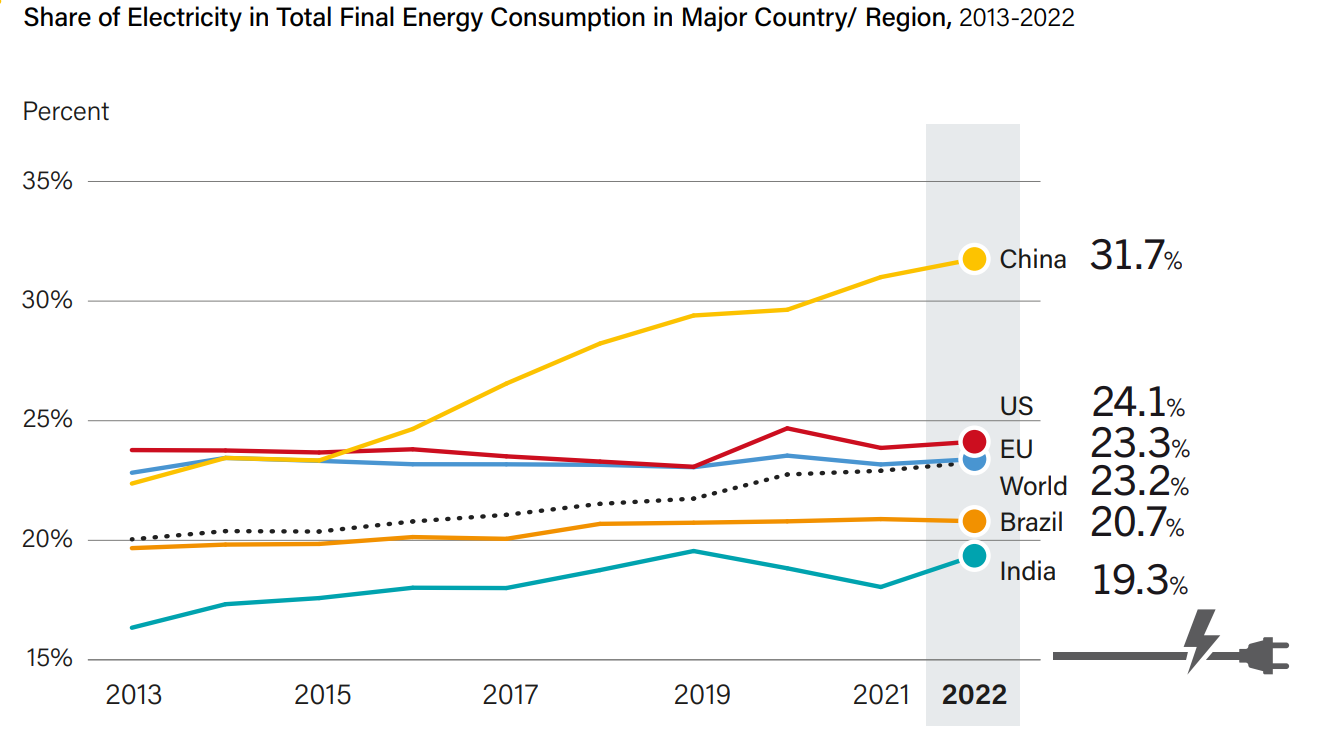
Solar water pumping
In 2023, the global installed solar water pump capacity reached 1.1 GW, up 1.8 per cent from 2022. India was home to 94 per cent of this capacity. Canada, China, France, India and Slovenia implemented mechanisms to encourage renewable energy uptake in the industrial sector, including subsidies and tenders.
India’s position in global rankings in 2024
-
India ranked 4th in the world for total renewable power capacity.
-
India ranked 3rd in the world for solar PV capacity.
-
India ranked 4th in the world for wind power capacity.
-
India ranked 5th in the world for solar water heating collector capacity.
-
India ranked 5th in the world for total biofuels production.
 Access the full report here.