The pace of renewable energy development is accelerating globally, driven by climate change concerns, the need to ensure energy security, and cost reductions. However, the variable and intermittent nature of renewable generation presents challenges for integrating large shares of renewables into the electricity grid. Therefore, accurate forecasting of renewable power production is crucial for maintaining grid reliability and stability. This article provides an overview of the latest technology trends and advancements in renewable energy forecasting…
Importance of renewable energy forecasting
Renewable energy forecasting refers to the prediction of future power output from renewable energy plants such as wind farms and solar parks, generally from a week ahead to intra-day timescales. Forecasting supports system operators in despatch planning and balancing of electricity supply and demand. Accurate forecasts enable the optimal scheduling of conventional power plants along with renewable energy sources, support the participation of renewables in electricity markets for trading and ancillary services, allow transmission system operators to manage congestion and take preventive actions, and inform maintenance scheduling/outage planning.
Accurate and granular forecasts across different time horizons, from months to minutes ahead, provide greater visibility into renewable generation variability. This helps reduce integration costs and improves the efficiency of power system operations with higher renewable energy penetration.
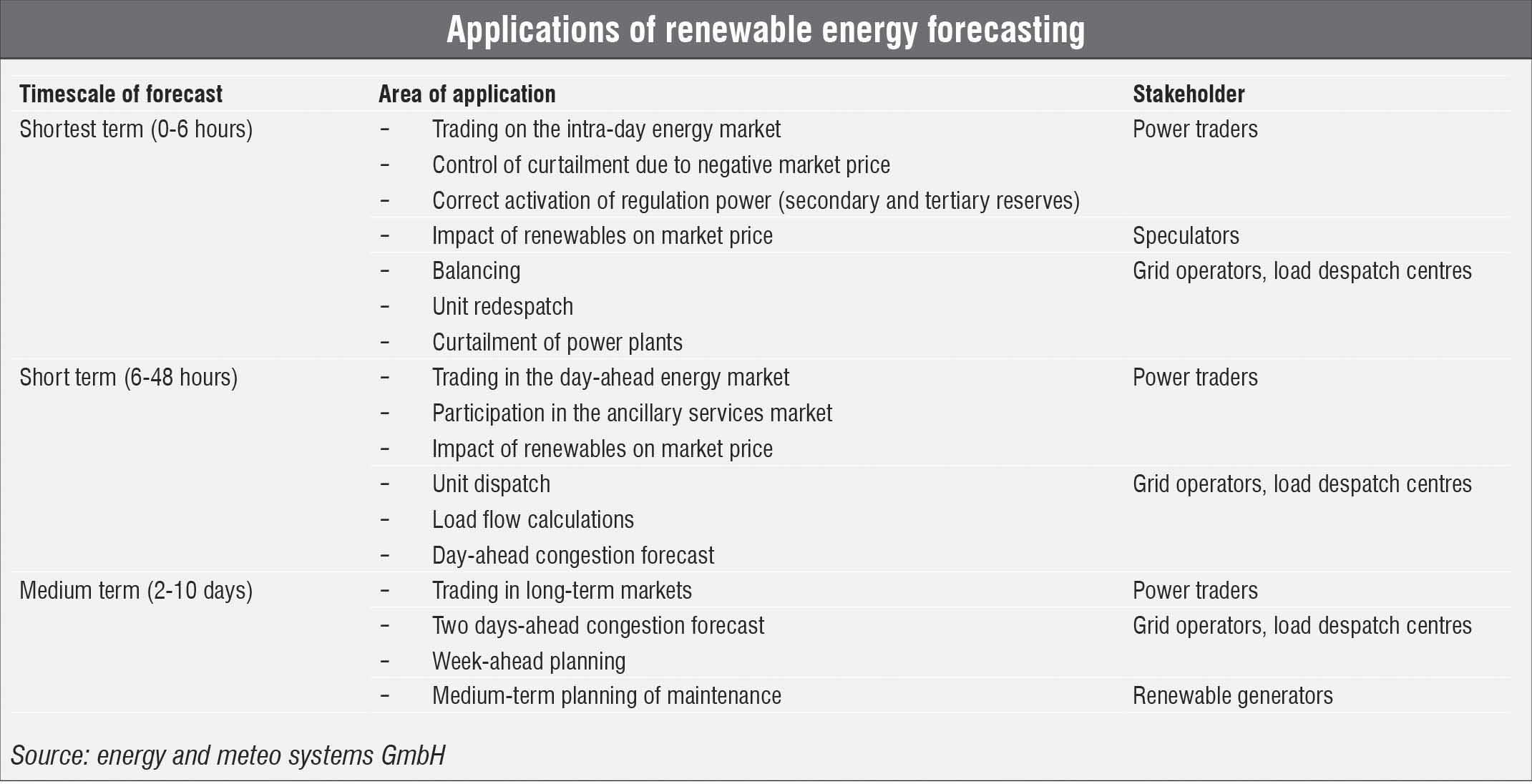
Various stakeholders utilise forecasts tailored to their specific timescales of interest, as shown in the table.
Growing importance of short-term forecasting
While the initial focus was on day-ahead predictions, intra-day and short-term forecasting from minutes to hours ahead is gaining significance due to real-time balancing needs. With renewable energy penetration increasing, system operators have to adjust generation and load more frequently within the operating day. Shorter-term forecasts enable optimal scheduling of fast-ramping resources to account for renewable variability on such operational timescales.
Real-time electricity markets rely heavily on very short-term or “nowcasting” forecasts. Moreover, increasing forecast granularity and updates are enabling various power system flexibility options.
 Forecasting methods and techniques
A variety of methods and techniques are employed for renewable forecasting, particularly in a hybrid approach:
Physical modelling: This approach utilises numerical weather prediction (NWP) models to simulate the physical atmosphere and provide weather forecasts as input. Physical parameterisations then convert weather data into power production time series for wind and solar farms. Micro-scale modelling is used to incorporate local terrain and climate effects. Physical models require extensive location-specific configuration but can integrate diverse weather data.
Statistical/Machine learning (ML): Historical relationships between weather, generation data, and power output are derived to create statistical models. Time series analysis and regression techniques characterise plant output patterns. With growing renewable data, ML methods such as artificial neural networks, support vector machines, and gradient boosting machines are being widely utilised for forecast model development and adaptation. Purely statistical approaches are simpler to implement while ML provides more modelling flexibility.
Hybrid approach: The blending of physical and statistical methods leverages their complementary strengths. Physical models can provide credible weather scenarios for the forecast period while statistical techniques help improve accuracy and calibrate output. ML enables the integration of multiple model outputs to minimise errors. Thus, hybrid methods tend to perform better than pure modelling approaches.
Latest technology advancements
Some of the ongoing research and industry initiatives driving technology innovation across the forecasting process are:
High resolution NWP and ensemble forecasts
State-of-the-art NWP models offer higher spatial (1-3 km) and temporal resolution (15 minute updates) along with ensemble forecasts to characterise forecast uncertainties. These provide detailed, rapidly updating inputs for renewable forecasting models, capturing localised effects and extreme events better.
Improved satellite monitoring
Geostationary satellites like GOES-16 provide enhanced visibility into developing weather patterns by capturing images every five minutes. Polar orbiting satellites also monitor atmospheric moisture, clouds, and temperature at much higher resolutions, updating input data for weather models. For solar forecasting, satellite-derived irradiance estimates from GOES-16 and other platforms improve the real-time monitoring of cloud cover, aerosols and water vapour, which are the key determinants of Photovoltaic output.
Dedicated wind LiDARs and solar sensors
Wind light detection and ranging sensors (LiDARs) use laser pulses to remotely sense atmospheric conditions and wind speeds ahead of turbines. Installing LiDARs on wind farms provides accurate inflow measurements for very short-term forecasts. It can also scan wake effects behind turbines to help improve park-level wind power estimates.
Likewise, dedicated on-site solar measurement stations with irradiance and PV reference sensors gather high quality input data to enhance intra-hour solar forecasts. The reference cell calibrated to the PV array measures real-time performance impacts from soiling, degradation, etc.
Phasor measurement units
Phasor measurement units installed across transmission networks remotely monitor grid parameters like phase angles at very high resolutions (30 observations per second). Wide-area phasor data provides enhanced grid visibility and can help detect renewable ramps faster for extremely short-term forecasting and situational awareness.
Automated model tuning and retraining
With expanding renewable assets and data, manual model tuning is infeasible. Automated algorithms dynamically update model training based on new weather and generation patterns detected. For example, IBM Insights and Utopus Insights have developed renewable forecasting solutions that retrain themselves continuously as new operating data comes in, adjusting to evolving conditions. AutoML tools automate iterative testing of model architectures as well. “Online learning” integrates real-time feedback to improve intra-hour forecast accuracy.
Uncertainty quantification
Quantifying uncertainty and probability distributions around forecasts significantly enhances decision-making. Ensemble predictions from multiple NWP runs provide uncertainty ranges, while stochastic models characterise errors statistically. Further, ML techniques like Bayesian deep learning explicitly quantify uncertainty bounds along with point forecasts.
Advanced visualisation and situational intelligence
Modern forecasting platforms integrate advanced data visualisation technology, geospatial analytics and natural language generation for intuitive human-machine interfaces. Interactive dashboards connect high resolution weather maps, real-time sensors, forecast outputs and situational awareness, which build operational trust and enable the rapid assessment of forecast reliability.
Future outlook
The diversity of methods available reflects the complex, interdisciplinary nature of renewable forecasting. While physical and statistical approaches will continue to evolve, hybrid ML techniques are expected to dominate, leveraging advancements in high performance computing. Edge computing and internet of things sensors will support distributed intelligence and real-time data use. As variable generation grows, forecasting processes will transition from passive to active systems – combining prediction with renewable plant controls, energy storage and grid flexibility resources for integrated optimal operations. Thus, reliable, integrated forecasts will prove critical in driving the clean energy transition.