

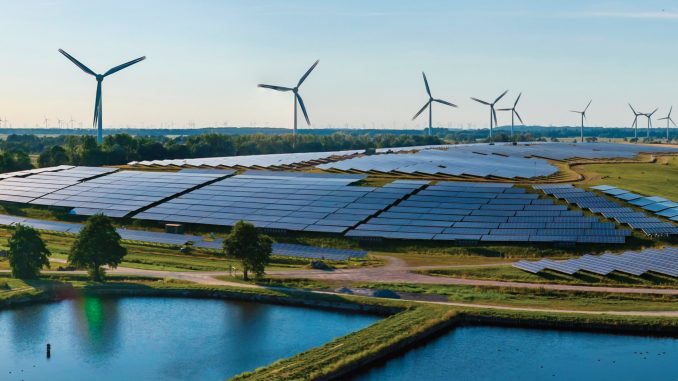
India’s total renewable energy capacity, excluding large hydro, stood at 131,783.39 MW in September 2023. This accounts for around 30 per cent of the country’s total power capacity of 425,406.47 MW. The top 10 states, in terms of renewable capacity deployment, account for over 90 per cent of India’s total renewable energy capacity. Renewable Watch provides a brief overview of these states…
Rajasthan
Rajasthan has made significant strides in the past few years to become the state with the highest renewable energy capacity of 23,431.56 MW. As of September 2023, the total renewable energy capacity of the state, excluding large hydro, comprised 5,193.42 MW of wind power, 18,089.21 MW of solar power, 125.08 MW of biopower and 23.85 MW of small-hydro power. Its solar power capacity, which accounts for approximately 77 per cent of the state’s total installed capacity, comprises ground-mounted solar (14,511.22 MW), rooftop solar (1,002.44 MW), off-grid solar (595.55 MW) and hybrid solar (1,980 MW). Further, Rajasthan has effectively harnessed its wind resources, ranking fourth in terms of the total installed wind power capacity. The state’s biopower capacity comprises 119.25 MW of biomass power/bagasse cogeneration capacity, 2 MW of biomass cogeneration (non-bagasse) and 3.83 MW of off-grid waste-to-energy (WtE) capacity. During the past year, Rajasthan released its new renewable energy policy with the aim of facilitating the development of 90 GW of clean power projects. Of this, 65 GW will be dedicated to solar energy, 15 GW to wind and hybrid sources, and 10 GW to hydro, pumped storage plants and battery energy storage systems. It will be interesting to see whether the state will be able to meet its target given the cautious sentiment among stakeholders regarding the Great Indian Bustard (GIB) issue.
Gujarat
As of September 2023, Gujarat’s total installed renewable energy capacity reached 21,715.45 MW, comprising 11,094.02 MW of wind power, 10,417.56 MW of solar power, 112.23 MW of biopower, and 91.64 MW of small hydro. This accounts for approximately 16 per cent of India’s renewable energy portfolio. The state has the second-largest installed solar power capacity in the country, second only to Rajasthan. Its solar capacity comprises ground-mounted solar (6,896.36 MW), rooftop solar (2,898.16 MW), off-grid solar (54.3 MW) and hybrid solar (568.75 MW). Recently, Gujarat introduced a new renewable energy policy in a bid to harness its substantial solar and wind potential of 36 GW and 143 GW respectively. The objective of the policy is to facilitate the development of 100 GW of cumulative renewable energy capacity by 2030 with investments of around Rs 5,000 billion, utilising approximately 400,000 acres of land. Going forward, offshore wind presents an attractive market opportunity for the state. However, the primary challenge facing renewable energy stakeholders in the state is the GIB issue.
Tamil Nadu
As of September 2023, the total renewable energy capacity of the state, excluding large hydro, stood at 18,549.86 MW (comprising 10,300.62 MW of wind power, 7,082.49 MW of solar power, 1,043.7 MW of biopower and 123.05 MW of small-hydro power). The state’s solar capacity includes ground-mounted solar (6,567.41 MW), rooftop solar (449.22 MW) and off-grid solar (65.86 MW). Meanwhile, its biopower capacity constitutes biomass power/bagasse cogeneration (969.1 MW), biomass cogeneration (non-bagasse) (43.55 MW), WtE (6.4 MW) and off-grid WtE (24.65 MW). At 10,300.62 MW, Tamil Nadu currently has the second-highest installed wind power capacity across states. Going forward, it plans to leverage its offshore wind potential of 35 GW. However, renewable energy stakeholders may face issues related to lack of accurate forecasting and scheduling of wind power, leading to high deviations, as well as challenges in repowering old wind power projects.
Karnataka
Over the years, Karnataka has emerged as a key state for renewable energy development with the total capacity reaching 17,848.74 MW, as of September 2023. This constitutes 5,313.55 MW of wind power, 9,347.18 MW of solar power, 1,907.28 MW of biopower and 1,280.73 MW of small-hydro power. Its lead in renewable energy is mainly due to the growth of solar power, which makes up about half of the state’s renewable energy capacity. The state’s solar capacity comprises ground-mounted solar (7,754.77 MW), rooftop solar (1,562.11 MW) and off-grid solar (30.31 MW). Its biopower capacity comprises 1,867.1 MW of biomass power/bagasse cogeneration, 20.2 MW of biomass cogeneration (non-bagasse), 1 MW of WtE and 18.98 MW off-grid WtE. Recently, Karnataka became one of the first states to issue green energy open access rules, in line with the central policy. It intends to expand the open access market for small customers with a contracted or sanctioned load of 100 kW or more. Meanwhile, it faced an acute power shortage recently due to rainfall deficits, wet coal and a decline in renewable energy generation. The state resorted to purchase of electricity from power exchanges and power swapping agreements with different states. Going forward, it will be interesting to see how the greater uptake of renewables will address the power crisis.
Maharashtra
At 13,159.73 MW, Maharashtra holds the fifth position in terms of installed renewable energy capacity in the country. Its renewable energy capacity, excluding large hydro, comprises 5,147.18 MW of wind power, 4,988.33 MW of solar power, 2,641.94 MW of biopower and 382.28 MW of small hydro. The state has the highest installed biopower capacity in the country, comprising biomass power/bagasse co-generation (2,568 MW), biomass cogeneration (non-bagasse) (16.40 MW), WtE (12.59 MW) and off-grid WtE (44.95 MW). Its solar capacity encompasses 3,009.14 MW, 1,716.3 MW and 262.89 MW of ground-mounted solar, rooftop solar and off-grid solar respectively. According to the Unconventional Energy Generation Policy 2021, the state aims to produce 40 per cent of its power from renewable sources by 2030 and implement 17.36 GW of transmission system-linked renewable power projects by 2025, comprising 12.93 GW of solar projects, with 2 GW of grid-connected rooftop solar projects. Going forward, the state also plans to leverage its pumped hydro storage potential. Maharashtra’s renewable energy sector faces grid integration complexities, land acquisition issues and financial distress on part of discoms. Overall, the state needs to increase the pace of renewable energy deployment and participation in green markets.
Andhra Pradesh
The initial enthusiasm witnessed in the state’s renewable energy sector took a back seat when Andhra Pradesh decided to review and renegotiate solar and wind power purchase agreements (PPAs). In addition, curtailment, payment dues to renewable energy projects and other policy flip-flops dampened investor confidence even further. However, Andhra Pradesh is gradually recovering the lost ground to become a major hub of renewable energy generation with a significant potential for solar and wind generation as well as pumped hydro storage. The state has identified potential pumped storage hydropower sites of 33,240 MW near existing reservoirs and off-river locations. Apart from the Andhra Pradesh Pumped Storage Hydro Power Projects Policy, 2022, the state has launched its Green Hydrogen and Green Ammonia Policy, 2023. As part of the green hydrogen policy, it aims to achieve a production capacity of 0.5 million tonnes per year (mtpa) of green hydrogen and 2 mtpa of green ammonia in the next five years, promote green hydrogen- and green ammonia-related equipment manufacturing plants, and assist in the creation of 12,000 jobs per mtpa. The state’s total renewable energy capacity, excluding large hydro (as of September 2023), comprises 4,096.65 MW of wind power capacity, 4,555.2 MW of solar power, 566.39 MW of biopower and 163.31 MW of small hydro. Its solar capacity encompasses ground-mounted solar (4,286.87 MW), rooftop solar (179.99 MW) and off-grid solar (88.34 MW). Its biopower capacity comprises biomass power/bagasse co-generation (378.1 MW), biomass cogeneration (non-bagasse) (105.57 MW), WtE (53.16 MW) and off-grid WtE (29.56 MW).
Madhya Pradesh
In the past few years, Madhya Pradesh has become one of the most active states in the renewable energy space. It has gained recognition for achieving record low tariffs in the rooftop solar space, by reducing the risk for rooftop solar developers, and providing power to the Delhi Metro Rail Corporation through an open access agreement. As of September 2023, the total renewable energy capacity of the state, excluding large hydro, stood at 6,270.86 MW, comprising 2,844.29 MW of wind power, 3,167.92 MW of solar power, 134.94 MW of biopower and 123.71 MW of small hydro. Its solar capacity includes ground-mounted solar (2,779 MW), rooftop solar (296.02 MW) and off-grid solar (92.90 MW) while its biopower capacity comprises biomass power/bagasse cogeneration (92.5 MW), biomass cogeneration (non-bagasse) (14.85 MW), WtE (15.4 MW) and off-grid WtE (12.19 MW). The state has a solar and wind power potential of 61 GW and 11 GW respectively. Madhya Pradesh has set ambitious investment targets for the sector. It plans to invest Rs 150 billion and Rs 500 billion in renewable energy production by 2024 and 2027 respectively. Meanwhile, investments in the production of renewable energy equipment are expected to reach Rs 40 billion by 2024 and Rs 100 billion by 2027. The state aims to produce 20 per cent of its electricity from renewable sources by the end of financial year 2024, 30 per cent by 2027 and 50 per cent by 2030.
Telangana
Telangana has undergone a remarkable transformation – from being a young state with an acute power deficit to becoming a leading state in renewable power development, especially in the solar segment. As of September 2023, its total renewable energy capacity stood at 5,152.32 MW (consisting of 128.1 MW of wind power, 4,712.98 MW of solar power, 220.37 MW of biopower and 90.87 MW of small-hydro power). The solar capacity comprises ground-mounted solar (4,360.49 MW), rooftop solar (343.78 MW) and off-grid solar (8.71 MW). Meanwhile, biopower capacity encompasses biomass power/bagasse cogeneration (158.1 MW), biomass cogeneration (non-bagasse) (2 MW), WtE (45.8 MW) and off-grid WtE (14.47 MW). Telangana has been witnessing interesting developments in the floating solar segment. Like many other states, it faces land acquisition challenges., Meanwhile, commercial and industrial users face denial or delay in open access approvals, and lack of clarity on cross-subsidy surcharges and banking of power.
Uttar Pradesh
With 4,889.09 MW of total renewable energy capacity (comprising 2,620.43 MW of solar power, 2,219.56 MW of biopower and 49.1 MW of small-hydro power), Uttar Pradesh is a front runner in renewables deployment. It holds the second position in the bioenergy space after Maharashtra, owing to the abundance of sugar industries in the state. Its biopower capacity comprises biomass power/bagasse cogeneration (1,957.5 MW), biomass cogeneration (non-bagasse) (160.76 MW) and off-grid WtE (101.3 MW). Meanwhile, its solar capacity comprises ground-mounted solar (2,149.5 MW), rooftop solar (265.1 MW) and off-grid solar (205.83 MW). During the past year, Uttar Pradesh introduced its new solar energy policy with a target of setting up 22,000 MW of solar power projects by 2026-27. This includes 14,000 MW of utility-scale, 4,500 MW of residential rooftop, 1,500 MW of non-residential rooftop and 2,000 MW of distributed projects. However, the state faces several challenges in its power sector. These issues pertain to inadequate transmission and distribution (T&D) infrastructure, high T&D losses and financial distress faced by discoms.
Punjab
The state seems to have overcome the power deficit faced by renewable energy stakeholders a few years ago when it decided to renegotiate renewable energy PPAs. The total renewable energy capacity of the state (1,970.5 MW) as of September 2023 comprised solar power (1,266.55 MW), biopower (527.85 MW) and small hydro (176.1 MW). Its solar capacity encompasses ground-mounted solar (886.27 MW), rooftop solar (298.92 MW) and off-grid solar (81.36 MW), and its biopower capacity includes biomass power/bagasse cogeneration (299.5 MW), biomass cogeneration (non-bagasse) (196.65 MW), WtE (10.75 MW) and off-grid WtE (20.95 MW). A key priority for the state government going forward should be efficient collection of biomass from farms and its conversion to bioenergy given the severe health hazard that stubble burning causes in north India during the winter months.
Outlook
According to the Central Electricity Authority, in 2024-25, the annual energy requirement for Rajasthan, Gujarat, Tamil Nadu, Karnataka, Maharashtra, Andhra Pradesh, Madhya Pradesh, Telangana, Uttar Pradesh and Punjab will reach 116,151 MUs, 153,318 MUs, 132,871 MUs, 94,637 MUs, 220,732 MUs, 86,416 MUs, 106,252 MUs, 97,547 MUs, 159,621 MUs and 77,851 MUs respectively. In addition, the all-India annual peak demand in 2024-25 is expected to reach 256,530 MW. Therefore, it is imperative to prepare for the upcoming power generation capacity, particularly renewable energy, given India’s climate targets. To achieve the climate goals, the leading renewable energy states must realise their full potential and address the inherent challenges facing the sector.
By Sarthak Takyar

