

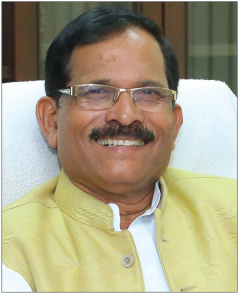
 Shripad Yesso Naik, Member of Parliament from North Goa, recently took over as Minister of State for Power and New & Renewable Energy. His appointment comes at a time when India’s renewable energy sector is at a critical crossroads, as it powers its way to meeting ambitious climate goals. Distributed solar, especially residential rooftop solar, has received a significant fillip; the domestic solar manufacturing base is expected to broaden; the green hydrogen segment is gaining momentum with significant industry interest; and offshore wind is expected to become the next frontier of growth. Naik, who has led various central ministries in the past, now has the key responsibility of strengthening government efforts to drive further growth in the renewables’ sector. In an interview with Renewable Watch, Naik talked about recent trends in the sector, key policy initiatives, and the status of domestic manufacturing. He also discussed the major challenges and opportunities in the sector. Edited excerpts…
What have been the key recent achievements in the country’s renewable energy sector?
Under the visionary leadership of Honourable Prime Minister Narendra Modi, India is implementing one of the world’s largest renewable energy expansion programmes, targeting 500 GW of renewable energy capacity by 2030, with around 290 GW coming from the solar energy sector. This ambitious goal is a cornerstone of our mission for a self-reliant India, significantly reducing our dependence on fossil fuels and cutting down on carbon emissions.
As per the International Renewable Energy Agency’s Renewable Energy Statistics 2024, today India ranks fourth globally in installed renewable energy capacity, fourth in wind power and fifth in solar energy capacity.
As of October 31, 2024, we have installed an impressive 211.36 GW of capacity from non-fossil fuel sources, which includes renewable energy and nuclear energy. This means that a significant 46.51 per cent of our total installed generation capacity comes from non-fossil sources. As of October 31, 2024, India’s total installed electricity capacity stands at 454.42 GW, including 243.06 GW from thermal, 8.18 GW from nuclear and 203.18 GW from renewable energy sources. The renewable energy capacity includes 92.12 GW of solar, 46.93 GW of large hydro, 47.72 GW of wind, 11.33 GW of biopower and 5.08 GW of small-hydro. Overall, the installed renewable energy capacity has increased from 76.38 GW in March 2014 to 203.18 GW in October 2024, an increase of over 2.6 times. In addition, over the past 10 years, the installed solar capacity has increased from 2.82 GW in March 2014 to 92.12 GW in October 2024, an increase of over 32 times. Similarly, wind energy capacity has increased from 21.04 GW in March 2014 to 47.72 GW in October 2024, an increase of around 2.2 times. All these are significant achievements by any standards and we are proud of whatever we have achieved so far. But we are not going to rest here and are committed to achieving the clean energy transition and goals set under the Nationally Determined
Contribution (NDC).
What are the key initiatives and policies that your ministry is implementing to accelerate the transition to renewable energy? What efforts are being made to attract investments, both foreign and domestic, to the sector?
The government has taken several initiatives to promote and accelerate renewable energy capacity to realise the commitment of 500 GW of non-fossil energy capacity by 2030. I would like to highlight the key initiatives of our ministry, as under:
- Notification of the trajectory for renewable energy bids of 50 GW per annum, to be issued by Renewable Energy Implementation Agencies (REIAs) from 2023-24 to 2027-28. Four central PSUs – Solar Energy Corporation of India Limited (SECI), NTPC Limited, NHPC Limited and SJVN Limited – have been designated as REIAs for the implementation of this roadmap.
- Foreign direct investment (FDI) of up to 100 per cent has been permitted under the automatic route.
- Interstate transmission system (ISTS) charges have been waived for interstate sale of solar and wind power for projects to be commissioned by June 30, 2025, green hydrogen projects till December 2030 and offshore wind projects till December 2032.
- To boost renewable energy consumption, the renewable purchase obligation (RPO) trajectory has been notified till 2029-30, including a separate RPO for decentralised renewable energy.
- Standard bidding guidelines have been issued for the tariff-based competitive bidding process for the procurement of power from grid-connected solar, wind and wind-solar projects.
- Schemes such as the Pradhan Mantri Kisan Urja Suraksha evam Utthaan Mahabhiyan (PM-KUSUM), PM Surya Ghar: Muft Bijli Yojana, the National Programme on High Efficiency Solar PV Modules, the National Green Hydrogen Mission (NGHM) and viability gap funding (VGF) for offshore wind energy have been launched.
- The scheme for setting up ultra mega renewable energy parks is being implemented to provide land and transmission to renewable energy developers for the installation of large-scale renewable energy projects.
- Installation of new transmission lines and substation capacity has been funded under the Green Energy Corridors (GEC) scheme for the evacuation of renewable power.
- The Electricity (Rights of Consumers) Rules, 2020 has been issued to enable net metering for capacities up to 500 kW or the electrical sanctioned load, whichever is lower.
- The National Repowering and Life Extension Policy for Wind Power Projects, 2023 has been issued.
- The Strategy for Establishment of Offshore Wind Energy Projects has been issued, outlining a bidding trajectory of 37 GW by 2030 and various business models for project development.
- The Offshore Wind Energy Lease Rules, 2023 have been notified vide a Ministry of External Affairs notification dated December 19, 2023, to regulate the granting of lease for offshore areas for the development of offshore wind energy projects.
- The procedure for implementing the Uniform Renewable Energy Tariff programme has been issued.
- Standards and labelling programmes for solar PV modules and grid-connected solar inverters have
been launched. - A transmission plan has been prepared till 2030 to augment the transmission infrastructure required to support the steep renewable energy trajectory.
- The Electricity (Late Payment Surcharge and related matters) Rules, 2022, have been notified.
- The Green Energy Open Access Rules, 2022 have been notified for promoting renewable energy.
- The green term-ahead market has been launched to facilitate the sale of renewable energy through power
exchanges. - The government has issued orders stipulating that power should be despatched against a letter of credit or advance payment to ensure timely payments by distribution licensees to renewable energy generators.
The key initiatives and policies mentioned above have attracted private investments and enabled capacity addition. India has witnessed a significant shift in the investment dynamics of renewable energy projects. Most renewable energy projects in the country are being set up by private sector developers, selected through a transparent bidding process.
As per Bloomberg New Energy Finance reports, $87 billion of new investments were made in the clean energy sector in the country between 2014 and 2022. Further, the non-conventional energy sector received FDI worth $14.88 billion during the period 2014-15 to 2023-24.
The non-conventional energy sector received FDI worth $14.88 billion during the period 2014-15 to 2023-24.
How is the government ensuring that renewable energy solutions are accessible and affordable to all segments of the population, including underserved rural areas?
To facilitate the large-scale adoption of rooftop solar, the government launched PM Surya Ghar: Muft Bijli Yojana in February 2024, with a total outlay of Rs 750.21 billion for installing rooftop solar for 10 million households. This scheme will enable households to save on electricity bills as well as earn additional income through the sale of surplus power to distribution companies (discoms). The PM-KUSUM scheme promotes small grid-connected solar power plants, stand-alone solar-powered agricultural pumps and the solarisation of existing grid-connected agricultural pumps. The scheme benefits not only farmers but also states and discoms.
To facilitate the large-scale adoption of rooftop solar, the government launched PM Surya Ghar: Muft Bijli Yojana in February 2024, with a total outlay of Rs 750.21 billion for installing rooftop solar for 10 million households.
How does your ministry plan to encourage research and development in clean energy technologies, foster innovation and support start-ups in the energy sector?
The Ministry of New and Renewable Energy (MNRE) is implementing the Renewable Energy Research and Technology Development Programme through various research institutions and industry players to develop indigenous technologies and manufacturing, facilitating the widespread applications of new and renewable energy in an efficient and cost-effective manner. It provides up to 100 per cent financial support to government/non-profit research organisations and up to 70 per cent to industry, start-ups, private institutes, entrepreneurs and manufacturing units.
What is the status of domestic manufacturing of renewable energy components? What further steps are being taken by the government in this area?
We are making efforts to scale up the development of renewable energy projects, while also focusing on the promotion of domestic manufacturing. Solar PV manufacturing is a major focus area for the government and we are committed to making the country atmanirbhar (self-reliant) in solar PV manufacturing and establishing India as a major global player in the solar value chain. This will be achieved through financial support in the form of the production-linked incentive (PLI) scheme for high-efficiency solar PV modules with an outlay of Rs 240 billion, along with policy interventions such as the imposition of basic customs duty on the import of solar PV cells and modules, and the domestic content requirement in some schemes. India has rapidly increased domestic solar PV module production capacity over the past three years, from around 8 GW per year to 60 GW per year. The solar PLI scheme will not only help bring state-of-the-art solar PV module manufacturing technology to the country but will also reduce import dependence. Currently, more than 48 GW of fully/partially integrated solar PV module manufacturing projects are under implementation under the solar PLI scheme. With the solar PLI scheme and other favourable policy frameworks, India is likely to achieve 100 GW per year of solar module production capacity by 2027. This capacity will not only be sufficient to meet domestic demand but will also help the country earn foreign exchange by exporting the same.
With the solar PLI scheme and other favourable policy frameworks, India is likely to achieve 100 GW per year of solar module production capacity by 2027.
Wind turbine generator technology has evolved significantly, and state-of-the-art technologies are now available in the country for wind turbine manufacturing. Approximately 70-80 per cent indigenisation has been achieved, with strong domestic wind manufacturing. Leading global players in this field have established a presence in the country, with 14 companies manufacturing 30 different models of wind turbines. The current annual production capacity is around 18,000 MW, with turbines and components being exported to several countries.
What are the challenges and opportunities in achieving India’s renewable energy goals?
India has set an ambitious target of deploying 500 GW of capacity from non-fossil sources by 2030. Achieving this goal involves addressing specific challenges while capitalising on unique opportunities. One of the primary challenges is transmission connectivity. Many renewable energy projects are located in remote areas where existing infrastructure is inadequate. To address this, the MNRE is collaborating with the Ministry of Power (MoP) to strengthen the transmission network, enhance grid connectivity and develop a comprehensive transmission plan to meet the renewable energy target. The MNRE has been supporting the development of intra-state and ISTS for renewable energy projects through the GEC programme. As a minister of state for both these ministries, that is the MNRE and the MoP, my endeavour is to act as a bridge between the two, so as to achieve synergy, policy congruence and complementarity.
One of the primary challenges is transmission connectivity.
Another challenge is the high initial capital requirement for renewable projects. We aim to attract private investment by introducing more favourable financing models, along with incentives and subsidies for green energy projects. Additionally, the regulatory environment requires refining. Complex approval processes can delay project timelines. So our ministry is committed to simplifying these regulations to facilitate quicker project approvals and foster a more conducive environment for investment.
We aim to attract private investment by introducing more favourable financing models, along with incentives and subsidies for green energy projects.
On the opportunity side, the government’s strong commitment to renewable energy, exemplified by the 500 GW renewable energy target by 2030, presents a significant market for investors. Furthermore, advancements in technology are making renewable energy sources more cost-effective and efficient, particularly in solar panel manufacturing and wind turbine technology.
Among the major programmatic interventions, the MNRE has been implementing the NGHM, the PM Surya Ghar: Muft Bijli Yojana, PM-KUSUM, the National Programme on High Efficiency Solar PV Modules (PLI scheme), the solar parks and ultra mega solar projects initiatives, the Central Public Sector Undertaking Scheme Phase II, the GEC scheme and the VGF scheme for offshore wind energy projects. Moreover, the transition to renewable energy is expected to create millions of jobs across various sectors, from manufacturing to installation and maintenance, thereby contributing to economic growth.
In conclusion, both my ministries (MNRE and MoP), are committed to achieve the vision of Viksit Bharat @ 2047 set by our Honourable Prime Minister. We will leave no stone unturned to realise it and while achieving this goal, we will be mindful of our responsibility towards nature and mother Earth. We will tread on this path of becoming a developed nation by 2047 in an ecofriendly and sustainable manner, ensuring a clean and green future for our next generation.
Overall, the installed renewable energy capacity has increased from 76.38 GW in March 2014 to 203.18 GW in October 2024, an increase of over 2.6 times. In addition, over the past 10 years, the installed solar capacity has increased from 2.82 GW in March 2014 to 92.12 GW in October 2024, an increase of over 32 times. Similarly, wind energy capacity has increased from 21.04 GW in March 2014 to 47.72 GW in October 2024, an increase of around 2.2 times.


