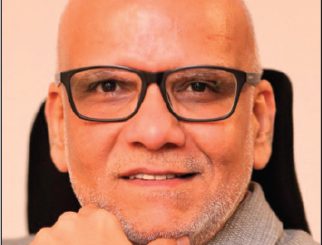
The wind power segment, which has long been witnessing a slowdown in capacity additions, is set to expand with new government interventions. Wind turbine manufacturers also have much reason to be hopeful, with encouraging developments not just in wind, but also in the hybrids and round-the-clock renewable power segments. In a recent interview with Renewable Watch, J.P. Chalasani, group chief executive officer, Suzlon Energy Limited, highlighted the key advancements in the renewable energy sector, the major challenges and the future outlook for the wind power segment. Edited excerpts from the interview…
How has the energy sector evolved over time? What have been the key achievements?
Over the past decade, India’s energy sector has undergone a remarkable transformation, with renewable energy emerging as a substantial contributor to meeting the nation’s escalating energy demand. In the past five years, renewable energy capacity addition has surged to an impressive 60,120 MW, surpassing the 17,306 MW increase in fossil fuel capacity. This rapid progress in renewable energy is underscored by the fact that it took approximately 65 years to achieve the first 100 GW of fossil fuel capacity, while the first 100 GW of renewable energy capacity was added in just around 30 years, with a substantial 60 GW being incorporated within the past five years.
This substantial expansion of renewable energy has been made possible, in no small part, due to the remarkable growth in our transmission capacity. Today, India boasts one of the world’s most extensive and intricately connected electricity grids. In essence, we have evolved into one unified nation, underpinned by a single grid. This monumental stride in our transmission infrastructure has served as a key catalyst for the exponential growth in renewable energy.
While the Indian government has been unceasing in its efforts to bolster the sector’s viability, the results are becoming increasingly, though gradually, evident. Initiatives such as the late payment surcharge scheme, the implementation of payment security measures for drawing power from interstate generating stations, funding tied to enhancing distribution segment efficiency, and the establishment of green open access rules stand testament are to the government’s commitment to fostering a conducive environment for the renewable energy sector.
What were the key hits and misses in the wind power segment this year?
There have been key policy announcements over the past year that are expected to provide a fillip to the wind segment. The most significant of these is the introduction of state-specific bidding with the pooled tariff concept. One of the major reasons for the limited growth of wind capacity in recent years (since 2017-18) has been the concentration of projects in one or two states. This was due to the bidding terms being agnostic to the state, making all bidders rush to states with the highest wind potential, leading to land and other infrastructure constraints. With the new policy, capacity will now be added in all eight windy states.
The second major policy initiative is the introduction of RPO guidelines under the Energy Conservation Act, specific to wind turbines commissioned from April 1, 2024. This will also accelerate new capacity additions. The third initiative is that in bidding for wind power projects, reverse auction is no longer mandatory. This will ensure reasonable/remunerative tariffs (within the tariff elasticity of discoms), thereby increasing the success rate of bid projects converting to commissioned projects.
The major concern I foresee pertains to project execution capabilities. The main reason for the commissioning of 5.5 GW in 2017-18 was not only the execution of projects in multiple states, but also OEMs providing end-to-end engineering, procurement and construction (EPC) services. There was more than a 70 per cent market share in 2017-18 between Suzlon and Siemens Gamesa, both of whom offered full EPC services.
However, today, other than Suzlon, no other major OEM is offering EPC services. All other OEMs are primarily selling equipment (or components). Converting supplied equipment to commissioned projects is a major concern. While a few players are emerging in the “balance of plant including land” area, the required capacity building would take considerable time. Based on my extensive experience, I can state that executing wind projects is much more complex than large thermal and solar projects.
As a country, we are concerned about commissioned capacity and not supply capacity. Due to this, we can see that on-ground capacity addition was only 1.5 GW this financial year (till September 2023), which is more or less the same as last year. I clearly foresee the possibility of a large number of turbines on the ground waiting for erection and commissioning, which will have a negative impact on future capacity addition.
How has the country’s performance been in advancing the energy transition?
In the past few years, energy transition has gained substantial momentum. The share of renewable energy (excluding large hydro) in the total capacity has experienced an ascent, progressing from 20 per cent to 30 per cent over the past five years. What is noteworthy is our transition from merely generating wind and solar power to effectively fulfilling the requirements for round-the-clock supply and peak power through innovative hybrid plus storage systems. With the right strategic investments and a continued commitment to sustainable practices, India is undeniably well positioned to not only meet but also potentially exceed its ambitious renewable energy targets by 2030.
What is your view on the future energy mix in the country? What should be the key focus areas to achieve the desired energy mix?
The Central Electricity Authority (CEA) has conducted a comprehensive region-wise study of power requirements for the year 2030, encompassing all 8,760 hours of the year. This rigorous analysis has projected a substantial surge in India’s energy needs, calling for an installed capacity of 777 GW, a significant jump from the current 425 GW. Moreover, energy demand is estimated to reach a staggering 2,441 BUs, compared to the current level of 1,624 BUs.
To fulfil this increasing demand in the most economically efficient manner, it is projected that by 2030, India should aim for a solar capacity of 293 GW, up from the current 72 GW. Additionally, wind capacity should be augmented to 100 GW from the existing 44 GW, and battery storage capacity should reach 42 GW. This concerted effort is expected to propel renewable energy’s contribution to the overall energy mix to an impressive 32 per cent by 2030.
In striving to attain these ambitious targets, there are several crucial focal points that need to be considered. These include prioritising infrastructure development for the timely execution of projects, ensuring policy stability, sustaining the emphasis on bolstering domestic manufacturing capabilities, securing adequate funding from banks and financial institutions and implementing strategies to significantly enhance the skilled workforce in the renewable energy sector, among other critical factors.
What is your outlook for the sector for the near to medium term?
In the near to medium term, we anticipate a sustained momentum in renewable energy capacity expansion. This growth will not only stem from the conventional bidding and utility PPA routes but will also be driven by substantial demand emanating from large industrial clients. These industries are actively transitioning from fossil-fuel-based captive plants to embracing renewable sources or establishing entirely new captive capacities rooted in renewables.
Beyond the obvious cost advantages, this strategic shift substantially diminishes their carbon footprint, aligning with environmental sustainability goals and reaping commensurate benefits. Furthermore, green hydrogen projects are likely to generate substantial demand and hold great potential for transforming the energy landscape.
Within the retail distribution segment, we can expect to witness a series of incremental measures aimed at enhancing commercial viability. Initiatives such as time-of-day tariffs and the widespread adoption of smart metering technologies are on the cusp of becoming a tangible reality.
Having nurtured an optimistic outlook on the power sector for over four decades, I find my optimism has now ascended to even greater heights.